
Choosing a cash flow forecasting software that supports both multi-entity needs and detailed scenario planning causes confusion for finance teams. Many tools limit integrations, lock features behind sales calls, or lack support for long-term forecasting in complex companies. This comparison covers real-time data sync, forecast horizons, and scenario controls so finance teams can pick a solution that matches their workflow and accounting stack.
Table of Contents
Peregrine
At a Glance
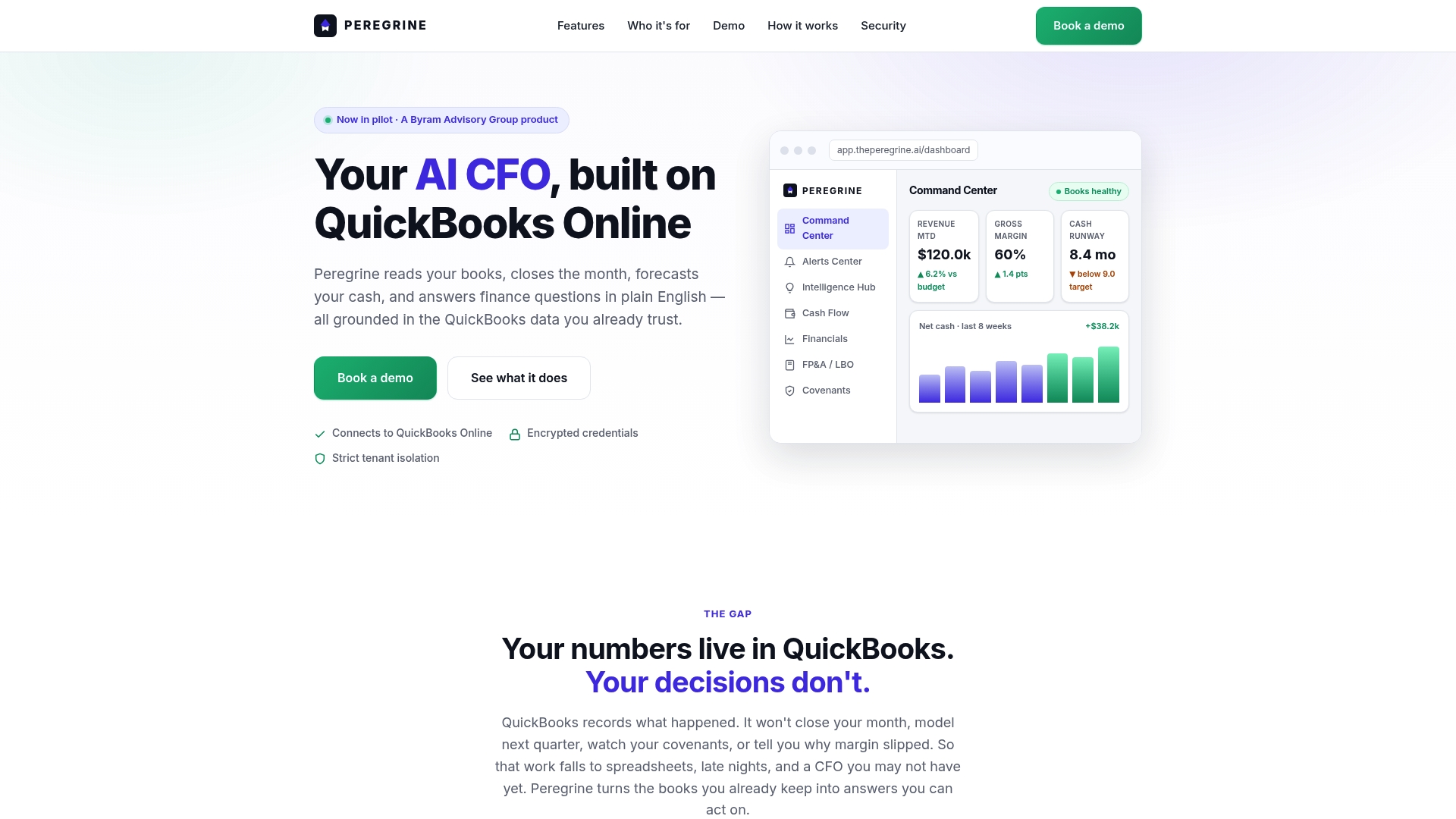
A 13-week rolling cash flow forecast links projections to live bookkeeping and accepts manual overrides for short-term planning. The platform reads QuickBooks Online books, closes month-end, and surfaces real-time KPIs and alerts. It also includes anomaly detection and human-in-the-loop approval for any data changes.
Core Features
A real time financial dashboard displays KPIs and alerts alongside a task driven, AI assisted month end close workflow that reduces manual checklist work. The system offers a 13 week rolling forecast with overrides plus FP&A and leveraged buyout modeling for scenario testing. It tracks covenants and debt with early warning signals so teams spot covenant risk before it affects borrowing.
Key Differentiator
Integrates directly with QuickBooks Online to ground forecasts and reporting in your existing bookkeeping data. That direct link removes the need to export or reconcile spreadsheets between forecasting and accounting. For firms, the multi tenant architecture means client books stay isolated while advisors view consolidated KPIs.
Pros
Deep bookkeeping integration keeps forecasts aligned with actual transactions and cut reconciliation work. The platform supports multiple client accounts with tenant isolation, which suits accounting and advisory firms managing portfolios. Plain English Q&A makes finance questions quick to answer, and the automated close checklist shortens the month end routine while built in forecasting and covenants monitoring centralize financial control.
Cons
- Requires QuickBooks Online as the accounting system, so businesses on other ledgers cannot use it.
Who It's For
Owners and finance teams that already use QuickBooks Online and want CFO grade visibility without adding headcount will get the most value. Accounting and advisory firms that manage many clients will appreciate the multi tenant controls and secure separation. Small to medium sized businesses focused on predictable cash management and covenant compliance will also find it relevant.
Unique Value Proposition
A real time financial command center that reads your QuickBooks books and answers finance questions in plain English turns bookkeeping into decision ready insight. That changes how you allocate time: less effort reconciling numbers, more time testing scenarios and preparing board reports. The human in the loop control keeps a reviewer in charge of data changes while the system automates routine tasks.
Real World Use Case
A small business owner runs the automated close checklist each month to finalize accounts faster and avoid manual journal errors. The owner then generates a cash flow forecast, tweaks key assumptions, and exports a board friendly report in minutes. The plain English Q&A answers follow up questions about burn rate and covenant headroom.
Pricing
Pricing information is not publicly available. Purchase typically requires a vendor conversation and likely targets professional users and firms rather than casual single user plans. Expect procurement through a sales channel instead of a self serve price sheet.
Website: https://theperegrine.ai
Cash Flow Frog
At a Glance
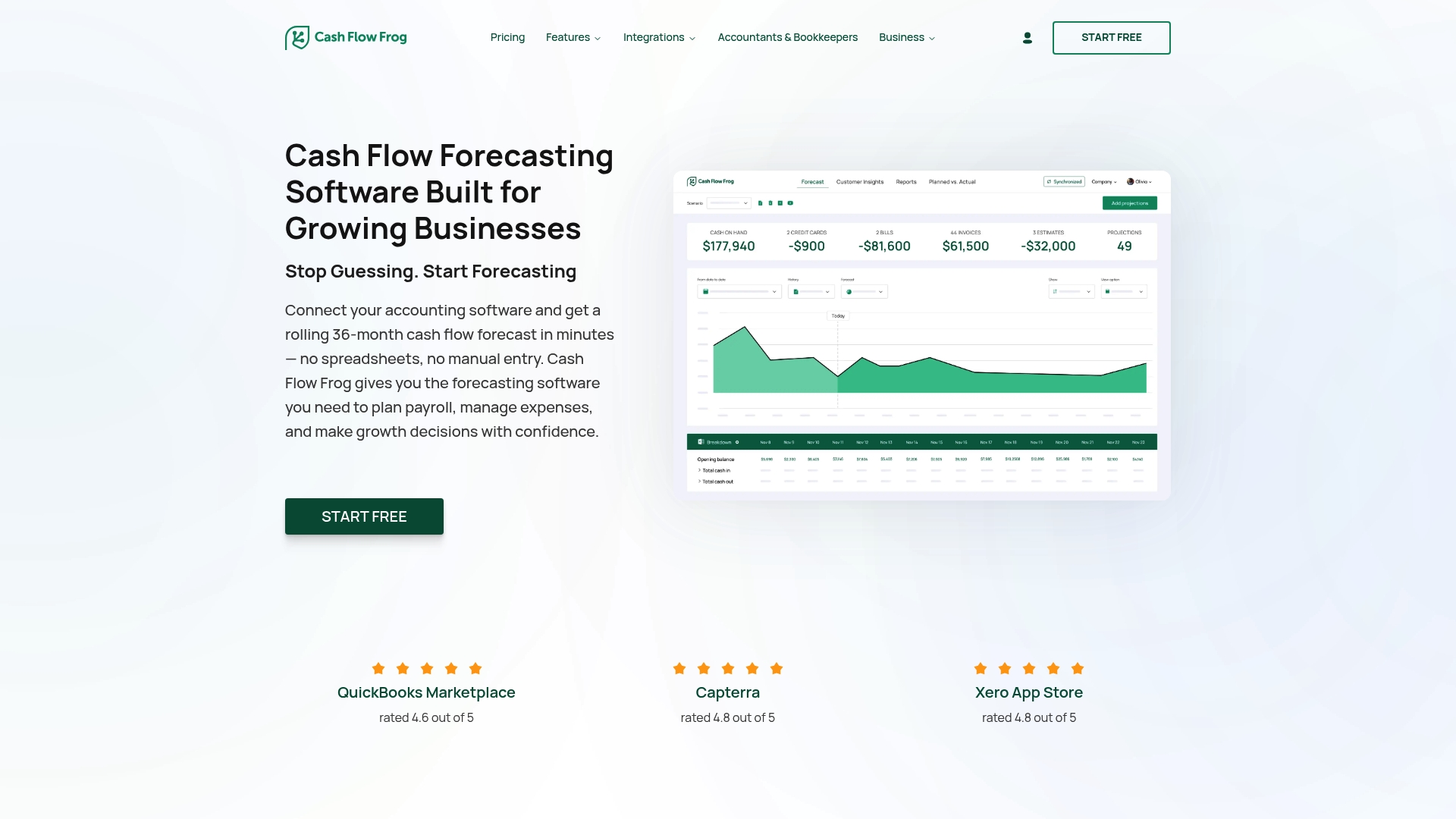
Automated 36 month rolling cash flow forecasts pull live data from your accounting system and update continuously. The tool connects to major platforms and bank feeds so you can run scenario planning without recreating spreadsheets. That live sync plus detailed drill down makes forecasts actionable for planning payroll and capital decisions.
Core Features
Cash Flow Frog links with QuickBooks Online, QuickBooks Desktop, Xero, Sage Intacct, Zoho Books, FreshBooks, Odoo, and Plaid to import invoices, bills, and bank transactions. The product produces 36 month forecasts, supports unlimited scenarios, and lets you break results down by vendor, customer, class, location, department, or project with transaction-level drill down. It also offers AI driven forecast suggestions and rule based automation to speed forecast adjustments.
Key Differentiator
The clearest distinction is the multi dimensional reporting that combines long horizon forecasts with deep transaction traceability. You can move from a consolidated cash view into the exact invoice or bill that drives a variance. That mix of a long forecast horizon and drill down is rare among midsize forecasting tools.
Pros
Automated syncing with popular accounting packages reduces setup errors and keeps forecasts current, which users mention often in reviews. The multi dimensional scenario modeling gives finance teams fine grained control over hiring, vendor timing, and project cash flows while keeping consolidated views intact. AI driven suggestions and rule based automation shorten the time you spend manual editing and make scenario creation faster for accountants managing several clients.
Cons
- Pricing may be steep for very small businesses on tight budgets.
- No write back functionality to accounting software, so you cannot correct transactions from inside the forecast tool.
- Initial setup requires connecting accounts and mapping classifications, which can take some configuration time.
- Does not cover every niche accounting platform, which may require a workaround for unusual stacks.
When It May Not Fit
If you need to edit source transactions from the forecasting interface, this tool will not meet that need because it lacks write back capability. Organizations with very small annual revenue may find the price structure heavier than simpler forecast tools. Teams that rely on a rare accounting package not listed in integrations will need an alternative integration path.
Notable Integrations
- QuickBooks Online
- QuickBooks Desktop
- Xero
- Sage Intacct
- Zoho Books
- FreshBooks
- Odoo
- Plaid
Who It's For
Growing small and medium sized businesses, accountants with multiple clients, and finance teams that need forward looking cash visibility and scenario analysis will benefit most. The product fits teams that want consolidated views across entities plus the ability to inspect the transactions behind the numbers.
Real World Use Case
A company connected its QuickBooks Online account and ran hiring scenarios across a 36 month horizon. The finance team used the drill down to identify which vendor payment dates amplified short term cash strain and adjusted payroll timing to avoid an overdraft. The scenario outputs also produced a polished report for leadership and lenders.
Pricing
From $69/month for the revenue tier that covers businesses with up to $1M annual revenue, with discounts for annual billing and special rates for practitioners. The vendor uses revenue based tiers rather than per seat billing, which changes cost calculations as revenue scales.
Website: https://cashflowfrog.com
Dryrun
At a Glance
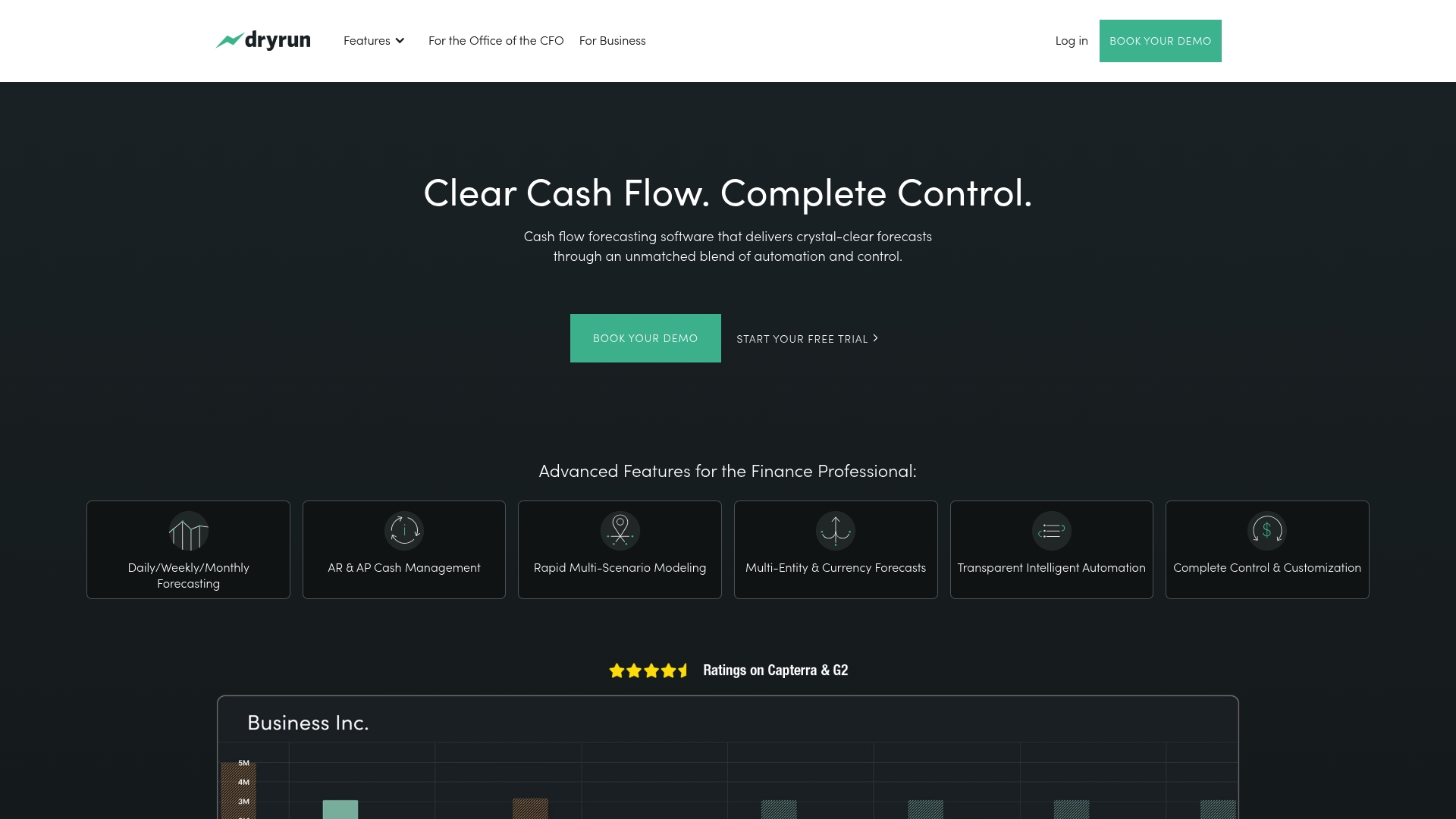
Multi entity consolidation and multi currency forecasting let finance teams model complex corporate structures and cash positions. Dryrun pairs automated feeds with manual controls so teams can correct assumptions without rebuilding models. The platform emphasizes scenario planning across daily, weekly, and monthly horizons for rolling visibility.
Core Features
Dryrun provides Cash Flow Forecasting, collaborative cash management, and Scenario Modeling that supports multiple horizons and what if analysis. The product includes Customization and Manual Control so users adjust assumptions and override automated entries. Reporting and visualizations present consolidated views across entities and currencies, and the platform connects to major accounting systems for live updates.
Key Differentiator
Dryrun combines automated data integration with persistent manual overrides so forecasts remain transparent and editable. That mix lets controllers keep audit trails while granting CFOs fast scenario runs. The approach suits teams that need both repeatable automation and hands on adjustments for complex corporate or multi currency situations.
Pros
Automated accounting integrations reduce spreadsheet reconciling and speed repeat forecasts. The visual reports make variance analysis and scenario comparisons easier for nontechnical stakeholders. Support for multi entity consolidation and currency conversion saves time when rolling up across subsidiaries. Manual override controls let you test assumptions without losing the underlying automated feed.
Cons
- Advanced features may require a learning curve based on third party reviews. Users report setup and complex scenario modeling need training and time.
- Pricing is not publicly listed, which suggests subscription based or custom plans with sales consultation. That can slow evaluation for smaller buyers.
- Some basic plans may restrict user management and automation, according to the vendor limitations.
- The vendor notes onboarding complexity for large models, which raises implementation effort for high volume accounts.
When It May Not Fit
Small businesses with simple cash flows or a single entity will find Dryrun more capable than necessary. Organizations that want fully hands off, AI driven forecasting without manual controls may prefer a different tool. Teams requiring transparent, per seat pricing up front will need to contact sales before committing.
Notable Integrations
Dryrun connects directly to leading accounting systems for live data ingestion. Key integrations include:
- Sage Intacct
- Microsoft Dynamics 365 Business Central
- QuickBooks Online
- Xero
Who It's For
Finance teams, CFOs, and controllers at mid sized to large organizations that manage multiple entities or currencies. Teams that run scenario planning for expansion, mergers, or product launches will get more value. The product fits groups that want control over assumptions rather than a purely automated black box.
Real World Use Case
A multinational finance team uses Dryrun to simulate a new product launch across three subsidiaries. They model currency swings and timing differences to forecast cash shortfalls and working capital needs. The scenario output feeds treasury decisions and short term borrowing plans.
Pricing
Dryrun does not publish standard pricing on its site. The vendor describes subscription based or custom plans, which typically require contacting sales for quotes. Expect license tiers that vary by features such as user management and automation levels.
Website: https://dryrun.com
Core Features
PlanGuru includes budgeting and financial analytics with custom assumptions and reporting. The product offers integrated income statement, balance sheet, and cash flow projections, so numbers tie across statements. Scenario analysis and what-if modeling let you compare funding or expense changes over multiple years.
Comparison of alternatives
Choosing the right cash flow forecasting tool requires balancing real-time integration, detailed reporting, and ease of configuration for your operational context. Each reviewed option demonstrates strengths tailored to specific financial practices, enabling clear decision-making for managers and finance professionals.
Real-time integration
Among these tools, Peregrine achieves a distinct advantage in real-time syncing and reconciling data with QuickBooks Online. This provides alignment between accounting and forecasting functions. This close connection eliminates errors stemming from manual data transfers, particularly critical for small-to-medium-sized businesses prioritizing accuracy and efficiency. By contrast, while both Cash Flow Frog and Dryrun offer integration with multiple accounting systems, their depth of data synchronization with individual tools like QuickBooks does not match the direct linkage seen in Peregrine.
Variable forecast horizons
For businesses planning far into the future, Cash Flow Frog proves highly advantageous with its 36-month forecasting model. This extended horizon empowers these organizations to plan projects and financial commitments confidently. Meanwhile, Peregrine focuses on a 13-week rolling forecast, delivering a concise view accommodating short-term operational management. Dryrun adopts another approach, supporting scenario modeling across daily to monthly horizons to fit mid-range tactical decisions. Each tool suits distinct time planning needs, highlighting the value of aligning forecast horizons with business planning goals.
Best fit
- Businesses using QuickBooks Online seeking synchronized financial tools will find Peregrine due to its direct integration and task-driven dashboards.
- Financial teams aiming to perform detailed long-term cash planning will benefit from Cash Flow Frog and its analysis capabilities over an extended horizon.
- Organizations handling multi-entity or multi-currency operations may find Dryrun's consolidation capabilities exceptionally fitting.
- Teams engaged in scenario testing on tactical spending and operational strategies will appreciate the flexible modeling options offered by both Dryrun and Cash Flow Frog.
Our pick
Peregrine emerges as the solution for businesses leveraging QuickBooks Online as their primary financial bookkeeping tool due to its integration and real-time forecasting capabilities. However, organizations outside the QuickBooks ecosystem or those needing extended forecast horizons might explore alternatives such as Cash Flow Frog, ensuring the selected platform aligns with their required financial planning scope.
For teams seeking tailored cash flow forecasts grounded in accurate bookkeeping data, these platforms provide diverse capabilities to suit entry-level to advanced needs.
| Product Name | Core Feature | Key Differentiator | Best For | Pricing | Notable Limitation |
|---|---|---|---|---|---|
| Theperegrine | Real-time financial dashboard | Direct integration with QuickBooks Online | QuickBooks Online users | Price not published | Limited to QuickBooks Online as a source |
| Cash Flow Frog | 36-month rolling cash flow forecasts | Multi-dimensional reporting with drill-down | Growing SMBs needing scenario analysis | From $69/month | No accounting write-back functionality |
| Dryrun | Multi-entity consolidation and scenario modeling | Automated feeds with manual override controls | Mid-sized to large multi-entity companies | Price not published | Steeper learning curve for advanced features |
How Can You Improve Cash Flow Forecasting Accuracy and Efficiency?
Managing cash flow forecasts can feel overwhelming for business owners and finance teams who rely on QuickBooks Online. Theperegrine answers this challenge by linking forecasts directly to your accounting data, removing spreadsheet reconciliation and manual errors. Its AI-driven platform automates month-end closing and provides clear, plain-English financial insights so you can focus on scenario testing and making smart decisions.
- Seamlessly integrate live bookkeeping data without export hassles
- Adjust short-term plans with customizable, rolling cash flow forecasts
- Monitor key metrics and receive early alerts on financial risks
Explore Theperegrine to gain CFO-grade visibility without adding headcount. Let Theperegrine streamline your financial command center so you spend less time on manual work and more time preparing impactful reports and forecasts.
FAQ
What features make Theperegrine ideal for cash flow forecasting?
Theperegrine offers a 13-week rolling cash flow forecast that links projections to live bookkeeping. Its integration with QuickBooks Online ensures real-time data consistency, reducing reconciliation work and providing actionable insights for financial teams.
How does Cash Flow Frog compare to Theperegrine?
Cash Flow Frog provides automated 36-month rolling cash flow forecasts and supports multiple scenario modeling. Theperegrine, by contrast, focuses on real-time financial dashboards and AI-assisted month-end workflows, which may better suit teams looking for CFO-grade visibility in shorter time frames.
Does Theperegrine support manual overrides for cash flow forecasts?
Yes, Theperegrine allows users to accept manual overrides for short-term planning within its cash flow forecasting. This feature enables finance teams to easily adjust forecasts based on real-time data and individual business needs.
Can small businesses effectively use Theperegrine for their cash management?
Small businesses using QuickBooks Online will find Theperegrine valuable for cash management due to its easy integration and real-time insights. It provides features that help these businesses focus on predictable cash flow and covenant compliance.
What unique capabilities does Theperegrine offer for financial teams?
Theperegrine integrates directly with QuickBooks Online for seamless forecasting and auditing. This eliminates the need for manual data entry and allows teams to focus on scenario testing and strategic decision-making.