
Strategic finance is defined as the discipline of integrating financial expertise with long-term business strategy to drive growth, allocate capital effectively, and create lasting organizational value. Unlike traditional finance, which centers on compliance, historical reporting, and short-term budgeting, strategic finance looks forward. It asks not just "what happened?" but "where should we go, and how do we fund it?" For business professionals and students alike, understanding this distinction is the foundation for making better decisions at every level of an organization.
What is strategic finance, and how does it differ from traditional finance?
Strategic finance is the practice of aligning a company's financial decisions with its long-term goals, typically across a planning horizon of 3–5 years. That time horizon alone separates it from traditional finance, which operates quarter to quarter. Traditional finance teams focus on closing the books, managing liquidity, and meeting compliance requirements. Strategic finance teams focus on where the company should invest, which markets to enter, and how to structure capital for maximum long-term return.
Operational finance focuses on day-to-day liquidity and compliance, while strategic finance aligns capital allocation with the company's long-term vision. That distinction matters because the two functions require different mindsets, different skills, and different relationships with leadership. A controller ensures the numbers are accurate. A strategic finance professional uses those numbers to shape the company's future.
Financial planning and analysis, commonly called FP&A, sits between the two. FP&A handles budgeting cycles, variance analysis, and near-term forecasting. Strategic finance takes those outputs and connects them to resource allocation decisions that span years, not quarters. The overlap is real, but the purpose is different.
Pro Tip: When evaluating a job posting labeled "strategic finance," look for explicit mentions of capital allocation, M&A support, or scenario planning. Many FP&A roles are marketed as strategic finance without involving true long-term decision-making.
| Focus area | Traditional / operational finance | Strategic finance |
|---|---|---|
| Time horizon | Short-term, quarterly | Long-term, 3–5 years |
| Primary tasks | Reporting, compliance, liquidity | Capital allocation, scenario modeling |
| Key output | Accurate financial statements | Recommendations that shape strategy |
| Relationship to leadership | Informational | Advisory and decision-driving |
What are the key functions of strategic finance?
Strategic financial planning is the core process that connects a company's goals to its financial reality. It uses tools like the strategy pyramid and strategic financial mapping to translate high-level business objectives into measurable financial targets. That translation is harder than it sounds. A goal like "become the market leader in three years" means nothing until someone converts it into revenue projections, headcount plans, and capital requirements.
The sequential process of strategic financial planning typically follows these steps:
- Define the long-term objective. Start with a clear business goal, such as doubling revenue, entering a new geography, or completing an acquisition.
- Map operational drivers. Identify the specific activities, investments, and resources required to reach that goal.
- Build financial scenarios. Model best-case, base-case, and downside outcomes using predictive analytics and historical data.
- Prioritize capital allocation. Strategic financial management requires prioritizing projects aligned with long-term goals, not simply accepting every project with a positive net present value.
- Align with stakeholders. Present recommendations to executives and boards with clear assumptions and decision criteria.
- Monitor and adjust. Track performance against the plan and revise assumptions as conditions change.
Capital allocation is where strategic finance has its sharpest impact. Capital is finite. Every dollar invested in one initiative is a dollar not invested in another. Strategic finance provides the analytical framework to make those trade-offs deliberately rather than reactively.
Pro Tip: Build your scenario models around operational drivers, not just revenue assumptions. A model tied to unit economics, customer acquisition costs, and retention rates will hold up under scrutiny far better than one built on top-line growth guesses.
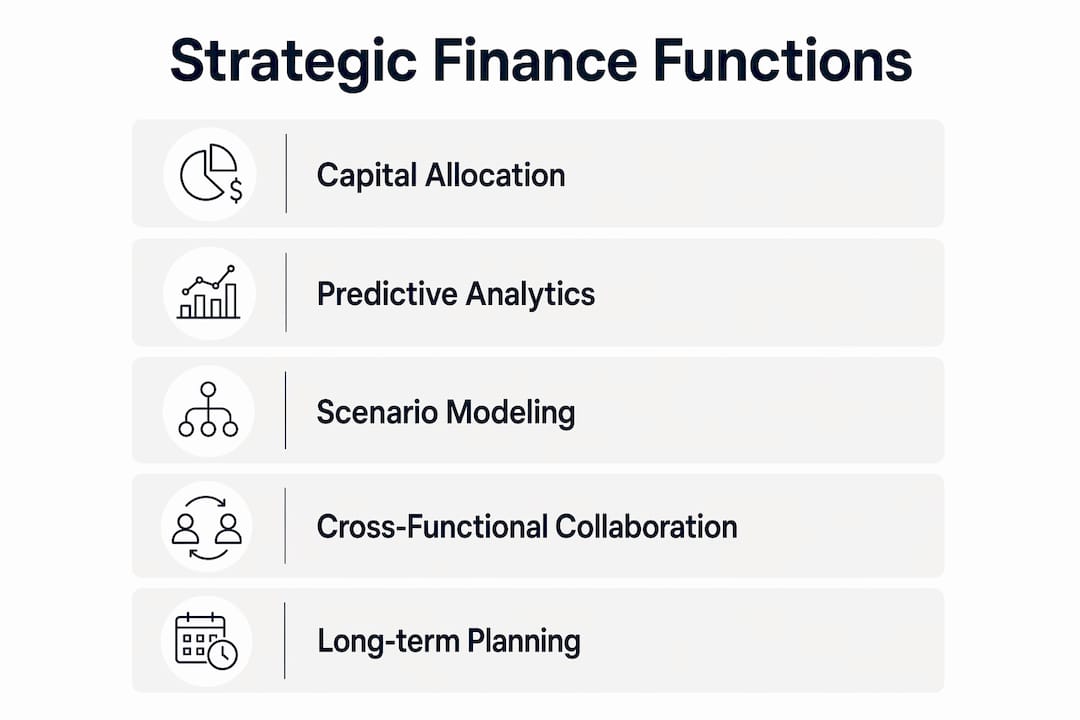
Predictive analytics and scenario modeling have become central to this function. Finance teams now use rolling forecasts and driver-based models to stress-test plans against market disruptions, interest rate shifts, and competitive moves. The goal is not to predict the future perfectly. The goal is to make sure the company is not blind sided by the futures that matter most.

What skills do strategic finance roles require?
The technical foundation of strategic finance includes advanced financial modeling, capital markets knowledge, and proficiency with analytics tools. You need to build models that hold up under pressure, understand how debt and equity structures affect long-term value, and translate data into clear recommendations. These are table-stakes skills for anyone entering the field.
The soft skills are where most professionals fall short. Strategic finance roles require strong skills in navigating ambiguity, often incorporating AI and predictive analytics to support high-value problem solving. Ambiguity is the norm, not the exception. You will rarely have complete information when a decision needs to be made. The ability to form a clear recommendation under uncertainty, and to communicate it persuasively to a non-finance audience, separates good analysts from great strategic finance leaders.
Key competencies for the role include:
- Financial modeling: Building three-statement models, DCF analyses, and scenario frameworks from scratch
- Capital markets literacy: Understanding how debt covenants, equity dilution, and cost of capital affect strategic choices
- Cross-functional communication: Strategic finance professionals collaborate with operations, marketing, and product teams to align financial and business strategy
- Judgment under uncertainty: Forming clear recommendations when data is incomplete or conflicting
- AI and automation fluency: Using AI-native workflows to speed up analysis and focus human effort on interpretation
Compensation reflects the seniority and scope of these responsibilities. Entry-level analysts earn $75,000–$95,000, while senior directors and CFO-level roles command $160,000–$200,000 or more. That range signals how much organizations value the function when it is done well.
How is strategic finance applied in real business decisions?
Strategic finance shows up most visibly in three contexts: growth planning, mergers and acquisitions, and capital structure decisions. In growth planning, the strategic finance team translates a product roadmap or market expansion plan into a funded financial model. They answer the question: "Can we afford this, and is it worth it relative to our other options?"
In M&A, strategic finance professionals evaluate target companies, model synergies, and assess how a deal changes the combined entity's long-term value. This requires both technical rigor and business judgment. A model can show that a deal is accretive on paper. Strategic finance determines whether the underlying assumptions are realistic.
In high-growth environments, strategic finance leaders translate ambiguous inputs into clear, actionable financial recommendations for executives and boards. That skill is especially valuable when a company is moving fast and the data is messy. The finance function becomes a stabilizing force, not a bottleneck.
Cross-functional collaboration is not optional in this role. Strategic finance professionals sit at the intersection of finance, operations, and strategy. A marketing team planning a major campaign needs to know whether the expected return justifies the spend. A product team building a new feature needs to understand the revenue model. Strategic finance provides the analytical backbone for those conversations.
Pro Tip: Avoid anchoring your recommendations to short-term metrics like quarterly EBITDA when the decision has a multi-year payoff horizon. Boards and executives will respect a longer view when it is supported by clear scenario analysis and well-defined assumptions.
CFOs increasingly act as strategists and automation champions, shifting focus from routine accounting to predictive analytics and scenario planning. That shift is redefining what finance leadership looks like at every level of the organization.
Key Takeaways
Strategic finance connects financial decisions to long-term business goals, making it the most forward-looking function in any finance organization.
| Point | Details |
|---|---|
| Definition of strategic finance | It aligns capital allocation and financial planning with a company's 3–5 year business strategy. |
| Difference from FP&A | FP&A handles budgets and near-term forecasts; strategic finance shapes resource allocation for long-term value. |
| Core process | Strategic financial planning translates business goals into funded, scenario-tested financial plans. |
| Skills required | Technical modeling, capital markets knowledge, and cross-functional communication are all required. |
| Career compensation | Roles range from $75,000 for entry-level analysts to $200,000 or more for senior leaders. |
Why strategic finance is no longer a back-office function
I have watched the finance function change more in the past five years than in the previous two decades. The shift is not subtle. CFOs who used to spend their time on close cycles and audit prep are now sitting in product strategy meetings and presenting to boards on capital allocation frameworks. That is not an accident. It reflects a genuine change in what organizations expect from finance.
The professionals who thrive in strategic finance are not the ones who are best at spreadsheets. They are the ones who can walk into a room with incomplete data, form a defensible point of view, and communicate it clearly to people who do not speak finance. That skill is rare, and it is increasingly what separates a finance team that influences decisions from one that just reports on them.
My practical advice for anyone entering this field: stop waiting for perfect data before forming an opinion. The value you add is not in the model. It is in the judgment you bring to interpreting the model. Build that muscle early, and you will move faster than most of your peers.
— Owen
How Peregrine supports strategic finance execution
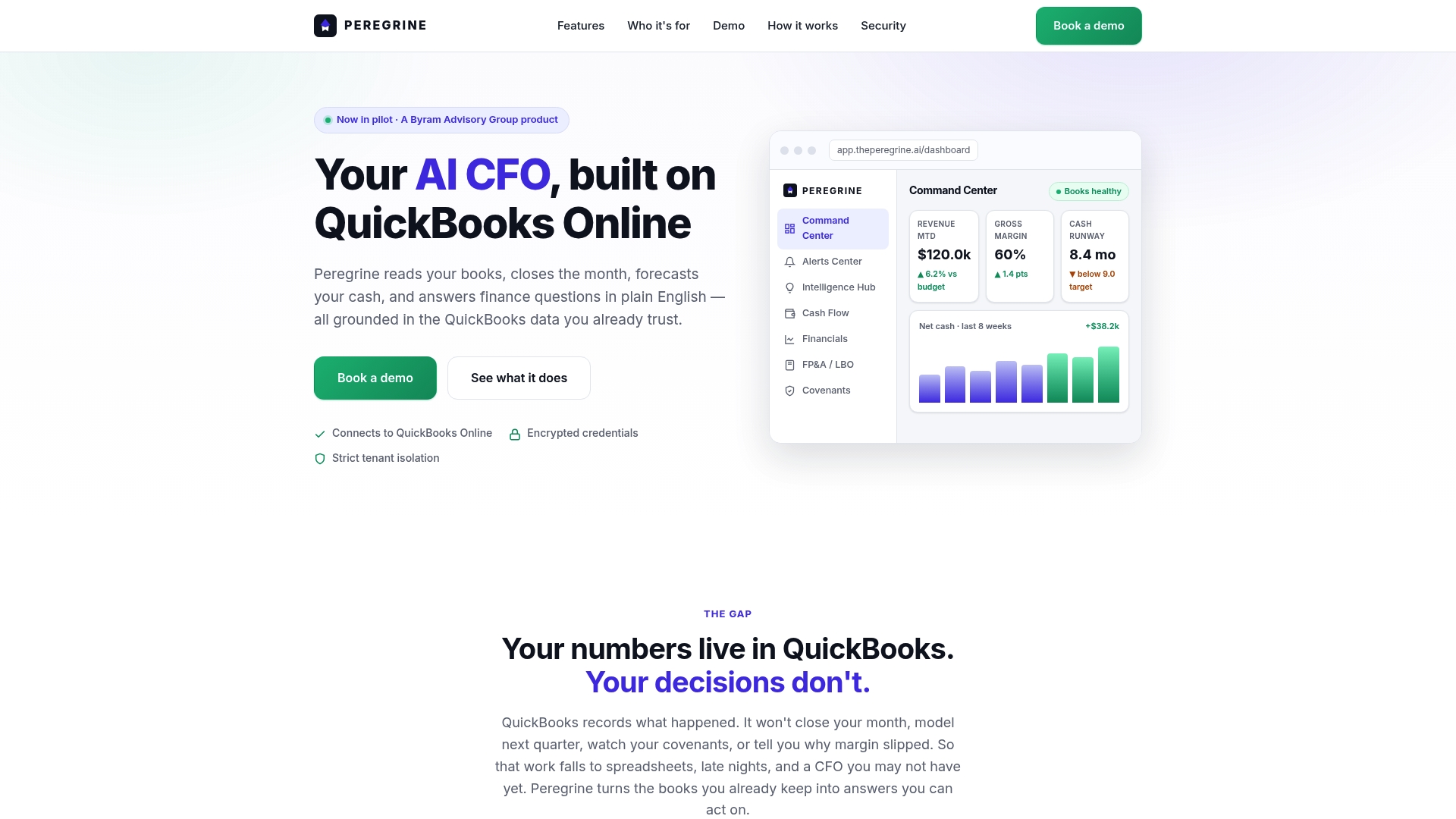
Strategic finance requires real-time visibility into cash flow, revenue trends, and operational performance. Peregrine delivers exactly that by integrating directly with QuickBooks Online to give finance teams and business owners CFO-grade analytics without the overhead of a full-time hire. Peregrine automates month-end closing, generates cash-flow forecasts, and flags anomalies before they become problems. For professionals applying strategic finance principles in growing businesses, Peregrine provides the financial command center that turns data into decisions. If you are building a finance function that looks forward instead of backward, Peregrine is built for that work.
FAQ
What is the definition of strategic finance?
Strategic finance is the practice of integrating financial planning and analysis with long-term business strategy to guide capital allocation, growth decisions, and value creation. It operates on a 3–5 year horizon rather than a quarterly reporting cycle.
How does strategic finance differ from FP&A?
FP&A focuses on budgeting, variance analysis, and near-term forecasting. Strategic finance uses those outputs to inform long-term resource allocation and decisions that shape the company's direction over multiple years.
What skills are most important in a strategic finance role?
Advanced financial modeling, capital markets knowledge, and the ability to communicate recommendations clearly to non-finance stakeholders are the most critical skills. Proficiency with AI and predictive analytics is increasingly expected as well.
What does a strategic finance professional earn?
Compensation ranges from $75,000–$95,000 for entry-level analysts to $160,000–$200,000 or more for senior directors and CFO-level roles, depending on company size and scope of responsibility.
Is every "strategic finance" job title actually strategic?
Not always. Many organizations label standard FP&A or accounting roles as strategic finance. Professionals should look for explicit responsibilities around capital allocation, scenario modeling, and long-term planning before accepting the label at face value.