
A finance tech stack is the integrated collection of software systems that powers every financial operation in a business, from recording transactions to forecasting cash flow. The right financial technology architecture separates companies that close their books in two days from those that spend nine days manually assembling a board deck. For business owners and finance professionals, building an effective finance tech stack is not optional. It is the operational foundation that determines how fast you can make decisions, how accurately you can report, and how well you can scale.
What is a finance tech stack and what does it include?
A finance tech stack is defined as the layered set of software tools that collectively manage a company's financial data, workflows, and reporting. The general ledger sits at the center of every well-built stack. Platforms like QuickBooks Online, Xero, and NetSuite serve as the single source of truth for all financial data, and every other tool in the stack feeds into or draws from that core.

The term "finance tech stack" is informal shorthand. The recognized industry term is financial technology architecture, which describes how each software layer connects, exchanges data, and supports the broader finance function. Both terms refer to the same concept, and finance professionals use them interchangeably.
A complete financial technology architecture typically spans six functional layers:
- General ledger and ERP. QuickBooks Online, Xero, or NetSuite record every transaction and serve as the authoritative data source.
- Payments, AP, and AR. Tools that manage vendor payments, customer invoicing, and collections.
- Payroll and expense management. Platforms that process payroll, track employee expenses, and enforce spend policies.
- FP&A and planning. Modeling and forecasting tools that support budgeting, scenario analysis, and board reporting.
- Data warehouse and BI. A storage and visualization layer that aggregates data from multiple sources for dashboards and analysis.
- AI and automation layer. AI-native tools that automate repetitive tasks, flag anomalies, and generate plain-English financial summaries.
Pro Tip: Excel is not dead in a modern finance stack. Finance teams use Excel for flexible scenario modeling while automated systems handle data entry and reconciliation in the background. The goal is to automate the data flow into Excel, not eliminate the spreadsheet.
How does AI-native technology improve your finance stack?
AI integration in a finance stack is not about adding a chatbot to your accounting software. The meaningful shift is at the architecture level, where AI connects directly to your ERP or data warehouse and acts on live data without manual exports.
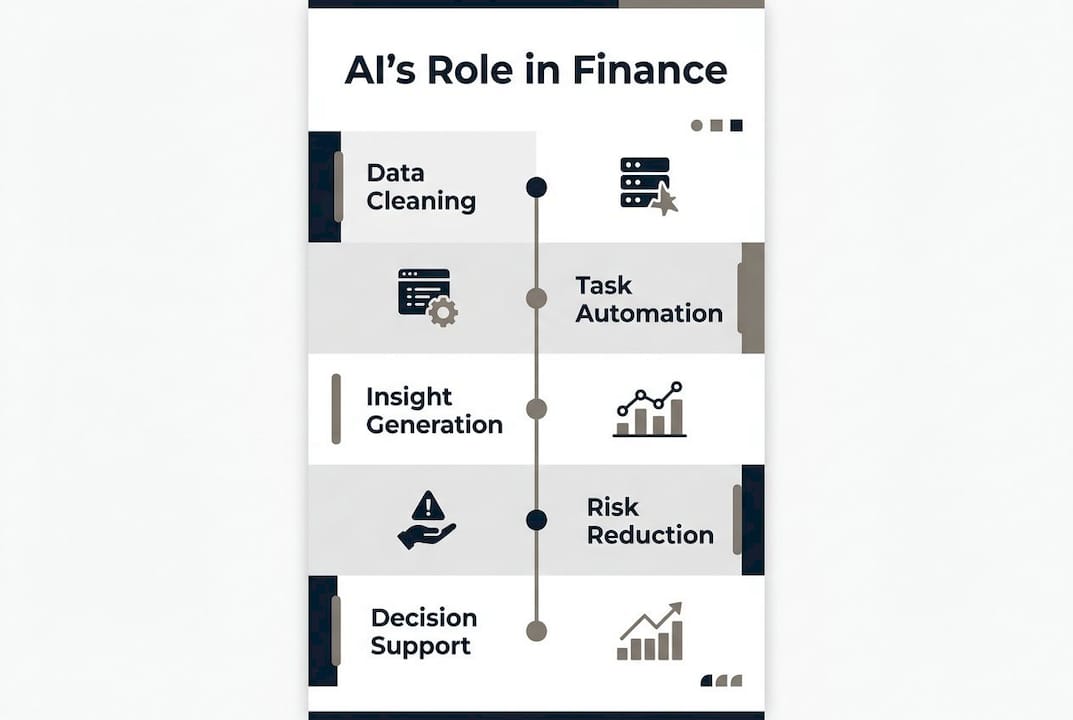
The most advanced stacks in 2026 use Model Context Protocol (MCP), a connectivity standard that lets AI pull data directly from ERPs and data warehouses. This eliminates the manual export-and-import cycle that wastes hours every month. The practical result is real-time dashboards and the ability to close books by day one of the following month, a capability that was previously reserved for large enterprises with dedicated data engineering teams.
The contrast between bolted-on AI and AI-native integration is significant:
- Bolted-on AI chatbots sit on top of existing tools and answer questions based on whatever data you manually feed them. They do not connect to live systems and cannot act on your data.
- AI-native stacks use open APIs and protocols like MCP to pull live data, run analysis, and generate outputs like cash flow forecasts or flux analyses without human intervention.
Automating repetitive, rule-based tasks while preserving human judgment for complex decisions is the correct model. AI handles transaction categorization, variance detection, and routine reporting. Finance professionals handle interpretation, strategy, and stakeholder communication.
The quality of AI outputs depends entirely on the quality of the underlying data. A clean general ledger with consistent naming conventions produces reliable AI-generated forecasts. A messy ledger with duplicate accounts and inconsistent categories produces unreliable outputs, regardless of how sophisticated the AI layer is.
What best practices build a scalable finance stack?
Building a finance stack that holds up over time requires deliberate architectural decisions, not just good software choices. The four practices below separate stacks that scale from stacks that require expensive rebuilds every two years.
-
Stabilize your core data layer first. Stabilizing core data and existing applications before layering AI automations is the single most important sequencing decision. Adding AI to a messy general ledger amplifies errors, not efficiency.
-
Build for 18–24 months of growth. Choosing scalable systems from the start avoids costly migrations when transaction volume, headcount, or reporting complexity increases. Ask whether each tool can handle three times your current volume before you commit.
-
Enforce data standardization. No software creates a reliable single source of truth without consistent naming conventions and data definitions. Define your chart of accounts, cost center labels, and revenue categories before you configure any tool. Document them so any new hire can follow the same rules.
-
Prioritize open APIs and native integrations. Open, bi-directional APIs create connected data flows that prevent manual reconciliation work and data silos. A connected ecosystem of mid-tier tools outperforms a collection of isolated best-in-class apps that cannot talk to each other.
-
Build documented, transferable systems. A finance stack that only works because one person knows how it fits together is a liability. Document every integration, every data flow, and every naming convention so the system survives personnel changes.
Pro Tip: Process clarity must come before tool upgrades. If your team cannot describe the exact steps in your month-end close without referencing a specific person, fix the process first. Software will not solve a workflow that nobody has defined. For a detailed breakdown of how to structure this, the month-end close automation guide covers the sequencing in practical terms.
What are the real benefits and common pitfalls of a finance stack?
The measurable benefits of a well-integrated finance application stack are significant. Teams that automate six core finance functions, including modeling, planning, data access, visualization, closing, and revenue management, cut board deck preparation from nine days to a fraction of that time. That is not a marginal improvement. It is the difference between reporting on last month and making decisions about next month.
Real-time visibility is the most immediate benefit. When your general ledger, payroll platform, and payment tools all feed into a central data layer, your cash position, burn rate, and revenue figures are current without anyone running a manual export. Finance professionals shift from data gathering to analysis.
The pitfalls are equally concrete. Disconnected tools create manual spreadsheet stitching, reconciliation errors, and reporting delays. A company running five finance tools that do not integrate natively will spend more time managing data than analyzing it. The spreadsheet becomes the integration layer, and that breaks under any meaningful volume.
| Common pitfall | What it costs you |
|---|---|
| Disconnected tools with no API integration | Hours of manual exports and reconciliation every month |
| Inconsistent data definitions across systems | Unreliable reports and conflicting numbers in board meetings |
| Skipping annual stack audits | Paying for redundant licenses and running outdated workflows |
| Adding AI before stabilizing core data | AI outputs that amplify existing errors instead of reducing them |
Regular annual audits of your finance stack prevent infrastructure drift. Tool licenses accumulate, integrations break quietly, and workflows become outdated. A one-hour annual review of every tool, its cost, its integration status, and its actual usage prevents the slow decay that makes stacks expensive and unreliable. For a broader view of how finance strategy connects to stack decisions, the strategic finance guide provides useful context.
Key Takeaways
A well-built finance tech stack starts with a clean general ledger, connects every tool through open APIs, and layers AI only after the core data is stable and standardized.
| Point | Details |
|---|---|
| General ledger is the foundation | QuickBooks Online, Xero, or NetSuite must serve as the single source of truth before any other layer is added. |
| AI works only on clean data | Stabilize naming conventions and data definitions before adding AI automation to avoid amplifying errors. |
| Build for 18–24 months ahead | Choose tools that handle your anticipated growth to avoid costly migrations and downtime. |
| Open APIs prevent data silos | Native integrations eliminate manual exports and reconciliation, which are the primary sources of reporting delays. |
| Audit your stack annually | Review every tool, license, and integration each year to prevent drift, redundancy, and outdated workflows. |
The part most finance stack guides get wrong
The advice I see repeated most often is "pick the best tool for each function." That sounds reasonable. In practice, it produces a collection of excellent, isolated applications that do not talk to each other, and a finance team that spends its best hours moving data between them.
The real question is not which tool is best in its category. The real question is which combination of tools shares data without friction. A mid-tier planning tool that integrates natively with your general ledger and your BI layer will outperform a premium standalone tool every time, because the value of a finance stack comes from the connections, not the individual components.
The second mistake I see consistently is adding AI too early. Finance teams see a compelling AI demo, bolt it onto a general ledger with three years of inconsistent categorization, and then wonder why the outputs are unreliable. The AI is working correctly. The data is the problem. Fixing the data layer is unglamorous work, but it is the only work that makes everything else function.
The third thing worth saying directly: build systems, not dependencies. If your month-end close process lives in one person's head, you do not have a finance stack. You have a key-person risk. Document every workflow, every integration, and every exception rule. The goal is a finance operation that any competent professional can run on day one.
— Owen
How Peregrine fits into your finance technology stack
Finance teams that run on QuickBooks Online have a direct path to AI-native financial management through Peregrine.
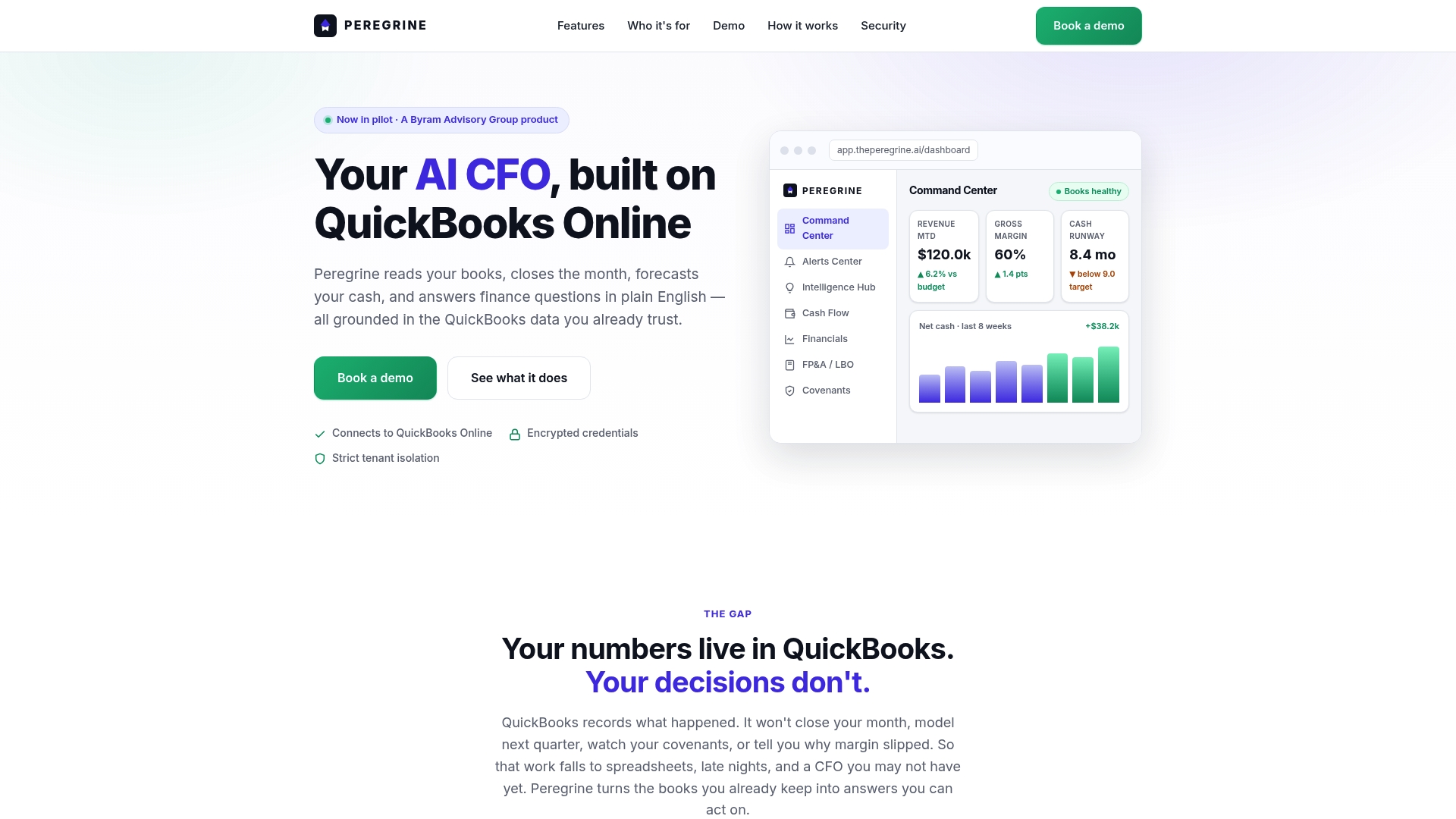
Peregrine integrates directly with QuickBooks Online and acts as an AI CFO layer on top of your existing finance stack. It automates month-end closing, cash flow forecasting, and anomaly detection without requiring you to rebuild your current setup. Finance professionals get real-time visibility into revenue, cash position, and operational metrics through a plain-English interface, with no manual exports required. Business owners get CFO-grade reporting without the CFO-grade salary. If you are building or upgrading your finance stack and run on QuickBooks Online, see how Peregrine works and whether it fits your current architecture. For teams ready to move quickly, the Peregrine implementation guide walks through the setup process step by step.
FAQ
What is a finance tech stack?
A finance tech stack is the integrated set of software tools that manages a company's financial data, workflows, and reporting. It typically includes a general ledger, payment tools, payroll, FP&A software, and a data visualization layer.
What software belongs in a core finance stack?
The core includes a general ledger platform such as QuickBooks Online, Xero, or NetSuite, supported by AP/AR management, payroll, expense tracking, and a planning or FP&A tool. A BI or dashboard layer connects the outputs for reporting.
How does AI improve a finance tech stack?
AI automates repetitive tasks like transaction categorization, variance analysis, and cash flow forecasting. AI-native tools that connect directly to your ERP via open APIs or protocols like MCP deliver the most reliable results, because they work on live data rather than manual exports.
What is the biggest mistake when building a finance stack?
The most common mistake is adding new tools before standardizing data definitions and naming conventions in the general ledger. No software creates a reliable single source of truth without process clarity and consistent data governance underneath it.
How often should you audit your finance tech stack?
Annual audits are the standard practice. A yearly review of every tool, its integration status, its cost, and its actual usage prevents redundant licenses, broken integrations, and workflows that no longer match how the business operates.