
Bookkeeping cost for small businesses is defined by three variables: transaction volume, service scope, and whether you hire in-house or outsource. Most small business owners pay between $160 and $2,500 per month for outsourced bookkeeping services, with solopreneurs at the low end and multi-entity businesses with payroll at the high end. The pricing model you choose, hourly or flat monthly fee, shapes your budget as much as the services themselves. Understanding these cost drivers before you hire saves you from sticker shock and helps you negotiate from a position of knowledge.
How much does bookkeeping cost for a small business?
Monthly bookkeeping fees follow a clear tier structure based on transaction volume and complexity. Solopreneurs pay $200–$400 per month, while small businesses processing 200–500 transactions monthly pay $600–$1,800. Full-service packages with payroll, multi-entity reporting, and advisory support regularly exceed $2,000 per month. That range exists because a freelance designer with 30 monthly transactions needs a fraction of the work a 15-person retail operation does.

The industry term for what most small business owners call "bookkeeping" is general ledger maintenance, which includes recording transactions, reconciling accounts, and producing monthly financial statements. Many providers bundle this with accounts payable, accounts receivable, and payroll processing under a single monthly fee. Knowing exactly which services are included in a quote is the first question to ask any provider.
What factors influence bookkeeping costs for small businesses?
Transaction volume is the single biggest cost driver in bookkeeping pricing. A bookkeeper handling 150 transactions per month works roughly 4–6 hours; 800 transactions require 12–20 hours. That difference in labor directly translates to higher monthly fees.
Business type and complexity add cost on top of volume. These factors push fees higher:
- Inventory tracking: Requires cost-of-goods-sold calculations and periodic physical counts.
- Payroll processing: Adds tax filings, garnishments, and multi-state compliance.
- Multiple revenue streams: E-commerce, subscriptions, and retail each require separate reconciliation.
- Accrual accounting: More complex than cash basis; requires matching revenues and expenses by period.
Cash basis accounting is the simpler and cheaper option. Accrual accounting, required by GAAP for businesses above certain revenue thresholds, takes more time and costs more to maintain accurately.
The scope of services you request also determines your bookkeeping rate. Basic bookkeeping covers transaction entry and bank reconciliation. Full-service offerings add payroll, sales tax filing, financial statement preparation, and sometimes CFO-level advisory. Each layer adds to the monthly fee.
Pro Tip: Request an itemized quote that lists every service included. Providers who bundle everything into one vague price often charge overage fees when you need something outside the base scope.
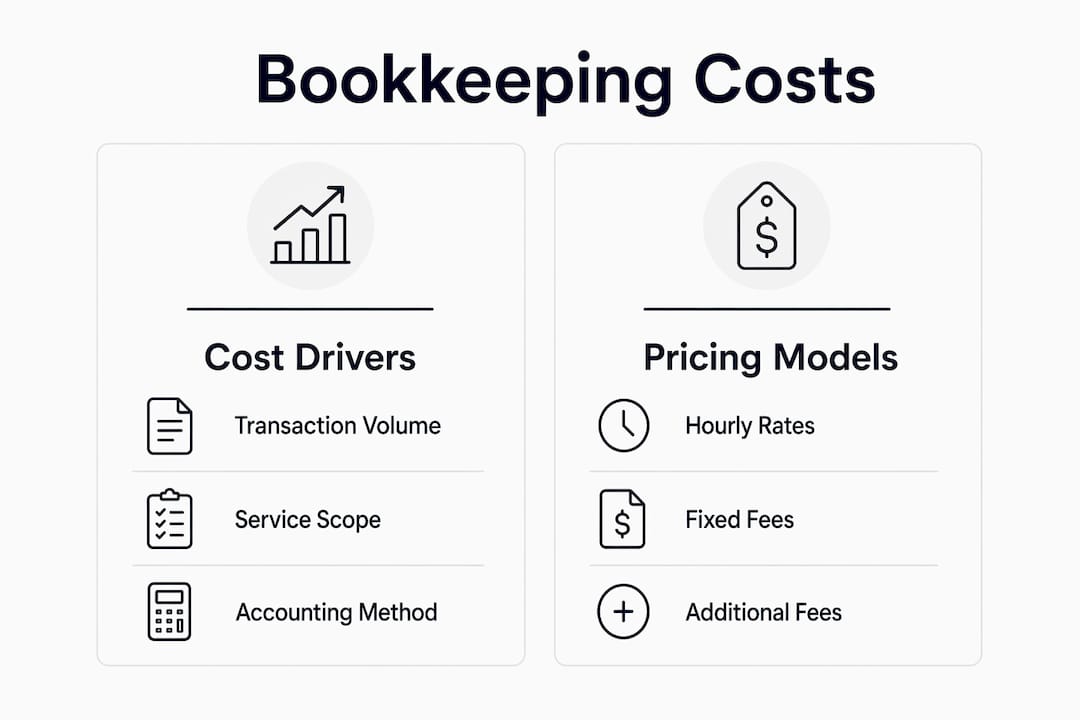
Hourly rates versus fixed monthly fees: what's best for your business?
Hourly bookkeeping rates range from $30 to $150 depending on experience, certification, and geography. Independent bookkeepers without certification typically charge $30–$60 per hour. Certified bookkeepers and those employed by accounting firms charge $60–$150 per hour. A bookkeeper in San Francisco or New York commands a higher rate than one in a mid-size Midwestern city.
The industry has shifted decisively toward flat monthly fees. Flat-rate monthly subscriptions are the dominant pricing model in 2026, and for good reason. They give you predictable costs, eliminate the incentive to bill extra hours, and make annual budgeting straightforward.
| Pricing model | Best for | Key advantage | Key risk |
|---|---|---|---|
| Hourly rate | Catch-up work, uncertain scope | Pay only for time used | Unpredictable monthly cost |
| Flat monthly fee | Ongoing maintenance | Budget certainty | Overage charges if volume spikes |
| Value-based pricing | Advisory and CFO services | Tied to financial outcomes | Harder to benchmark |
Hourly pricing still makes sense in two situations: one-time catch-up projects where the scope is unclear, and businesses with highly seasonal transaction volumes. For everything else, a flat monthly fee protects your budget.
Pro Tip: Ask any flat-fee provider what happens when you exceed the transaction cap. Many contracts include overage rates of $1–$5 per additional transaction. Know the number before you sign.
In-house versus outsourced bookkeeping: cost and risk comparison
Hiring a full-time in-house bookkeeper costs far more than most small business owners expect. The median salary for an in-house bookkeeper is $49,210, and when you add benefits, payroll taxes, office space, and software licenses, total annual cost reaches $55,000–$80,000. That works out to $4,583–$6,667 per month before you account for turnover or training costs.
Outsourced bookkeeping with controller oversight costs 3 to 10 times less than an equivalent in-house hire. A mid-range outsourced package at $800 per month delivers reconciled books, monthly reports, and a review layer that a solo in-house bookkeeper cannot provide alone.
The hidden risks of in-house hiring compound the cost problem:
- Turnover: Replacing a bookkeeper costs 50%–200% of their annual salary in recruiting and onboarding.
- Skills gaps: A single bookkeeper may lack expertise in payroll tax law, multi-state compliance, or accrual accounting.
- Audit exposure: Errors from an undertrained bookkeeper can trigger IRS penalties that dwarf the salary savings.
- Single point of failure: If your bookkeeper leaves mid-quarter, your records stop until you hire again.
DIY bookkeeping carries its own cost. Business owners who handle their own books spend 5–15 hours per month on manual entry and reconciliation. The opportunity cost of that time, measured against what the owner could earn doing billable work, often exceeds the cost of a professional service by a factor of 3–5.
For most small businesses with fewer than 20 employees, outsourced bookkeeping delivers better accuracy, lower total cost, and less operational risk than any in-house alternative. Explore AI-driven bookkeeping options if you want to reduce costs further without sacrificing accuracy.
Hidden fees and additional expenses to watch for
The monthly base fee is rarely the full picture. These are the most common costs that catch small business owners off guard:
- Year-end cleanup fees: Neglected or disorganized records trigger cleanup projects that cost $1,500–$8,000 depending on how far behind the books are. Year-end cleanup fees can spike total bookkeeping costs by over 80% in a single year.
- Tax preparation: Monthly bookkeeping packages almost never include tax filing. Budget $1,000–$5,000 annually for a CPA or tax preparer separate from your bookkeeping fees.
- Software subscriptions: QuickBooks Online, Xero, and similar platforms cost $35–$200 per month. Some bookkeeping providers include software in their fee; most do not.
- Payroll add-ons: Payroll processing typically adds $50–$200 per month depending on employee count and state requirements.
- Multi-entity compliance: If you own more than one business entity, expect a separate fee for each set of books.
Most firms raised their bookkeeping fees by 5–10% in 2026. Build that annual increase into your budget so a fee adjustment does not disrupt your cash flow planning.
Technology fluency also affects what you pay. Bookkeepers with certifications and software expertise charge premium rates, but they typically deliver faster turnaround and fewer errors. Paying slightly more for a certified professional often costs less in the long run than correcting mistakes made by a cheaper generalist.
Practical tips for budgeting and selecting bookkeeping services
Start by estimating your monthly transaction count before requesting any quotes. Count every bank transaction, credit card charge, invoice, and bill from the past three months and calculate the average. That number is the single most important input a bookkeeper uses to price your account.
When evaluating providers, ask these questions directly:
- What services are included in the base monthly fee?
- What triggers an overage charge, and what is the rate?
- Do you include software, or is that billed separately?
- How do you handle year-end tax preparation?
- What is your process if I fall behind on records?
Professional bookkeeping is a high-ROI investment, not just an operating expense. Accurate books surface deductions you would otherwise miss, improve cash flow visibility, and reduce the risk of costly IRS penalties. Business owners who treat bookkeeping as a cost to minimize often spend far more correcting errors than they saved by cutting corners.
Upgrading your bookkeeping services makes financial sense when your revenue crosses $250,000 annually, when you add employees, or when you start managing inventory. At those inflection points, the complexity of your books outpaces what a basic service can handle accurately. Integrating your books with a platform like QuickBooks Online also reduces manual entry and gives your bookkeeper cleaner data to work with.
Pro Tip: Ask your bookkeeper for a monthly financial summary in plain language, not just a PDF of statements. If they cannot explain your numbers clearly, you are not getting the full value of the service.
Key Takeaways
Bookkeeping costs for small businesses range from $160 to $2,500 per month, and the right investment level depends on transaction volume, service scope, and whether you outsource or hire in-house.
| Point | Details |
|---|---|
| Monthly cost range | Most small businesses pay $200–$1,800/month based on transaction volume and services. |
| Flat fees beat hourly for budgeting | Fixed monthly pricing gives predictable costs and removes the incentive to overbill hours. |
| In-house costs more than it looks | A full-time bookkeeper costs $55,000–$80,000 annually; outsourcing costs 3–10× less. |
| Hidden fees add up fast | Year-end cleanup, tax prep, and payroll add-ons can double your base monthly fee. |
| Bookkeeping is an ROI-positive expense | Accurate records catch deductions and prevent IRS penalties that far exceed service fees. |
The mistake I see small business owners make most often
Most small business owners underestimate bookkeeping costs because they only think about the monthly fee. They sign up for a $300-per-month service, then get hit with a $4,000 year-end cleanup bill because nobody told them their books were three months behind. That is not a bookkeeper problem. That is a budgeting problem.
The owners who get the most value from their bookkeeping spend treat it like a financial control system, not a compliance checkbox. They review monthly reports, ask questions about variances, and use their books to make decisions about hiring, pricing, and cash reserves. A bookkeeper who just closes the month and sends a PDF is not giving you that.
I have also watched the pricing trend shift sharply toward flat monthly fees, and I think that is good for small business owners. Hourly billing creates a perverse incentive: the slower the bookkeeper works, the more they earn. Flat fees flip that. The provider earns the same whether the work takes two hours or ten, so efficiency becomes their problem, not yours.
One thing I would caution against: choosing a provider purely on price. The cheapest bookkeeper often lacks the software fluency or tax knowledge to catch the errors that cost you money at year-end. A certified bookkeeper charging $900 per month who saves you $3,000 in missed deductions is a better deal than a $400-per-month generalist who misses them. Do the math before you sign.
— Owen
Peregrine: AI-driven financial clarity beyond basic bookkeeping
Bookkeeping keeps your records accurate. Peregrine takes that accuracy and turns it into real-time financial intelligence.
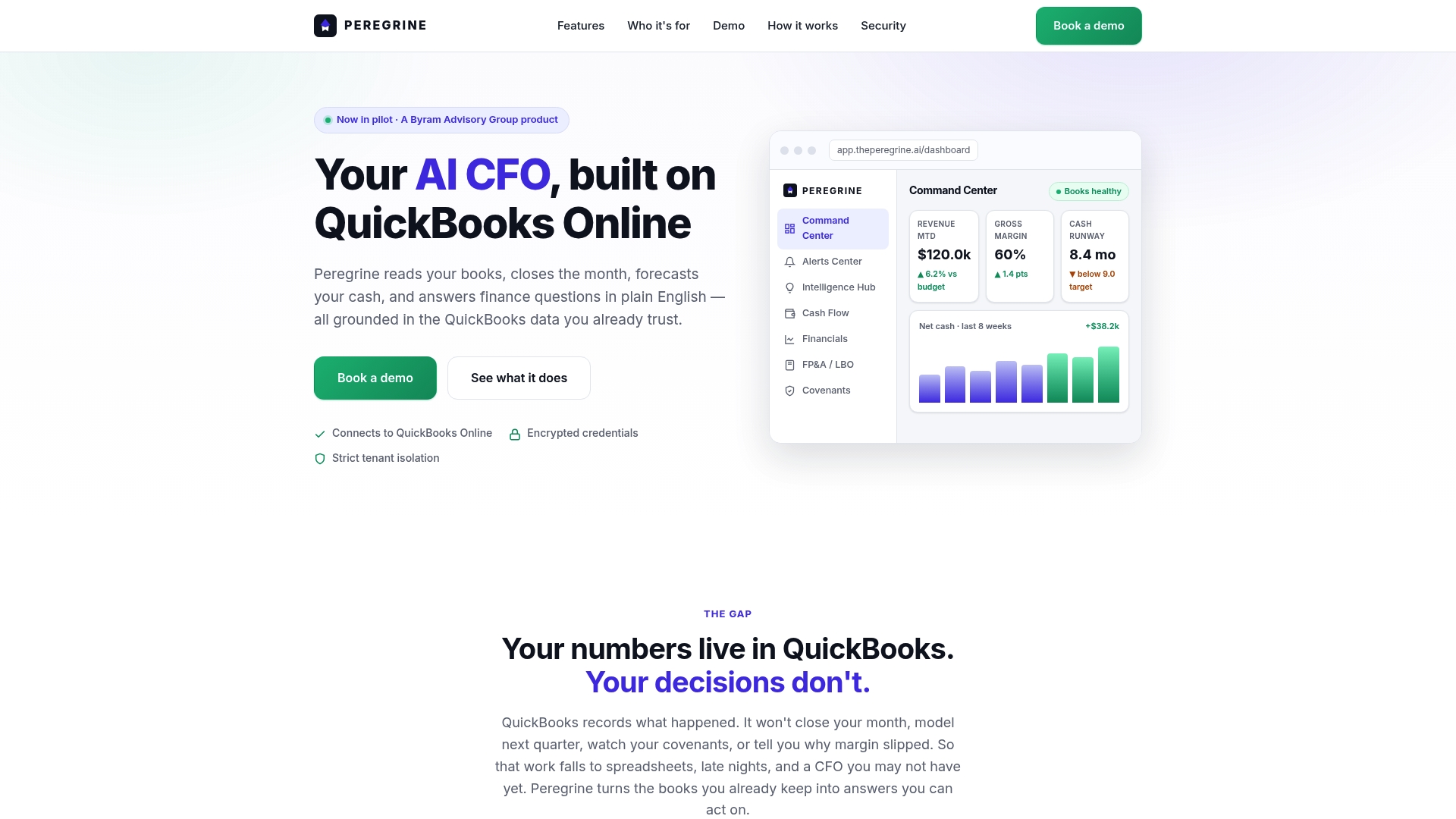
Peregrine integrates directly with QuickBooks Online to automate month-end closing, cash-flow forecasting, and anomaly detection. Instead of waiting for a monthly PDF from your bookkeeper, you get a live financial command center with CFO-grade visibility into revenue, expenses, and cash position. The implementation process is straightforward, and the platform answers financial questions in plain English so you do not need an accounting degree to understand your own numbers. For small business owners who want more than reconciled books, Peregrine delivers the financial clarity that drives better decisions.
FAQ
What is the average cost of a bookkeeper per month?
The average monthly bookkeeping cost for a small business ranges from $200 to $1,800, depending on transaction volume and services included. Solopreneurs typically pay $200–$400, while businesses with payroll and higher transaction volumes pay $600–$1,800 or more.
Is hourly or flat-rate bookkeeping pricing better?
Flat-rate monthly pricing is better for most ongoing bookkeeping needs because it gives you predictable costs and removes the incentive for a provider to work slowly. Hourly pricing works best for one-time catch-up projects where the scope is not yet defined.
What hidden costs should I budget for beyond the monthly fee?
Budget separately for tax preparation ($1,000–$5,000 annually), software subscriptions ($35–$200 per month), payroll processing add-ons, and potential year-end cleanup fees ($1,500–$8,000) if your records fall behind.
Is outsourced bookkeeping cheaper than hiring in-house?
Outsourced bookkeeping costs 3 to 10 times less than an in-house hire when you account for salary, benefits, payroll taxes, and overhead. A full-time in-house bookkeeper costs $55,000–$80,000 per year; outsourced services typically run $2,400–$21,600 annually for comparable work.
When should a small business upgrade its bookkeeping services?
Upgrade when your annual revenue crosses $250,000, when you add employees, or when you start managing inventory. At those points, the complexity of your books exceeds what a basic service handles accurately, and errors become significantly more costly.