Finding a cash flow forecasting tool that aligns forecasts to live accounting data and fits team workflows is complicated. Many tools gate core features behind enterprise plans or skip integrations with key accounting and bank platforms, leaving gaps for finance teams. This article compares pricing, data syncing, and scenario modeling across four cash flow forecasting platforms so finance teams can match one to their accounting setup and workflow.
Table of Contents
Peregrine
At a Glance
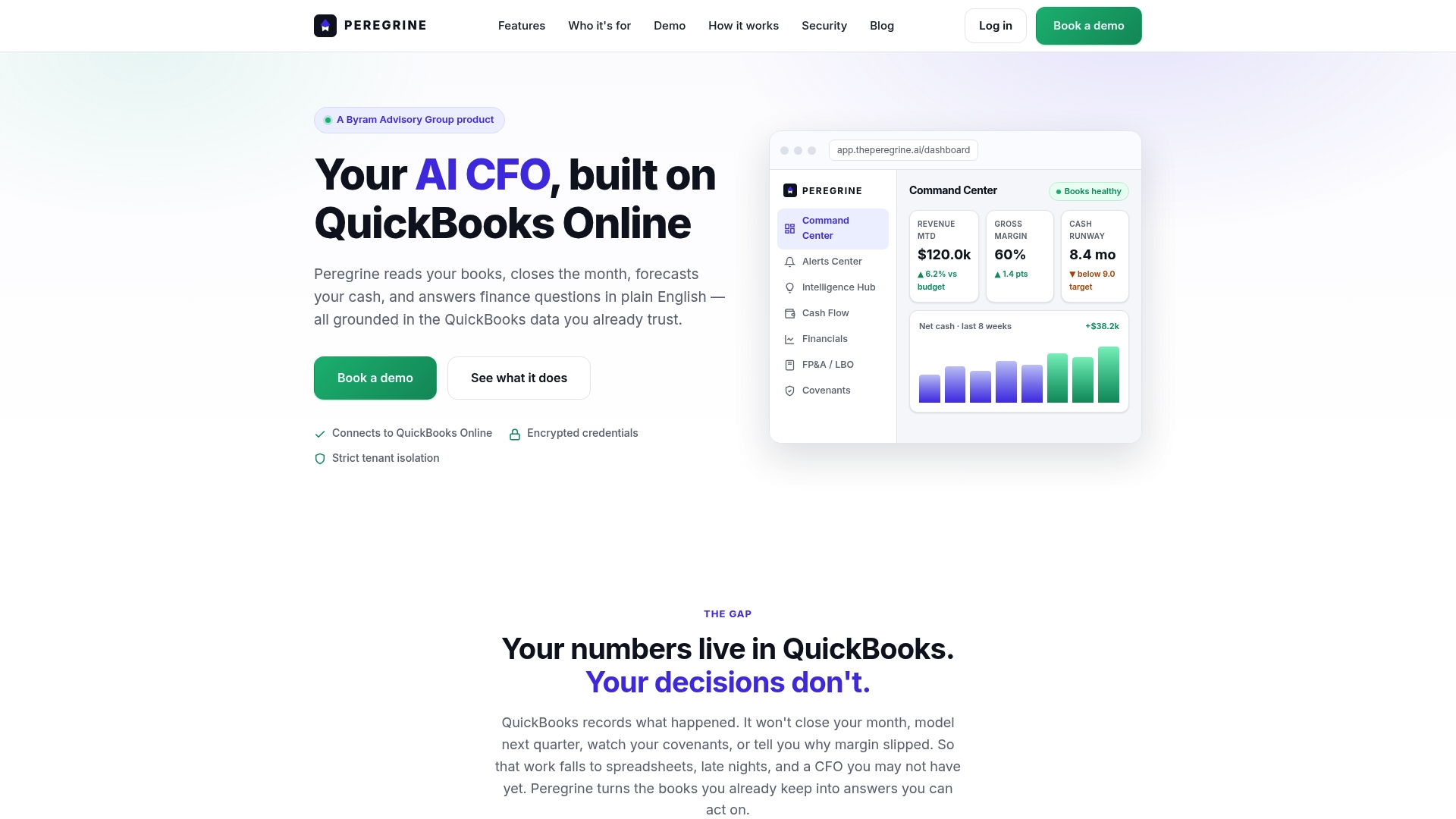
Reads your QuickBooks Online books without changing them and produces a 13-week rolling cash flow forecast with editable assumptions. The platform automates month end close tasks and tracks covenants and debt with early warnings. Encrypted credentials and tenant isolation protect access while plain-English queries summarize performance quickly.
Core Features
Peregrine connects directly to QuickBooks Online and reads ledger data to power forecasts, reporting, and automated close checklists. It delivers a guided month end close workflow and supports FP&A and leveraged buyout modeling based on live books. The system tracks covenants and debt, issues threshold alerts, and exposes revenue, cash flow, and operational metrics in a single command center.
Key Differentiator
Deep integration with QuickBooks Online drives Peregrine's ability to automate CFO level insights and decision making using AI. Because it reads live ledger data without requiring accounting changes, forecasts and models stay aligned to actual books. That live link lets finance teams run scenario models and get covenant alerts tied to the same source of truth.
Pros
Automates manual finance work so teams spend less time on reconciliations and routine close tasks. Standardized close checklists and reporting speed up multi entity or multi client workflows for accounting firms and portfolio managers. Real time, plain English summaries reduce the time stakeholders spend interpreting spreadsheets. Built in forecasting, covenant tracking, and modeling keep planning and compliance on the same ledger.
Cons
- Pricing and subscription details are not publicly listed, and the vendor provides no clear published tiers. This makes procurement planning harder for teams budgeting for a new platform.
Who It's For
Finance teams and accounting practices that run QuickBooks Online day to day and want CFO level reporting without hiring. Portfolio and private equity managers managing multiple companies will get value from consolidated modeling and covenant alerts. Small and mid sized businesses looking for tighter cash flow control can use the platform for rolling forecasts.
Unique Value Proposition
Delivers CFO grade visibility without adding headcount by turning live QuickBooks Online ledger data into forecasts, models, and covenant alerts you can act on. That reduces the gap between bookkeeping and strategic finance because the same transactions drive reporting and scenario analysis. For teams that need a single source for forecasts and compliance signals, this replaces manual consolidation work.
Real World Use Case
A CPA firm connects each client file to Peregrine and runs the guided month end close checklist. The firm publishes consistent financial packs faster and flags covenant breaches before they hit bank tolerances. Partners spend fewer hours assembling reports and more time advising clients on cash flow moves.
Pricing
No public pricing is available. The product description indicates a subscription or custom pricing model rather than fixed public tiers. Procurement teams should contact the vendor for quotes and implementation estimates.
Website: https://theperegrine.ai
Tidely
At a Glance
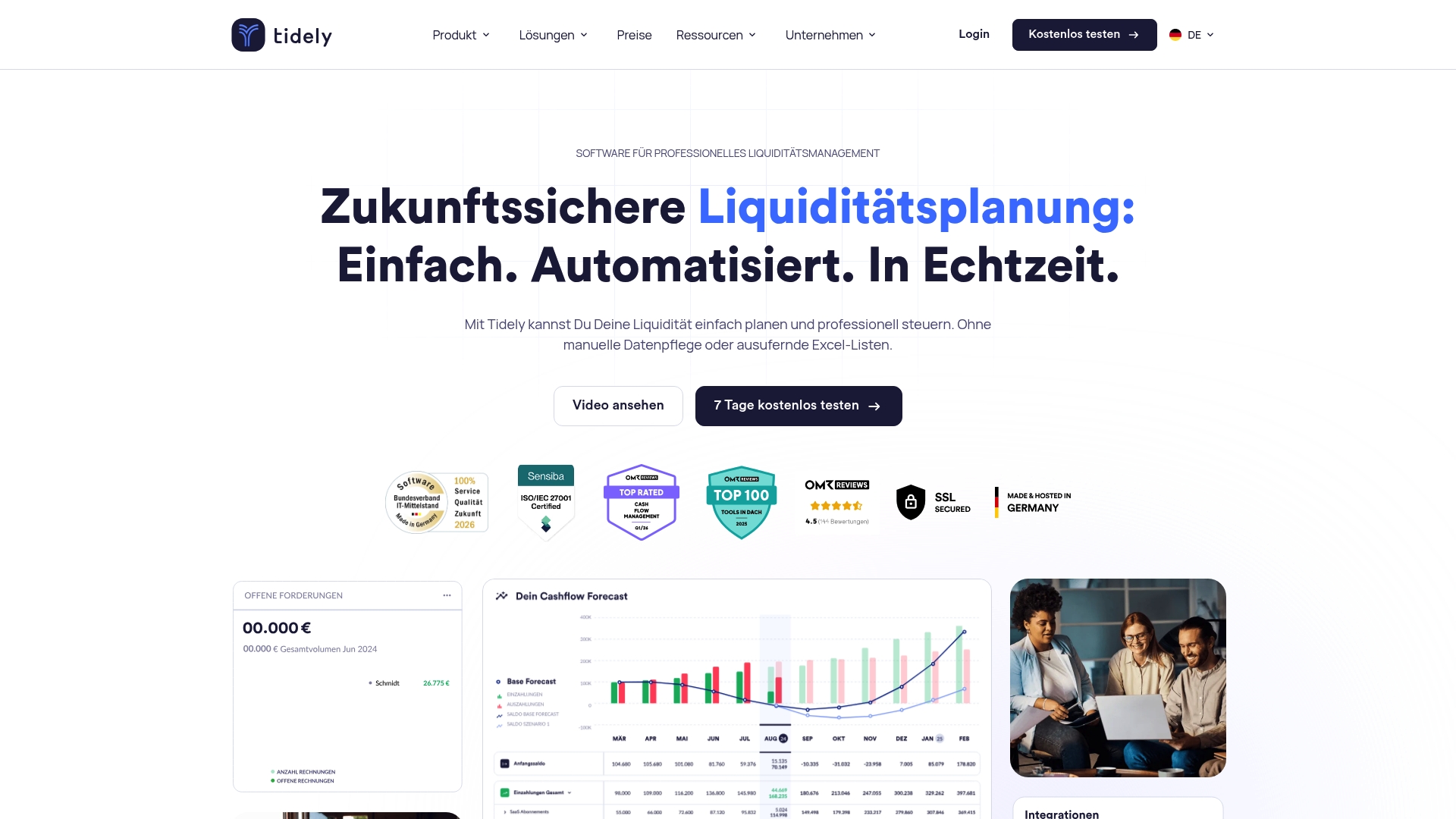
The vendor reports integrations with bank accounts from over 5,000 banks. Tidely was developed and hosted in Germany, and the vendor states the product uses encryption used by banks and holds ISO 27001 certification while complying with GDPR. The company also reports more than 1,800 customers, positioning it toward organizations with recurring cash flow needs.
Core Features
Tidely centralizes liquidity control, offering real time account syncing, scenario planning, and transaction level reporting. The platform supports team and company management workflows, plus invoice and transaction handling that reduce manual reconciliations. Reporting modules generate investor or bank ready exports and scenario outputs for short term and long term planning.
Key Differentiator
Tidely pairs automated real time account connection with AI supported scenario analysis and dedicated onboarding and support. That combo reduces the time finance teams spend on data collection and lets them test investment or financing scenarios quickly. The vendor positions the support element as a differentiator for finance teams that need hands on setup and tailored guidance.
Pros
Automatic account syncing gives finance teams a near immediate view of cash positions without manual imports. The interface aims to be approachable for non specialists while keeping deeper controls for finance staff. Extensive connectivity, including the bank integration claim above and links to ERP and accounting systems, cuts data silos and speeds reporting. Dedicated onboarding and responsive support help teams get live faster. The vendor states security and privacy adherence, which fits regulated environments.
Cons
-
The feature set can feel large for sole proprietors or micro firms with minimal transactions.
-
Pricing is not listed publicly, so small teams may face unexpected costs when they request a quote.
-
Organizations with strict bespoke privacy rules should review the vendor privacy documentation carefully.
When It May Not Fit
Tidely is not built for single person businesses that only need a simple cash tracker. Very small teams that use spreadsheets and want a low cost entry tool may find the onboarding and feature mix excessive. Companies with partial or unsupported source systems could see gaps if specific integrations are missing.
Notable Integrations
The vendor lists connections to bank accounts from over 5,000 banks, ERP systems, and accounting software. It also links to PayPal, EBICS, credit card feeds, Zapier, and offers custom API access for bespoke workflows.
Who It's For
Companies that need structured liquidity planning and forecasting over time will benefit most. The product suits small and mid sized enterprises, startups, agencies, e commerce sellers, and hospitality operations that want automated cash visibility and scenario testing. Teams that require vendor led onboarding will find the support model helpful.
Real World Use Case
A mid market e commerce firm connects its bank accounts, ERP, and accounting system to Tidely to sync cash flows automatically. The finance team uses the dashboard for a daily liquidity snapshot and runs scenarios for inventory purchases. Reporting exports to banks and investors reduce manual report prep before funding rounds.
Pricing
Pricing is available on request. Tidely does not publish a public price list, so you must contact sales for quotes and plan details. Expect tiering or custom quotes for larger integrations and support packages.
Website: https://tidely.com
T-X
At a Glance
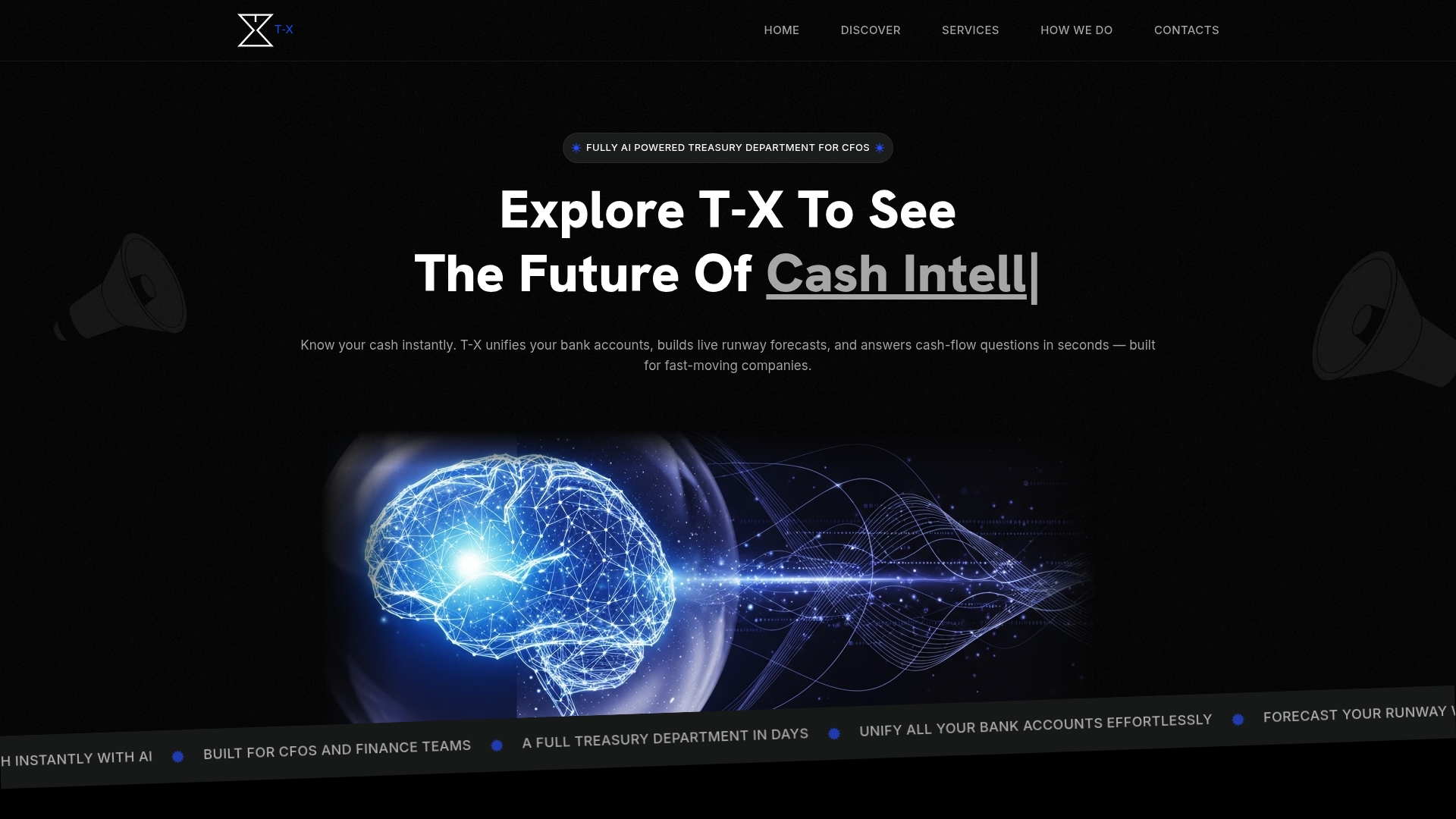
T-X reports average 80% time savings on cash reporting and claims full visibility across bank accounts. That statement comes from the vendor and reflects their internal reporting. The product centralizes bank feeds, runs real time scenario models, and issues liquidity alerts so CFOs can move faster on funding decisions.
Core Features
T-X unifies accounts into a single cash view and ingests live balances from bank account APIs and ERP system connections. It produces AI driven cash forecasts, runs scenario models in real time, and generates alerts for risk and short term liquidity needs. Automated reconciliations reduce spreadsheet work and shorten the monthly cash close.
Key Differentiator
The vendor describes T-X as able to replace a full treasury department through automation and AI. That positioning targets teams that need treasury level visibility without adding headcount. The combination of continuous bank integrations and treasury grade forecasting separates it from generic forecasting tools.
Pros
T-X cuts manual cash reporting and reconciliation time, which is how the vendor frames the time savings claim. Treasury grade models and risk alerts produce forecasts that feel more dependable than simple trend extrapolation. Continuous bank and ERP links keep forecasts aligned with live balances and reduce stale inputs during tight cash windows.
Cons
- Manual control may be constrained. The product relies on AI driven automation, which can limit hands on tweaks for bespoke scenarios.
- Ongoing connectivity matters. Performance depends on the accuracy and stability of bank and ERP links.
- Forecast customization details are sparse. The vendor provides limited public information on how deep model tuning can go.
When It May Not Fit
If your team requires full manual control over each forecast line, T-X may not match that workflow. Finance groups that run complex bespoke scenarios with many manual overrides will find the product restrictive. Organizations with unreliable bank connectivity or fragmented ERP feeds should evaluate integration stability before committing.
Notable Integrations
- Bank account APIs
- ERP system connections
Who It's For
CFOs and finance teams at fast growing companies that need automated liquidity oversight fit T-X well. It suits teams that prefer fewer manual processes and want treasury level reporting without adding staff. Companies that already maintain clean live feeds will realize the most immediate benefits.
Real World Use Case
A rapidly scaling startup consolidated all its bank accounts into T-X and gave the CFO a single real time cash position. The CFO ran instant forecasts and modeled funding scenarios without creating spreadsheets. That setup reduced manual effort and sped decision making during fundraising and payroll cycles.
Pricing
Pricing is not publicly listed. The product entry lists pricing as Not applicable — informational only, so you will need to contact the vendor for a commercial proposal and deployment options.
Website: https://t-x.ai
Cash Flow Frog
At a Glance
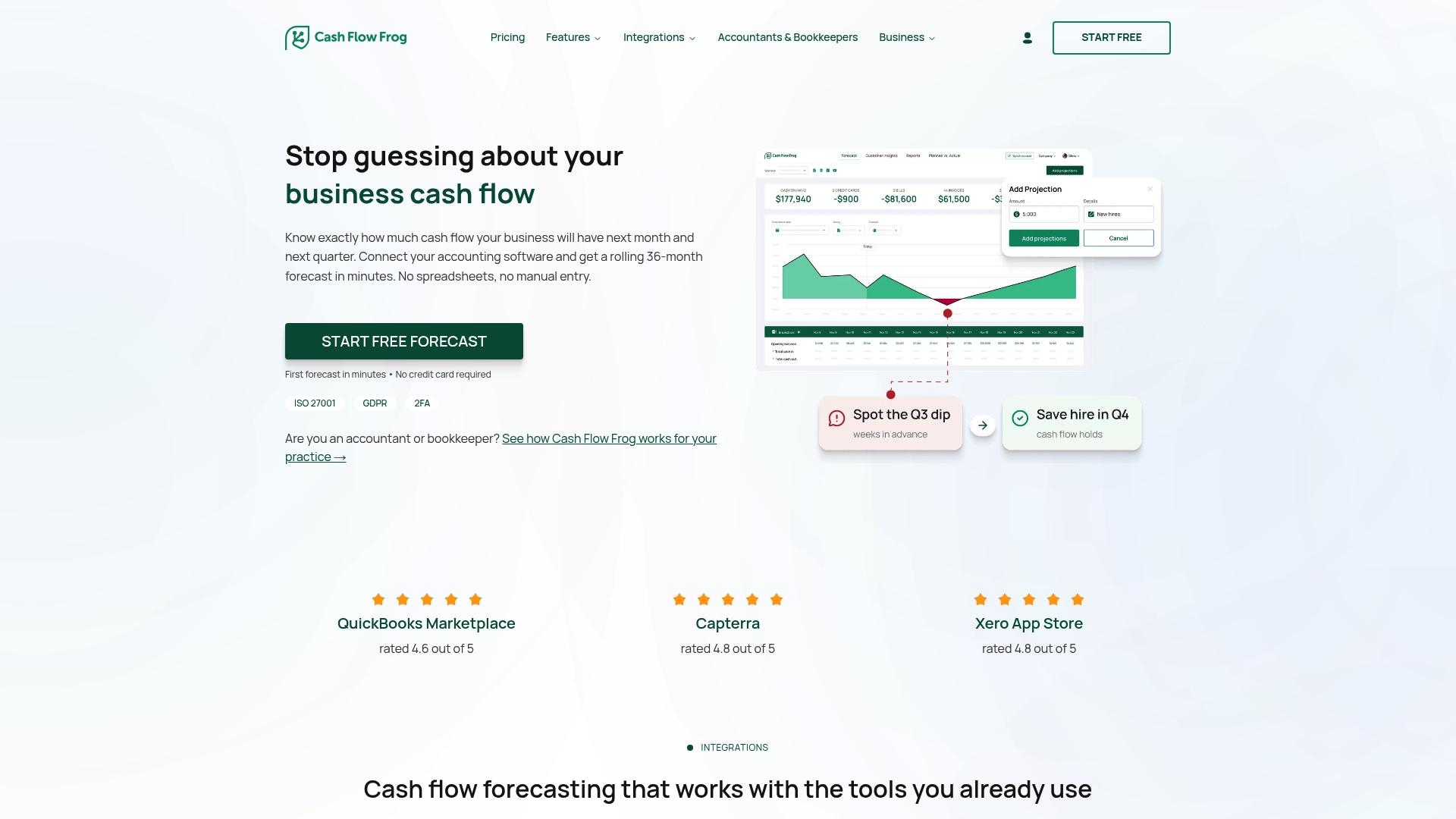
Cash Flow Frog reports connections to eight major accounting platforms, including QuickBooks Online and Xero. The vendor advertises a rolling 36-month forecast with daily, weekly, monthly, and quarterly views. That live-sync plus long-horizon forecasting lets finance teams keep models current as books change.
Core Features
Cash Flow Frog offers real-time data sync from accounting systems and bank feeds, plus Excel imports for legacy workflows. It includes scenario modeling and what-if analysis with breakdowns by vendor, customer, and department, and supports multi-entity and multi-currency consolidation. The platform also includes an AI chat interface for conversational forecasting and presentation-ready branded reports.
Key Differentiator
The product pairs automatic connections to multiple accounting platforms with scenario modeling and a conversational AI interface. That mix reduces manual data stitching and speeds hypothesis testing for finance teams managing cash across entities. The vendor positions the AI chat as a central tool for adjusting assumptions and exporting investor-ready outputs.
Pros
Easy setup and straightforward connectors make initial deployment fast for teams already on QuickBooks or Xero. The product keeps forecasts up to three years ahead and updates them from live books, which reduces stale assumptions and manual imports. Scenario planning supports hiring, spend, and financing paths, and the AI chat simplifies iterative revisions and report generation for investor conversations.
Cons
- Pricing varies by revenue bands, which adds complexity when choosing the right plan.
- Advanced features like AI suggestions and multi-client dashboards are limited to higher plans, increasing cost for accountants.
- Bank feed coverage depends on Plaid for many banks, so direct bank links are not universal.
When It May Not Fit
Cash Flow Frog requires internet access and accounting credentials for live sync, and it does not write back to your ledgers. Firms that need direct book edits or offline forecasting will find the platform limiting. Small businesses that do not need three-year forecasts may prefer simpler, lower-cost tools.
Notable Integrations
- QuickBooks Online
- QuickBooks Desktop
- Xero
- Sage Intacct
- Zoho Books
- FreshBooks
- Odoo
- Plaid bank feeds
Who It's For
Growing small and medium businesses and financial managers who need automated cash forecasting tied to live books. Accountancy practices managing multiple clients will appreciate multi-entity consolidation and branded reports. Teams that plan several scenarios and share board-ready outputs will get the most value.
Real World Use Case
A startup connects its QuickBooks account and enables Plaid bank feeds to populate cash positions automatically. The finance lead runs that rolling forecast, models hiring and marketing scenarios, and refines assumptions via the AI chat. They export branded reports and send them to investors ahead of a funding round.
Pricing
Monthly plans start at $69, with discounts for annual billing and tiered pricing by revenue band. Higher plans add AI suggestions and multi-client dashboards, which increases the monthly bill for multi-entity or accountant use cases.
Website: https://cashflowfrog.com
Comparison of alternatives
Among available options in advanced cash flow forecasting tools, each product demonstrates unique strengths tailored to different financial needs. However, differences in integration depth, onboarding mechanisms, and forecasting flexibility highlight areas of distinction.
Onboarding and Usability
Tidely leads in onboarding support, delivering dedicated team assistance during the software setup and customization phases. For companies requiring hand-on vendor guidance to ensure tool alignment with operational needs, Tidely's service offering stands out.
Forecasting Customization
Cash Flow Frog excels in forecasting flexibility, with capabilities like 36-month forecasts and interactive AI-based scenario modeling. This allows businesses to visualize financial planning over extended periods and modify assumptions dynamically. For finance teams managing complex projections across multiple entities, Cash Flow Frog provides an efficient approach.
Best fit
- Businesses using QuickBooks Online needing direct forecasts will benefit most from Peregrine's source-of-truth integration.
- Teams needing extensive onboarding support should consider Tidely for reliable vendor-led implementation services.
- Companies requiring treasury-grade cash management will find T-X’s automation and continuous integrations valuable.
- Firms valuing multi-client dashboards and three-year forecasting horizons can optimize operations with Cash Flow Frog.
Our pick
For businesses relying on QuickBooks Online who seek automated high-grade financial forecasting, Peregrine provides compatibility and functionality without manual data adjustments. While competitors offer specialized features, Peregrine's direct ledger integration and scenario modeling deliver superior value.
Select the cash forecast software aligning best with your finance management needs.
| Product | Core Feature | Key Differentiator | Best For | Limitations |
|---|---|---|---|---|
| Peregrine | Integrates QuickBooks for modeling forecasts | Live ledger connection ensures synced reporting | Firms using QuickBooks needing CFO-level insights | Pricing details are not publicly listed |
| Tidely | Centralized liquidity control via sync | Extensive integrations including bank systems | SMEs requiring automated cash visibility | Feature set may be excessive for sole proprietors |
| T-X | Real-time cash forecasts | Treasury-grade forecasts for high-level decision-making | CFOs preferring automation and consolidated views | Limited forecast customization details |
| Cash Flow Frog | 36-month rolling forecast | AI chat for scenario assumptions and investor-ready reports | SMEs on QuickBooks or Xero | Higher features locked behind premium plans |
How Can Finance Teams Find Real-Time Clarity With AI Forecasting Tools?
Many finance teams, portfolio managers, and small businesses struggle with manual reconciliations, delayed cash flow insights, and fragmented forecasts. Peregrine directly connects with QuickBooks Online to deliver a live financial command center. It automates month-end close tasks and generates rolling, editable cash flow forecasts that align with actual books.
Peregrine reduces time spent on routine accounting tasks while providing CFO-level visibility. Its clear, plain-English summaries and early alerts on covenants enable faster decisions about liquidity and operations. If your team needs a solution that reads live ledger data and offers scenario modeling without adding headcount, explore what Peregrine offers today.
Explore Peregrine's AI forecasting tools and see how automatic forecasting and covenant alerts can improve your financial management.
FAQ
How does Peregrine automate month end close tasks?
Peregrine automates month end close tasks through a guided workflow that simplifies and standardizes the process. The platform delivers automated close checklists that help finance teams perform monthly reconciliations efficiently. Users can expect reduced manual work and quicker reporting times.
What is the difference between Tidely and Peregrine?
Tidely excels with its automatic account syncing and real-time dashboard for cash positions, designed for teams needing hands-on support for setup. In contrast, Peregrine focuses on providing CFO-level insights by leveraging live QuickBooks Online data for forecasts and models. Users might find Tidely beneficial for real-time account management, while Peregrine suits those needing deeper financial insights.
Which cash flow forecasting software is better for cash flow control?
Peregrine offers a 13-week rolling cash flow forecast that allows teams to edit assumptions, which is ideal for businesses wanting tight control over their cash flow. The platform’s integration with QuickBooks Online ensures that forecasts reflect actual financials, providing a solid base for planning and decision-making.
Can I use Cash Flow Frog if my business doesn't need extensive forecasting?
Cash Flow Frog caters to growing businesses that require automated cash forecasting tied to live books. If your business only needs basic cash tracking, opting for Peregrine might be a lower-commitment choice, as it simplifies access to forecasts without overwhelming users with unnecessary features.
How does the pricing model of Peregrine work?
The pricing and subscription details for Peregrine are not publicly listed, making it important for procurement teams to contact the vendor for quotes. Users can expect a subscription model tailored to their specific business needs, which helps in budgeting for their new cash flow forecasting software.