
A financial operating system (financial OS) is a governed, AI-driven data foundation that consolidates financial data from across your business into a single, real-time command center. Unlike traditional accounting software that records what already happened, a financial OS acts as proactive infrastructure that automates workflows, surfaces insights, and connects your entire financial data ecosystem. It represents a fundamental shift in how finance teams operate, moving from backward-looking record keeping to forward-looking intelligence. Peregrine is one example of this new generation of financial management software, built natively on QuickBooks Online to deliver CFO-grade visibility without the CFO headcount.
What is a financial OS and how does it differ from accounting software?
A financial OS is defined as governed infrastructure that integrates, consolidates, and automates financial operations across every system your business runs on. The term signals a deliberate break from legacy accounting software. Traditional tools record transactions. A financial operating system acts on them.
The distinction matters because most finance teams still spend the majority of their time on reconciliation rather than analysis. A financial OS shifts finance teams from spending 70–80% of their time on manual reconciliation to providing forward-looking business intelligence. That is not a marginal efficiency gain. It is a complete reorientation of what your finance function does every day.

The "operating system" framing is intentional. Just as a computer OS manages hardware resources so applications can run, a financial OS manages your financial data resources so your team, your AI tools, and your decision-making processes can run reliably. It sits beneath your workflows, not beside them.
Adding AI on top of legacy systems does not achieve this. A true financial OS requires AI and humans to operate on the same structured data primitives, with full auditability. Without that shared foundation, AI outputs are unreliable and ungoverned.
How does a financial OS integrate with existing business systems?
Integration is the core technical challenge, and the best financial OS platforms solve it through an API-first architecture. A financial OS connects 600+ systems including ERPs, CRMs, HRIS platforms, banks, and billing systems for real-time data consolidation. That breadth matters because financial data rarely lives in one place.
The integration approach is non-disruptive by design. A genuine financial OS integrates natively via APIs with existing ERPs, CRMs, and banks to maintain a single source of truth, avoiding fragile workflows based on data exports or screen scraping. Screen scraping breaks. Manual exports introduce errors. Native API connections persist.
Here is what that architecture enables in practice:
- Real-time data sync across all connected platforms, so your cash position is never stale
- Persistent data models that map each source system's data to a unified financial schema
- Automated classification of transactions, reducing manual categorization work
- Audit trails that trace every number back to its source system and timestamp
- Role-based access controls that govern who sees what across entities and functions
Pro Tip: Before evaluating any financial OS platform, audit your current data sources. List every system that touches financial data, including your payroll tool, your CRM, and your bank feeds. Platforms that cannot connect natively to all of them will create gaps that undermine the entire value proposition.
Implementation follows a phased approach. Phased integration delivers real-time visibility within weeks, reducing manual rework and enabling CFO-grade intelligence without extra headcount. You do not need to overhaul your existing systems to get started.
What are the key automation capabilities of a financial OS?
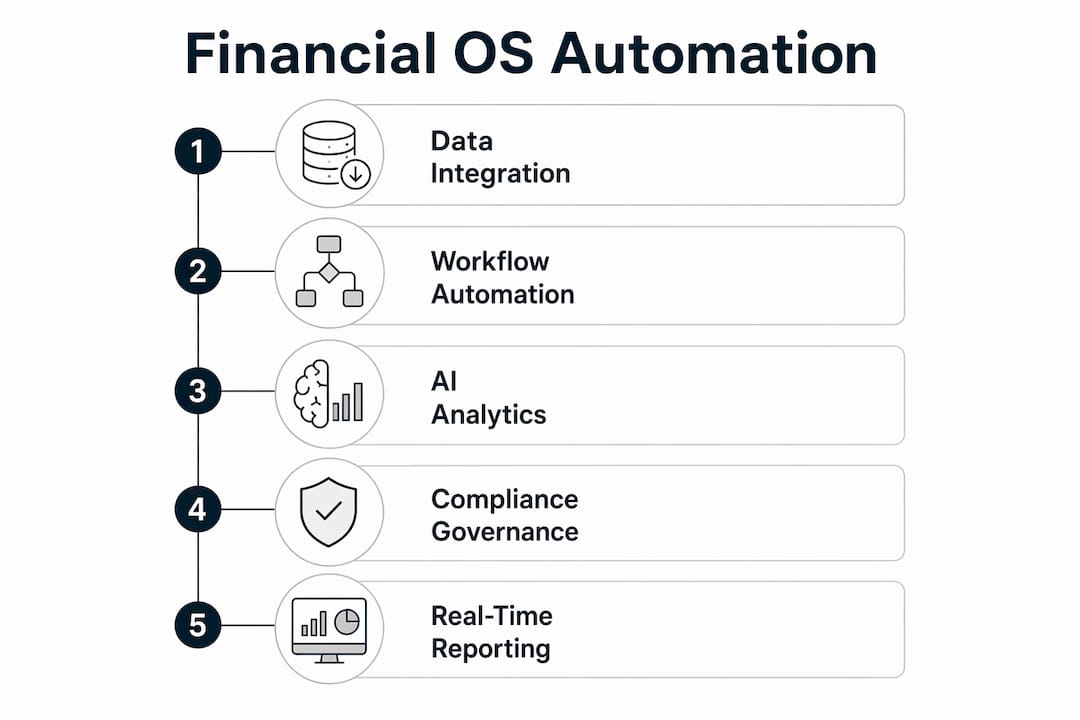
Automation is where a financial OS earns its place in your tech stack. The capabilities go well beyond basic bookkeeping.
- Automated financial consolidation pulls data from multiple entities, currencies, and systems into a single consolidated view without manual intervention.
- Month-end close automation eliminates the spreadsheet marathon that consumes finance teams at the end of every reporting period. Read more about automating month-end close to understand the workflow in detail.
- Intercompany eliminations are handled automatically, removing the manual matching that causes errors in multi-entity reporting.
- Cash-flow forecasting runs on live data rather than last month's export, giving you a current view of your runway and liquidity position.
- AI-powered anomaly detection flags unusual transactions before they become material errors or compliance issues.
- Tax filing and compliance workflows are automated with consistent logic applied across all entities and jurisdictions.
The compliance architecture underpinning these capabilities is not optional. SOC compliance and detailed data lineage are requirements for audit readiness, and an API-driven approach ensures consistent audit trails across all connected platforms. Auditors need to trace numbers to their source. A financial OS makes that traceable by default.
The AI integration layer is where the most significant productivity gains appear. A financial OS connects governed financial data to AI platforms like ChatGPT, ensuring trusted, mapped data drives AI outputs with full audit controls. This means you can ask plain-English questions about your financials and receive answers grounded in verified data, not hallucinated summaries of stale spreadsheets.
What are the business benefits of adopting a financial OS?
The strategic case for a financial operating system comes down to one shift: your finance team stops being a data gatekeeper and starts being a strategic advisor.
"Finance teams transform from manual reconciliation gatekeepers to strategic partners with real-time scenario planning using a financial OS. The infrastructure makes the difference, not just the tools layered on top of it."
That transformation has concrete operational consequences:
- Real-time cash flow visibility means you know your actual position today, not your position as of last Friday's export
- Profitability analysis by product, customer, or entity becomes available without building custom reports from scratch each time
- Scenario modeling runs on live data, so your forecasts reflect current conditions rather than assumptions baked in weeks ago
- Reduced spend leakage from automated classification catching miscoded expenses before they distort your margins
- AI-assisted decision support gives finance teams the ability to run analysis that previously required a dedicated FP&A analyst
The headcount implication is significant for growing businesses. CFO-grade visibility, including consolidated reporting, variance analysis, and forward-looking forecasts, no longer requires a full-time CFO. Platforms like Peregrine deliver that level of insight through automation and AI, making it accessible to businesses that cannot justify a six-figure finance hire. For a deeper look at how AI tools are reshaping the finance function, the evolution of AI accounting software illustrates how rapidly the category is moving.
How do you implement a financial OS without disrupting operations?
The most common implementation mistake is treating a financial OS like an ERP replacement. It is not. Layering a financial OS on existing ERPs improves real-time visibility without disrupting core accounting and compliance workflows. Your ERP stays in place. The financial OS sits above it, reading and acting on the data your ERP produces.
Pro Tip: Start with one high-pain workflow, such as month-end close or cash-flow reporting, and implement the financial OS there first. Demonstrating value in a single area builds internal confidence and gives your team time to adapt before expanding the integration.
Governance is the factor that separates successful implementations from expensive failures. Governance enforces strict mappings, logic, version control, and audit trails over all financial data sources to avoid unmanaged data accumulation and ensure workflow reliability. Without governance, a financial OS becomes a data swamp: lots of data, no trusted answers.
The table below compares two implementation approaches across the factors that matter most.
| Factor | Phased layered approach | Full rip-and-replace |
|---|---|---|
| Time to first value | Weeks | 12–18 months |
| Disruption to existing workflows | Minimal | High |
| ERP transactional integrity | Preserved | At risk during migration |
| Audit continuity | Maintained | Interrupted |
| Cost and resource demand | Moderate | Very high |
Role-based access controls are non-negotiable from day one. Every user should see only the data relevant to their function. Audit trails should capture every change, every query, and every export. These controls are not bureaucratic overhead. They are the mechanism that makes your financial OS trustworthy enough to act on.
Key Takeaways
A financial OS is governed infrastructure that consolidates financial data from 600+ systems, automates core workflows, and shifts finance teams from manual reconciliation to real-time strategic analysis.
| Point | Details |
|---|---|
| Definition matters | A financial OS is infrastructure, not software. It governs and automates, not just records. |
| API-first integration | Native API connections to ERPs, CRMs, and banks prevent the data gaps that manual exports create. |
| Governance prevents failure | Strict mappings, audit trails, and version control separate a trusted financial OS from a data swamp. |
| Layer, do not replace | Implement on top of your existing ERP to preserve compliance workflows and reach value faster. |
| Finance teams become advisors | Automating 70–80% of reconciliation work frees your team for scenario planning and strategic decisions. |
Why governance is the part most businesses underestimate
Most conversations about financial OS focus on the AI features and the integration breadth. I understand why. Those are the visible, exciting parts. But after watching businesses implement these platforms, the variable that determines success is almost always governance, and it is almost always underbuilt.
I have seen teams connect a financial OS to a dozen source systems, get excited about the real-time dashboards, and then quietly stop trusting the numbers within three months. The reason is always the same: nobody defined the mapping rules, nobody enforced consistent categorization logic, and nobody built the audit trail that would let them trace a discrepancy back to its source. The platform worked. The governance did not.
The insight that changed how I think about this: a financial OS is only as trustworthy as the rules you enforce inside it. The technology can automate almost anything. But automation without governance just produces wrong answers faster. Finance teams that treat governance as a setup task rather than an ongoing discipline are the ones that end up reverting to spreadsheets.
The practical implication is that your first implementation conversation should not be about which integrations to turn on. It should be about who owns the mapping logic, how often it gets reviewed, and what happens when a source system changes its data structure. Get those answers in writing before you go live. The businesses that do this well are the ones that actually make the transition from data gatekeepers to strategic advisors. The ones that skip it spend the next year debugging dashboards instead of running scenarios.
For finance professionals considering a fractional CFO model alongside a financial OS, the governance question applies equally. The platform and the person both need to operate from the same trusted data foundation.
— Owen
Peregrine: a financial OS built for growing businesses
Peregrine is an AI CFO platform built natively on QuickBooks Online, designed to give business owners and finance teams real-time visibility into cash flow, revenue, and profitability without adding headcount.
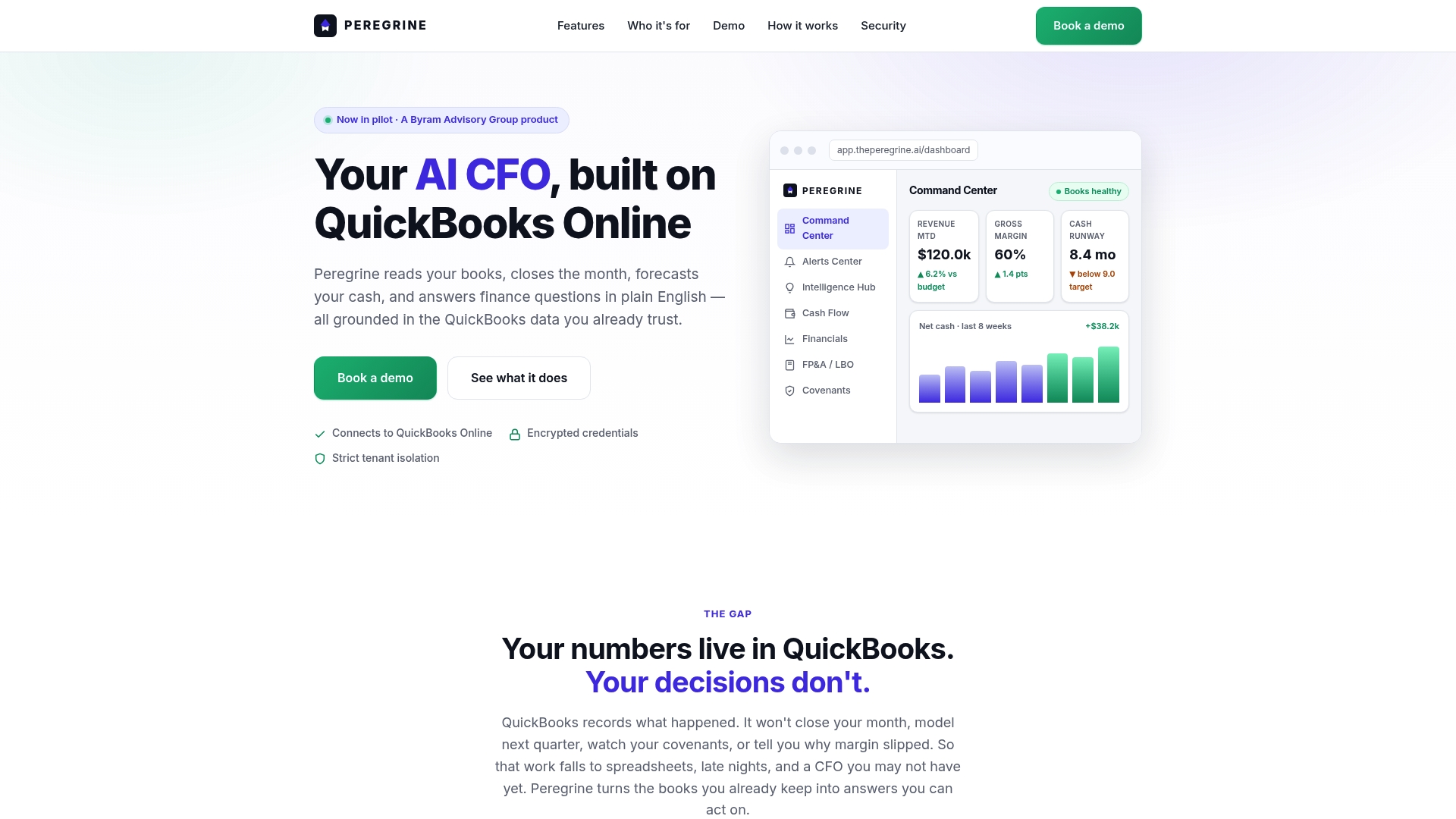
Peregrine automates month-end close, cash-flow forecasting, and anomaly detection, delivering CFO-grade insights through plain-English queries and customizable dashboards. The platform connects directly to your existing QuickBooks data, so implementation is fast and non-disruptive. If you are ready to move from manual financial management to a real-time financial command center, explore Peregrine and see what your numbers look like when they are always current.
FAQ
What is a financial OS?
A financial OS is governed, AI-driven infrastructure that integrates financial data from multiple systems, automates core workflows like month-end close and forecasting, and provides real-time visibility into cash flow and profitability.
How does a financial OS differ from accounting software?
Accounting software records past transactions. A financial OS acts on live data, automating reconciliation, consolidation, and reporting while connecting AI tools to trusted, governed financial data.
Does implementing a financial OS require replacing my ERP?
No. The best practice is to layer a financial OS on top of your existing ERP, preserving transactional integrity and audit continuity while adding real-time visibility and automation above it.
What does governance mean in a financial OS context?
Governance refers to enforcing consistent data mappings, categorization logic, version control, and audit trails across all connected systems. Without it, a financial OS produces unreliable outputs regardless of how many integrations it supports.
Can a financial OS support AI tools like ChatGPT?
Yes. A financial OS connects governed financial data to AI platforms, ensuring that AI outputs are grounded in trusted, mapped data with full audit controls rather than unverified exports.