
A SaaS fractional CFO is an outsourced senior financial leader who provides strategic financial management tailored specifically to subscription-based business models. Unlike a bookkeeper or CPA, a fractional CFO focuses on forward-looking decisions: fundraising, growth modeling, and investor readiness. For small SaaS businesses crossing the $1M ARR threshold, this role fills a critical gap between basic accounting and the financial leadership that drives real scale. Standards like ASC 606 revenue recognition and metrics like ARR, CAC, and LTV require specialized expertise that a general accountant simply does not provide.
What does a SaaS fractional CFO actually do?
Fractional CFOs are forward-looking strategic partners who focus on cash flow, unit economics, and growth forecasting. That distinction matters because most SaaS founders confuse this role with bookkeeping, and the confusion costs them. A bookkeeper records what happened. A fractional CFO tells you what will happen and what to do about it.
The core responsibilities of a SaaS fractional CFO include:
- Financial modeling and scenario planning: Building models that show how changes in pricing, churn, or sales velocity affect your runway and valuation.
- Cash flow management: Monitoring burn rate and projecting when you need to raise or cut costs.
- SaaS metric oversight: Tracking ARR, MRR, CAC, LTV, churn rate, and the Rule of 40 to give leadership a clear picture of business health.
- Fundraising support: Preparing investor-ready financial packages, board decks, and due diligence materials.
- Investor relations: Translating financial data into a compelling growth narrative for venture capitalists and angels.
SaaS leadership teams often lack visibility into CAC, LTV, churn, and margins. A fractional CFO builds the reporting infrastructure to fix that gap. The result is not just cleaner numbers. It is a finance function that actually informs decisions.
A fractional CFO also complements your existing CPA or bookkeeper rather than replacing them. The CPA handles tax compliance and historical reporting. The fractional CFO uses that data to plan the future.

Pro Tip: When interviewing fractional CFO candidates, ask them to walk you through how they would model your MRR growth over 18 months. If they cannot answer fluently, they lack the SaaS depth you need.
When should you hire a fractional CFO for your SaaS company?
The timing of this hire matters as much as the hire itself. Most SaaS companies engage a fractional CFO when they hit one of three clear triggers.
- Reaching $1M to $5M ARR. Financial complexity outgrows standard bookkeeping at this stage. You need someone who can model growth, not just record it.
- Preparing for a Series A funding round. Investors expect clean financials, SaaS-specific KPIs, and a credible financial story. A generalist accountant cannot build that package.
- Increasing operational complexity. Adding new pricing tiers, entering new markets, or hiring aggressively all create financial decisions that require senior-level input.
Once you decide to engage, the process typically starts with a 60-minute diagnostic session. This session identifies financial leaks and reporting gaps before any ongoing work begins. After the diagnostic, most engagements move to a retainer model covering forecasting, board reporting, and ongoing financial oversight.
Retainer pricing varies by scope and geography. As a reference point, fractional CFO retainers in the UK start around £2,500 per month, compared to a full-time CFO salary of £150,000 to £200,000 per year. US pricing follows a similar structure, with retainers often starting near $3,000 per month. That cost difference is the core economic argument for the fractional model.
Fractional CFOs integrate directly with your existing accounting software. Platforms like QuickBooks Online give them real-time access to your financial data, which is the foundation for accurate forecasting and month-end close automation.
Pro Tip: Use the initial diagnostic session to audit your chart of accounts, revenue recognition practices, and reporting cadence. Most SaaS companies discover at least one material gap in the first hour.
How does a fractional CFO improve financial management and decisions?
The most direct impact a fractional CFO delivers is a reporting infrastructure built around SaaS KPIs. Without that infrastructure, founders make growth decisions based on gut feel or lagging indicators. With it, every major decision connects to real data.
Building investor-ready dashboards
A fractional CFO designs dashboards that track the metrics investors actually care about: MRR growth, net revenue retention, CAC payback period, and gross margin by cohort. These are not vanity metrics. They are the numbers that determine your valuation multiple in a funding round.
Startups with fractional CFO support report a 45% higher fundraising success rate and 1.8x higher valuation multiples on average. That outcome reflects what happens when financial storytelling aligns with investor expectations.
Forecasting and cash flow modeling
Fractional CFOs build rolling 12 to 18 month cash flow models that update as your actuals change. They run scenario analyses: what happens if churn increases by 2%? What if your top sales rep leaves? These models give leadership the confidence to make bold decisions without flying blind.
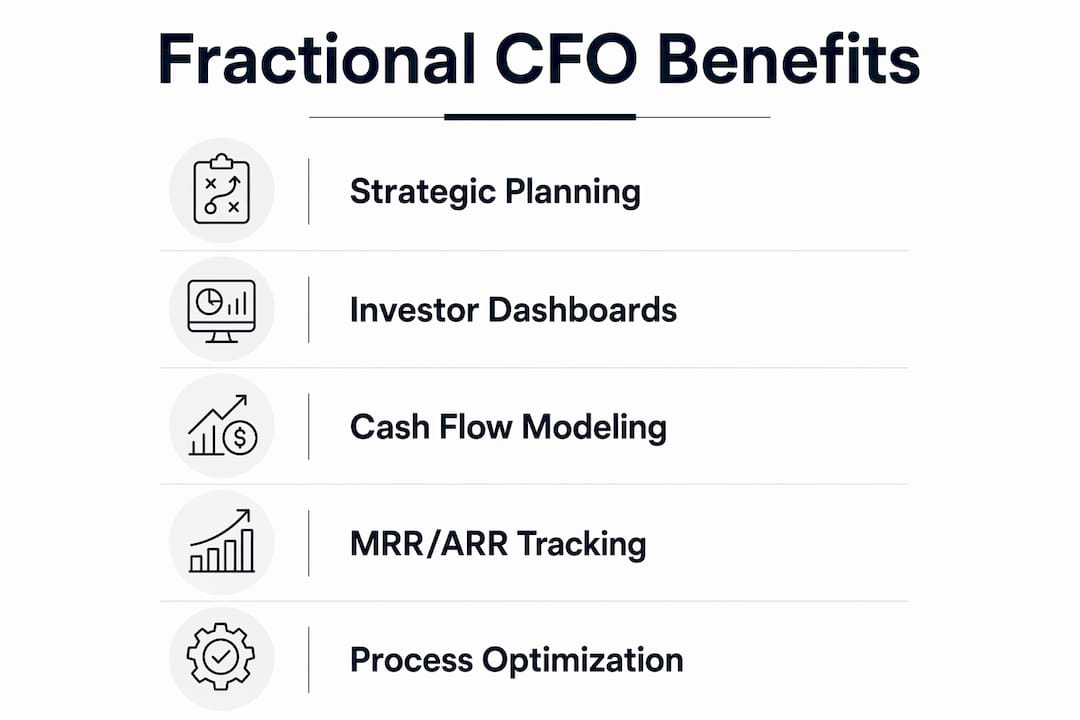
Pairing a fractional CFO with the right cash flow forecasting tools multiplies the impact. Automation handles the data collection. The CFO handles the interpretation.
| SaaS CFO service | Business benefit |
|---|---|
| MRR and ARR tracking | Accurate revenue visibility for growth decisions |
| CAC and LTV analysis | Reveals whether your acquisition model is sustainable |
| Churn modeling | Identifies retention risks before they damage revenue |
| Fundraising preparation | Produces investor-ready financials and board decks |
| Cash flow forecasting | Prevents runway surprises and informs hiring plans |
| ASC 606 compliance | Keeps revenue recognition audit-ready and investor-credible |
Understanding strategic finance leadership versus compliance accounting is the key to getting full value from this role. The CFO is not there to file your taxes. They are there to make your business worth more.
What are the common pitfalls when hiring a SaaS fractional CFO?
The biggest mistake SaaS founders make is hiring a generalist CFO who lacks subscription-model expertise. Generalist fractional CFOs risk improper handling of ASC 606, MRR benchmarking, churn analysis, and the financial storytelling that venture capitalists require. That gap does not show up in a resume. It shows up when a VC asks a question your CFO cannot answer.
A second common mistake is engaging a fractional CFO before your books are clean. Most fractional CFOs improve accounting processes rather than doing basic data entry, but they cannot build accurate forecasts on top of messy data. Get your bookkeeping current before the engagement starts.
Watch out for these specific pitfalls:
- Confusing the CFO role with a bookkeeper. A fractional CFO sets financial strategy. A bookkeeper records transactions. Hiring a CFO to do bookkeeping wastes money and misses the point.
- Skipping SaaS-specific vetting. Ask candidates directly about their experience with subscription revenue recognition under ASC 606 and their approach to cohort analysis.
- Misaligning on goals. Define success metrics before the engagement begins. What does a good outcome look like at 90 days? At 12 months?
- Ignoring integration with your tech stack. A fractional CFO who does not work inside your accounting software cannot deliver real-time insights.
A fractional CFO is a strategic partner who fixes underlying accounting processes to be investor-ready, not someone who manages your day-to-day data entry. Setting that expectation clearly from day one prevents most engagement failures.
Pro Tip: Ask any fractional CFO candidate to describe a SaaS company they helped prepare for a Series A. Listen for specific metrics they improved, not general process descriptions. Specificity signals real experience.
Key Takeaways
A SaaS fractional CFO delivers the most value when engaged early, matched to your business stage, and given clean financial data to work with.
| Point | Details |
|---|---|
| Hire at the right stage | Engage a fractional CFO when ARR reaches $1M–$5M or before a funding round. |
| Prioritize SaaS expertise | Generalist CFOs lack the ASC 606 and SaaS metric knowledge investors require. |
| Start with a diagnostic | A 60-minute audit identifies financial leaks before retainer work begins. |
| Expect strategic output | Fractional CFOs build forecasts and dashboards, not bookkeeping records. |
| Pair with the right tools | Accounting software integration is required for real-time financial insights. |
Why I think most SaaS founders wait too long
Working closely with SaaS startups over the years, I have seen the same pattern repeat: founders wait until they are in crisis before bringing in senior financial leadership. They hit a funding round, realize their financials are a mess, and scramble to clean up six months of problems in six weeks. That scramble costs them valuation points and sometimes the deal itself.
The founders who get this right bring in a fractional CFO before they think they need one. At $500K ARR, the cost feels high. At $2M ARR with a term sheet on the table, it feels cheap. The difference is that the early movers have 12 months of clean, investor-ready data by the time a VC asks for it.
A fractional CFO also changes how you think about your business. When you see your CAC payback period updated monthly and your churn modeled against retention initiatives, you stop making decisions based on revenue alone. That shift in thinking is worth more than any single financial model they build.
My honest advice: treat the fractional CFO engagement as a growth investment, not an overhead cost. The financial modeling tools and reporting infrastructure they build compound in value as your business scales. The founders who understand that early are the ones who close better rounds at better terms.
— Owen
Peregrine gives you CFO-grade financial visibility
For SaaS businesses that want the strategic clarity of a fractional CFO without the full retainer cost, Peregrine delivers CFO-grade financial oversight built directly on QuickBooks Online.
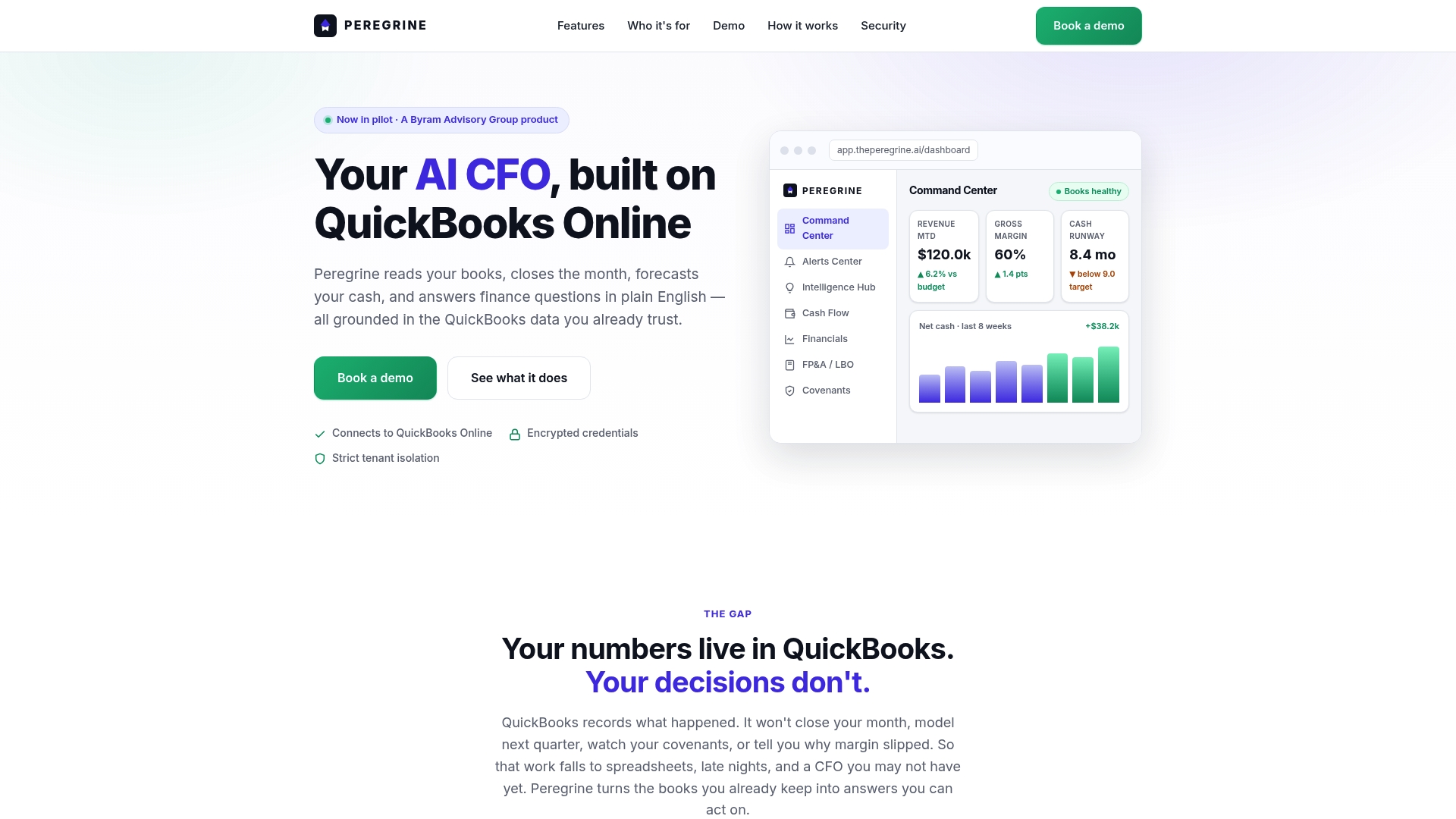
Peregrine automates cash flow forecasting, flags anomalies in real time, and answers plain-English financial questions so you always know where your business stands. It tracks the SaaS metrics that matter: revenue trends, cash position, and operational efficiency, all in one live financial command center. Whether you are preparing for a funding round or managing rapid growth, Peregrine's AI CFO platform gives your team the financial intelligence to make confident decisions every day.
FAQ
What is a SaaS fractional CFO?
A SaaS fractional CFO is an outsourced senior financial leader who provides part-time strategic financial management tailored to subscription-based business models. They focus on SaaS metrics, fundraising readiness, and growth forecasting rather than bookkeeping.
When should a SaaS company hire a fractional CFO?
Most SaaS companies benefit from a fractional CFO when ARR reaches $1M to $5M or when preparing for a Series A funding round. Financial complexity at those stages exceeds what standard bookkeeping can handle.
How much does a fractional CFO cost?
Fractional CFO retainers typically start around $3,000 per month in the US, a fraction of a full-time CFO salary. The exact cost depends on scope, company size, and the CFO's level of SaaS specialization.
What is the difference between a fractional CFO and a CPA?
A CPA manages historical financial compliance and tax reporting. A fractional CFO uses that historical data to build forward-looking forecasts, financial models, and investor-ready reporting.
Why does SaaS-specific CFO experience matter?
Generalist CFOs often lack expertise in ASC 606 revenue recognition, MRR benchmarking, and churn analysis. Those gaps create real problems during investor due diligence and can affect your valuation or deal terms.