
Fractional CFO cost refers to the monthly or hourly fees paid to part-time financial leaders who deliver CFO-level strategy without the expense of a full-time hire. Most small businesses pay between $3,000 and $12,000 per month, with enterprise-level or near-full-time engagements exceeding $20,000 monthly. That range represents a 60–85% reduction compared to a full-time CFO's total compensation package. For any business owner weighing outsourced CFO services cost against the value of real financial leadership, understanding what drives that price is the most useful place to start.
What factors determine fractional CFO cost?
Fractional CFO cost depends more on engagement scope and team composition than on company revenue alone. A $10M company with active M&A activity may pay more than a $40M company with straightforward finances. Revenue is a rough guide, not a pricing formula.
The main cost drivers break down as follows:
- Scope of work. Pure strategic advice costs less than a mix of strategy, operational accounting, and transaction support. The more hands-on the role, the higher the fee.
- Time commitment. A few hours per week for board prep costs far less than 20+ hours per week managing a finance team.
- Billing model. Monthly retainers, hourly rates, and project fees each carry different cost structures. Retainers are the most common for ongoing work.
- Industry specialization. A fractional CFO with SaaS metrics expertise or healthcare revenue cycle knowledge commands a premium over a generalist.
- Team configuration. A solo fractional CFO who handles everything from strategy to bookkeeping inflates costs. Tiered team models that reserve CFO billing for strategic tasks and use lower-cost Controllers or staff for routine work reduce the overall bill significantly.
- Onboarding urgency. A rushed engagement with a tight deadline costs more than a planned, phased start.
Pro Tip: Before you request a proposal, write down the three financial decisions you need help making in the next 90 days. That list defines your scope and prevents you from paying for services you do not need.
The distinction between a solo fractional CFO and a team-based model matters more than most owners realize. When one person does everything, you pay CFO rates for work a $75-per-hour bookkeeper could handle. A firm that deploys a CFO alongside a Controller and accounting staff allocates tasks by role. That structure keeps your total cost lower while maintaining the quality of strategic advice.

How do fractional CFO costs compare to hiring a full-time CFO?
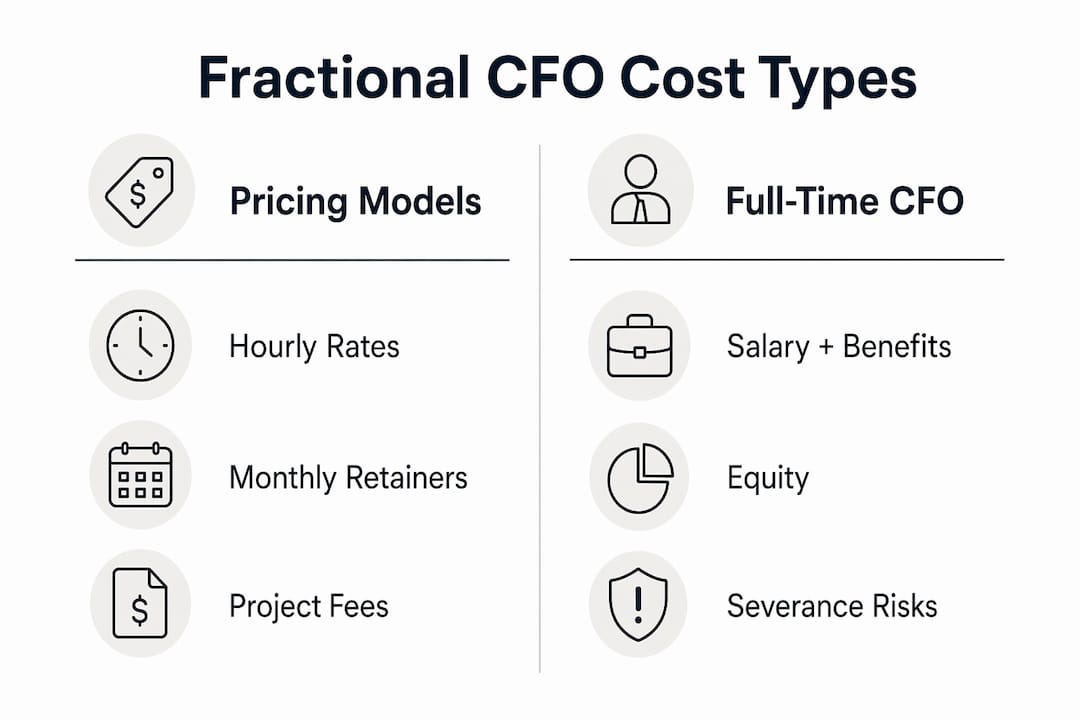
The cost gap between fractional and full-time CFOs is significant. Full-time CFO total compensation, including salary, bonuses, equity, and benefits, typically runs $350,000 to $800,000 per year depending on company size and stage. Fractional CFO costs range from $36,000 to $180,000 annually. That is a meaningful difference for any business watching its burn rate.
| Cost factor | Full-time CFO | Fractional CFO |
|---|---|---|
| Annual cost range | $350,000–$800,000 | $36,000–$180,000 |
| Recruiting fees | $50,000–$75,000 | Minimal or none |
| Time to onboard | 3–6 months | 2–4 weeks |
| Equity exposure | Common | Rare |
| Severance risk | Yes | No |
| Cross-industry insight | Single company | Multiple clients |
The recruiting process alone adds cost and delay. Full-time CFO recruitment takes 3–6 months on average and carries recruiting fees of $50,000–$75,000. A fractional CFO typically onboards in 2–4 weeks. For a business facing a fundraising deadline or an audit, that speed difference is worth real money.
A fractional CFO brings pattern recognition from working across multiple companies and industries simultaneously. That cross-company experience often surfaces solutions a single-company CFO would never encounter. You are not just buying time. You are buying a perspective shaped by dozens of financial situations your business has not faced yet.
Equity and severance risk also favor the fractional model. Full-time CFOs at growth-stage companies frequently receive equity grants and negotiate severance clauses. A fractional engagement carries neither. You pay for the work, and when the engagement ends, it ends cleanly.
What pricing models and tiers should you expect?
Monthly retainers are the standard pricing model for fractional CFOs. Senior practitioners prefer retainers because they focus on delivering advice rather than tracking hours. Hourly billing exists but works better for short-term projects or assessments.
Hourly rates
Fractional CFO hourly rates range from $175 to $450 per hour. Most experienced practitioners bill between $200 and $350 per hour. Hourly billing suits one-time projects, financial model reviews, or board presentation prep.
Project-based fees
Project fees for fundraising support, financial modeling, or M&A advisory typically run $5,000 to $35,000. The range reflects the complexity of the transaction and the time required to prepare materials, run scenarios, and support due diligence.
Monthly retainer tiers
Here is how retainer pricing typically breaks down by company stage:
| Company stage | Monthly retainer | Typical services included |
|---|---|---|
| Early stage ($2M–$5M revenue) | $3,000–$5,000 | Cash flow oversight, basic reporting, investor updates |
| Growth stage ($5M–$20M revenue) | $5,000–$10,000 | KPI dashboards, budget management, fundraising prep |
| Scale stage ($20M–$50M revenue) | $10,000–$20,000 | Board reporting, M&A support, team management |
| Enterprise or interim | $20,000+ | Near-full-time coverage, complex transactions |
Add-on services carry their own fees. Board reporting packages commonly cost $500 to $1,500 per month on top of the base retainer. Investor relations support, covenant compliance tracking, and SaaS metrics reporting for a SaaS fractional CFO engagement fall into the same category.
The tier you land in depends less on your revenue and more on what you need the CFO to do. A $15M company preparing for a Series B needs a growth-stage or scale-stage engagement. A $15M company with stable revenue and no near-term transactions may need only entry-level strategic support.
When should you hire a fractional CFO and how do you assess the ROI?
Certain events signal that your financial complexity has outgrown your current setup. Recognizing those triggers early prevents costly mistakes.
- Fundraising or investor reporting. Investors expect clean financials, detailed projections, and a CFO-level voice in conversations. A bookkeeper cannot fill that role.
- Mergers, acquisitions, or exit planning. Transaction work requires financial modeling, due diligence support, and negotiation experience that most small business finance teams lack.
- Revenue recognition complexity. SaaS businesses, professional services firms, and companies with multi-year contracts face revenue recognition rules that require CFO-level judgment.
- Rapid growth with cash flow pressure. Fast growth consumes cash. A fractional CFO builds cash flow forecasting models that prevent the business from running dry at the worst moment.
- Board or lender reporting requirements. Covenant compliance, board decks, and audit preparation require structured financial leadership, not just accurate books.
Founders often delay hiring a fractional CFO until financial complexity surpasses what bookkeeping can handle. That delay is expensive. The cost of a bad financing decision, a missed covenant, or a failed fundraise far exceeds a year of fractional CFO fees.
A financial discovery assessment is the most practical first step. Many fractional CFO firms offer a scoping session to define the engagement and estimate cost. That session protects you from paying for a $10,000-per-month engagement when a $4,000-per-month retainer covers your actual needs.
Pro Tip: A fractional CFO engagement should generate at least three times its annual cost in measurable business value, whether through better financing terms, avoided losses, or improved cash management. If you cannot identify where that value will come from, the scope is wrong.
The rise of fractional CFOs is driven by strategic agility, not just cost savings. Businesses gain access to executives with IPO experience, debt restructuring backgrounds, and cross-industry pattern recognition at a price point that fits a growth-stage budget. That access used to be reserved for companies large enough to afford a full-time hire.
Key Takeaways
Fractional CFO costs range from $3,000 to $12,000 per month for most small businesses, with engagement scope and team composition driving price more than company revenue alone.
| Point | Details |
|---|---|
| Typical monthly cost | Most small businesses pay $3,000–$12,000 per month for fractional CFO services. |
| Cost vs. full-time CFO | Fractional engagements cost 60–85% less than a full-time CFO's total compensation. |
| Key pricing driver | Scope and team configuration matter more than revenue when determining your rate. |
| Best time to hire | Hire before fundraising, M&A, or rapid growth, not after complexity creates a crisis. |
| ROI benchmark | A fractional CFO should generate at least three times its annual cost in measurable value. |
What I have learned about fractional CFO pricing after years of watching businesses get it wrong
The most common mistake I see is treating fractional CFO cost as a line item to minimize rather than an investment to size correctly. Owners shop for the lowest monthly fee and end up with a generalist who cannot speak to their investors or a solo operator billing CFO rates for work that belongs on a bookkeeper's desk.
The CFO title is unregulated. Anyone can use it. The indicators that actually matter are Big Four experience, domain-specific fundraising success, or a track record in your industry. Years of experience is a weak signal. Specific outcomes are a strong one.
I also think the timing question is underrated. The businesses that get the most from a fractional CFO engage one before the complexity hits, not during the crisis. Early engagement means the CFO builds the financial infrastructure, the reporting cadence, and the forecasting models before you need them under pressure. That preparation is where the real return lives.
For strategic finance decisions, the fractional model democratizes access in a way that genuinely changes outcomes for small businesses. A $5M company can now have the same quality of financial leadership as a $50M company. That was not true ten years ago.
— Owen
Peregrine gives you CFO-grade visibility without the retainer
Small business owners who need real-time financial insight do not always need a fractional CFO on retainer. Peregrine integrates directly with QuickBooks Online to automate month-end closing, build cash flow forecasts, and surface anomalies before they become problems.
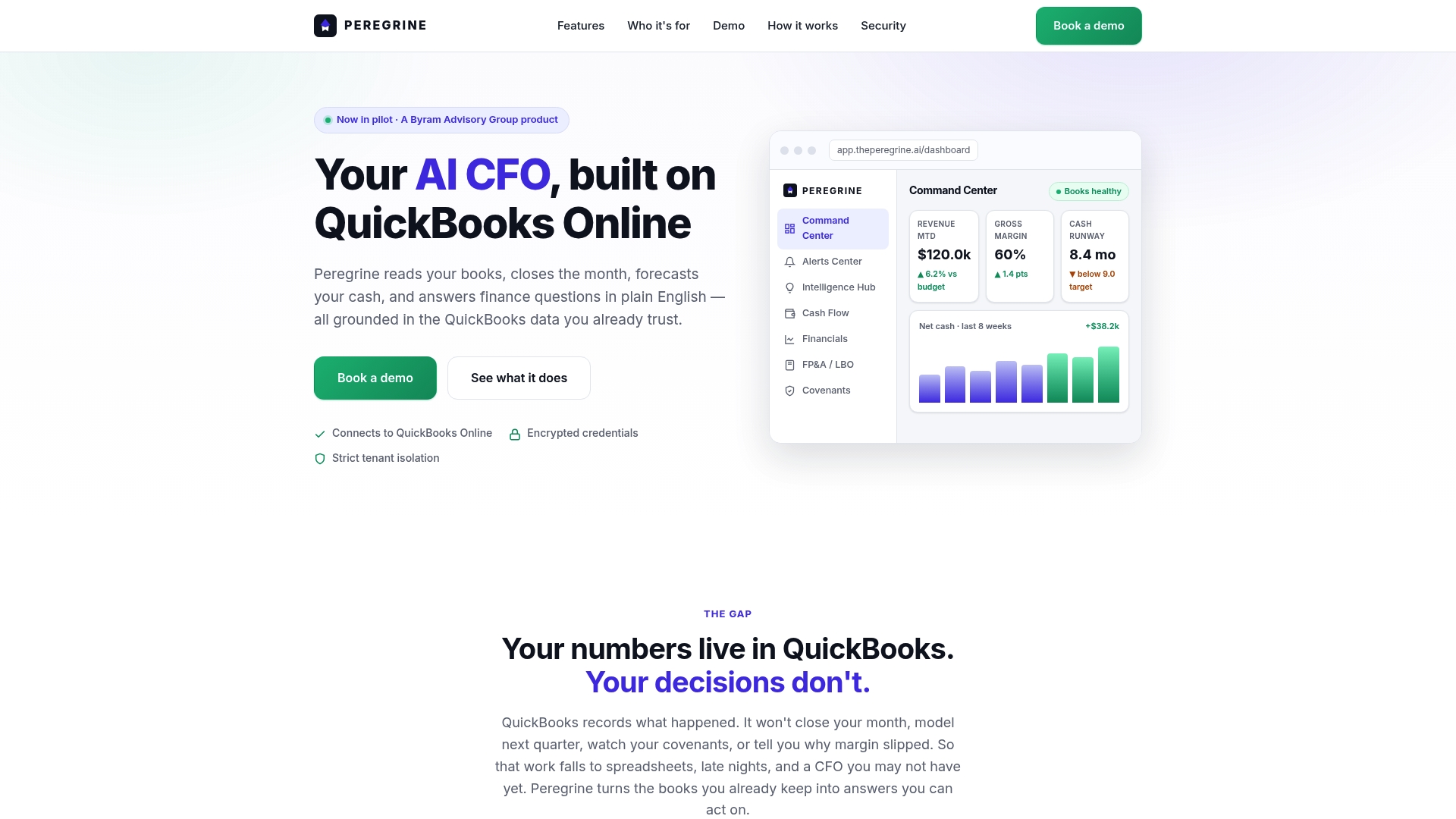
Peregrine delivers the financial command center that most fractional CFOs spend their first months building manually. You get instant visibility into revenue, cash flow, and operational metrics through plain-English queries, without waiting weeks for a CFO to onboard. For businesses that need strategic human judgment on top of that foundation, Peregrine reduces the scope and cost of any fractional CFO engagement. See how Peregrine works or review the implementation guide to understand what setup looks like for your business.
FAQ
How much does a fractional CFO cost per month?
Most fractional CFO engagements cost $3,000 to $12,000 per month. Enterprise-level or near-full-time arrangements exceed $20,000 monthly.
What is the fractional CFO hourly rate?
Fractional CFO hourly rates range from $175 to $450 per hour, with most experienced practitioners billing between $200 and $350 per hour.
How does fractional CFO cost compare to a full-time CFO salary?
Full-time CFO total compensation runs $350,000 to $800,000 annually. Fractional CFO costs range from $36,000 to $180,000 per year, representing a 60–85% reduction.
What is included in a fractional CFO retainer?
Entry-level retainers typically cover cash flow oversight, basic reporting, and investor updates. Growth-stage retainers add KPI dashboards, budget management, and fundraising preparation.
When is the right time to hire a fractional CFO?
The right time is before a fundraising round, M&A process, or rapid growth phase, not after financial complexity creates a crisis that requires emergency intervention.