
Bookkeeping will not be replaced by AI, but the profession is being fundamentally restructured by it. The Bureau of Labor Statistics projects a 6% decline in bookkeeping jobs by 2034, representing roughly 96,400 fewer positions. That decline reflects automation absorbing routine tasks, not AI eliminating the need for financial judgment. A separate survey found that 31% of accounting and finance leaders have already replaced entry-level roles with AI. The question for business owners and finance professionals is not whether AI will arrive. It already has. The real question is how to position for what comes next.
What tasks does AI currently automate in bookkeeping?
AI handles the high-volume, rule-based work that once consumed most of a bookkeeper's day. Transaction coding, bank reconciliation, and invoice processing are the clearest examples. Real-world accounting deployments show that AI reduces these processing times by 65–78%, with bank reconciliation time dropping 72% and invoice processing dropping 78%. That is not a marginal improvement. It is a structural shift in how financial data moves through a business.
The efficiency gains are real, but they come with a ceiling. AI performs well on transactions it has seen before. When a business encounters a new vendor category, an unusual expense structure, or a multi-entity allocation question, AI miscodes transactions and error rates rise. These are not edge cases. They are the normal complexity of running a business.

| Task | AI Performance | Human Role |
|---|---|---|
| Bank reconciliation | High accuracy, 72% faster | Review exceptions and flag anomalies |
| Invoice processing | 78% time reduction | Approve non-standard invoices |
| Transaction coding | Consistent on known categories | Correct miscoding on new or complex items |
| Compliance review | Flags potential issues | Final accountability and sign-off |
| Client advisory | Not applicable | Interpretation, context, and trust |
Human review is not optional in this model. It is the quality control layer that keeps AI output usable. Platforms like Peregrine build anomaly detection directly into their workflow, so exceptions surface automatically rather than hiding inside a clean-looking report.
Pro Tip: Audit your AI-coded transactions monthly for the first six months of any new deployment. New vendor types and seasonal expenses are where miscoding concentrates.
How is AI changing the bookkeeping profession?
The bookkeeping profession is shifting from data entry to data oversight. Job postings requiring AI skills in accounting rose 67% between 2025 and 2026, moving from 18% to 30% of all professional listings. That number tells you where hiring managers are placing their bets. The bookkeeper who can supervise AI outputs, catch errors, and translate financial data into plain language is more valuable than the one who can enter transactions quickly.
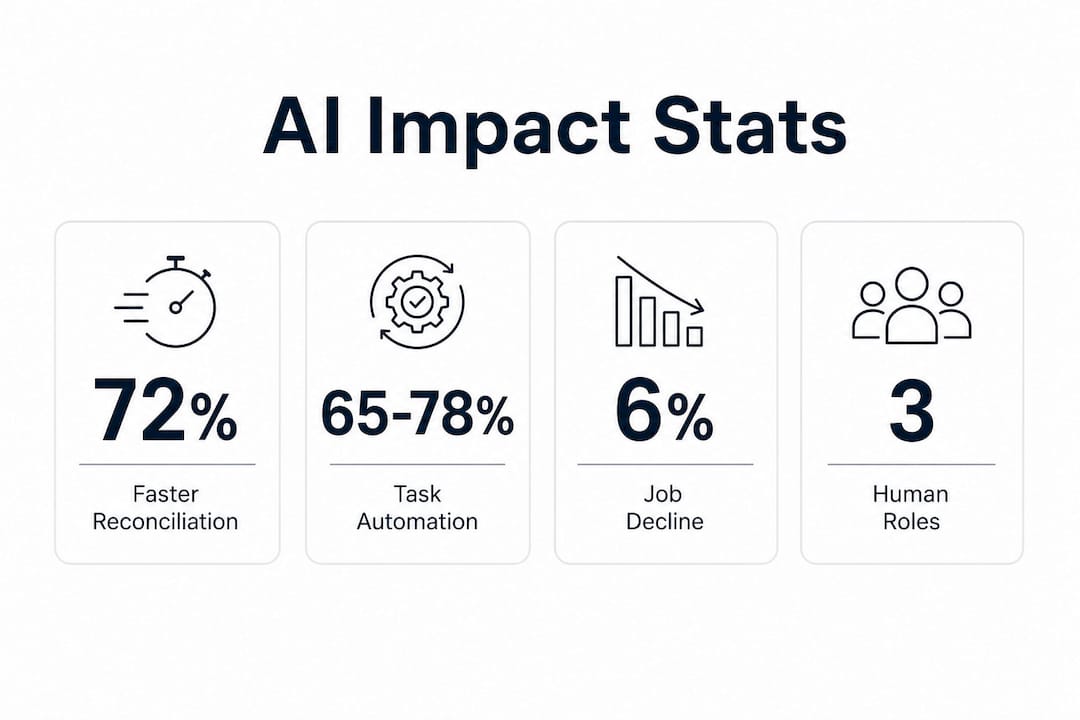
The Rise2040 initiative, a forward-looking framework from CPA Practice Advisor, describes the emerging model clearly. Financial professionals act as "AI supervisors" rather than data entry clerks. That means auditing AI outputs, catching classification errors, and translating numbers into decisions a business owner can act on. The role requires judgment, not just speed.
Three capabilities now define the high-value bookkeeper:
- AI output auditing. Reviewing coded transactions, reconciled accounts, and generated reports for accuracy before they inform business decisions.
- Financial storytelling. Translating month-end numbers into a narrative a non-financial business owner can understand and use.
- Client advisory. Identifying cash flow risks, flagging unusual patterns, and recommending corrective action before problems compound.
Clients value communication, interpretation, and trust in ways AI cannot replicate. A business owner facing a cash shortfall does not want a dashboard. They want someone who understands their situation and can explain what to do. That is a human skill, and it is becoming the core product of modern bookkeeping.
Pro Tip: Add a one-page financial summary to every monthly close. Write it in plain English. That single habit positions you as an advisor, not a data processor.
What are the risks of relying solely on AI for bookkeeping?
Full AI automation without human oversight creates three distinct risks: compounding errors, audit exposure, and legal liability. Each one is serious on its own. Together, they make AI-only bookkeeping a poor choice for any business that cares about accurate reporting.
AI errors accumulate over time without human review, particularly when tax rules change or a business adds new transaction types. A miscoded expense in january becomes a pattern by june. By year-end, the financial statements reflect a version of the business that does not match reality.
The audit risk is direct. Fully automated bookkeeping increases audit risk because AI errors produce statistical anomalies that tax authorities flag. A cluster of miscoded transactions in a single category looks suspicious even when the intent was innocent. The IRS and state tax agencies use pattern recognition too, and their models are built to catch exactly the kind of systematic errors AI produces.
Legal liability for accurate financial reporting stays with the business, not the software. No AI platform accepts responsibility for a misclassified expense or a missed deduction. The business owner signs the return. That signature carries the risk.
The practical lesson is straightforward. AI handles volume. Humans handle accountability. Any bookkeeping setup that removes the human from the final review step transfers risk to the business without transferring capability.
How should you integrate AI into your bookkeeping workflow?
Responsible AI integration starts with mapping your current workflow before changing anything. Identify which tasks are purely repetitive, which require judgment, and which involve client communication. The first category is where AI delivers the most value with the least risk.
A structured approach works better than a wholesale switch:
- Audit your current task mix. List every recurring bookkeeping task and estimate the time spent on each. Transactions that follow a consistent pattern are strong automation candidates.
- Pilot AI on low-risk categories first. Start with bank reconciliation or standard vendor invoices. Measure accuracy against your manual baseline before expanding.
- Build a human review checkpoint. Every AI output should pass through a review step before it enters your financial records. This is not redundancy. It is quality control.
- Track capacity gains, not just cost savings. AI-enabled bookkeeping can save $10,000–$25,000 per full-time bookkeeper annually or increase client capacity by 30–50%. The smarter economics often come from serving more clients, not cutting staff.
- Invest in AI fluency training. The future bookkeeping role involves supervising AI and auditing outputs. That requires understanding how AI makes decisions, not just how to click through a dashboard.
Peregrine integrates directly with QuickBooks Online and automates month-end closing and cash flow forecasting while keeping human review central to the process. Business owners get CFO-grade visibility without losing the accountability layer that accurate reporting requires. For teams evaluating where to start, the month-end close automation guide covers the specific workflow changes involved.
Pro Tip: Use your first three months of AI-assisted bookkeeping to build a "known exceptions" log. Document every transaction the AI miscoded and why. That log becomes your training data for improving accuracy over time.
Key Takeaways
AI automates bookkeeping tasks with measurable speed gains, but human judgment, compliance accountability, and client advisory remain irreplaceable parts of the profession.
| Point | Details |
|---|---|
| AI automates routine tasks | Bank reconciliation and invoice processing are 65–78% faster with AI in real deployments. |
| Jobs are shifting, not disappearing | The profession is moving toward AI oversight, financial storytelling, and advisory work. |
| Human review prevents compounding errors | AI miscoding accumulates without expert checkpoints, raising audit and liability risk. |
| Capacity gains beat headcount cuts | AI often delivers more value by expanding client capacity than by reducing staff. |
| AI fluency is now a hiring requirement | Accounting job postings requiring AI skills rose 67% between 2025 and 2026. |
The real shift nobody talks about
The conversation about AI and bookkeeping gets framed as replacement versus survival. That framing misses the actual opportunity. The bookkeepers and finance professionals who are thriving right now are not the ones who resisted AI or the ones who handed everything to it. They are the ones who got specific about what AI does well and built their practice around everything it cannot do.
I have watched finance teams spend months debating whether to adopt AI tools, while their competitors quietly doubled their client load using the same technology. The delay is almost never about the tool. It is about identity. Bookkeepers who define themselves by the tasks they perform feel threatened. Bookkeepers who define themselves by the outcomes they deliver for clients see AI as a capacity multiplier.
Clients increasingly demand clarity, trust, and empathetic guidance that AI cannot provide. That demand is not going away. If anything, as AI handles more of the mechanical work, the human layer becomes more visible and more valued. The business owner who gets a clean dashboard but no explanation will eventually want someone to help them understand what it means.
The professionals who will lead this next phase are the ones who treat AI oversight as a skill worth developing, not a threat worth avoiding. That means learning how AI makes decisions, building review processes that catch errors before they compound, and shifting client conversations from "here are your numbers" to "here is what your numbers mean for your next decision." That shift is available to every bookkeeper and finance professional right now. The question is whether you take it.
— Owen
Peregrine: AI-powered financial visibility with human accountability
Business owners who want the efficiency of AI without losing control of their financial accuracy have a clear path forward with Peregrine.
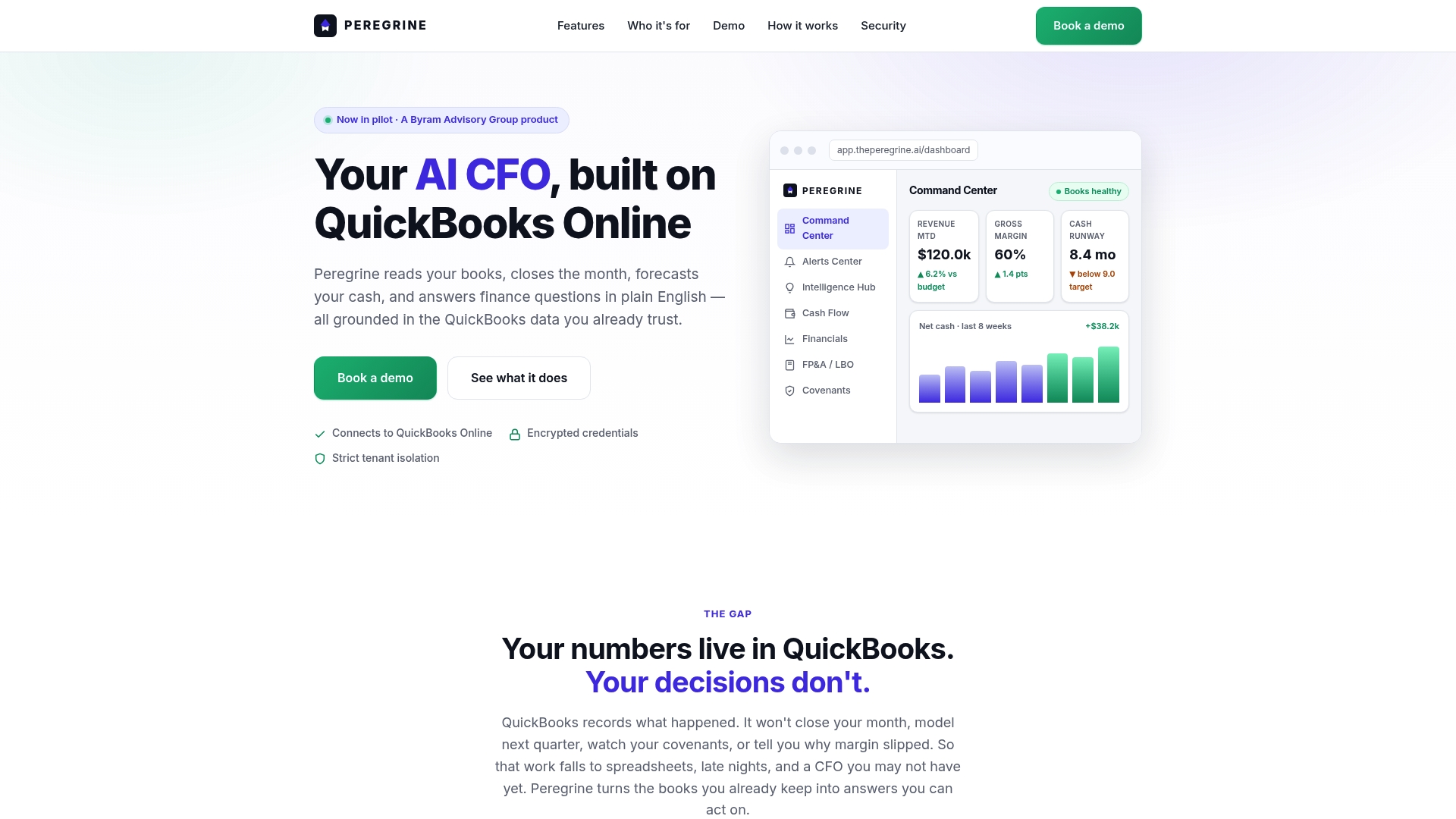
Peregrine connects directly with QuickBooks Online and automates month-end closing, cash flow forecasting, and anomaly detection. It gives finance teams CFO-grade visibility without requiring a full-time CFO hire. Every insight surfaces in plain English, so business owners can act on their numbers rather than just read them. Human review stays central to the process, which means accuracy and accountability stay intact. Explore Peregrine's AI CFO platform or walk through the implementation guide to see how AI-assisted bookkeeping fits your current workflow.
FAQ
Will bookkeeping be replaced by AI entirely?
Bookkeeping will not be fully replaced by AI. The Bureau of Labor Statistics projects a 6% job decline by 2034, reflecting automation of routine tasks, not elimination of the profession.
What bookkeeping tasks can AI handle reliably?
AI handles bank reconciliation, transaction coding, and invoice processing with high accuracy on routine, repeating transactions. Complex or non-standard transactions still require human review to prevent miscoding.
Is bookkeeping going to be replaced by AI for entry-level roles?
Entry-level roles focused on manual data entry are already shrinking. Thirty-one percent of accounting and finance leaders have replaced those roles with AI, shifting demand toward oversight and advisory skills.
How does AI affect bookkeeping accuracy?
AI improves speed significantly but introduces compounding errors on new or unusual transactions without human checkpoints. Ongoing expert review is required to maintain accurate financial records.
What skills do bookkeepers need in the AI era?
Bookkeepers now need AI output auditing, financial interpretation, and client advisory skills. Job postings requiring AI fluency in accounting rose 67% between 2025 and 2026, making these skills a baseline hiring requirement.