
How accounting and FP&A actually differ — and why both matter
Accounting and FP&A are not rivals. They are two halves of a complete financial picture, and confusing one for the other is one of the most common mistakes finance leaders make when building their teams.
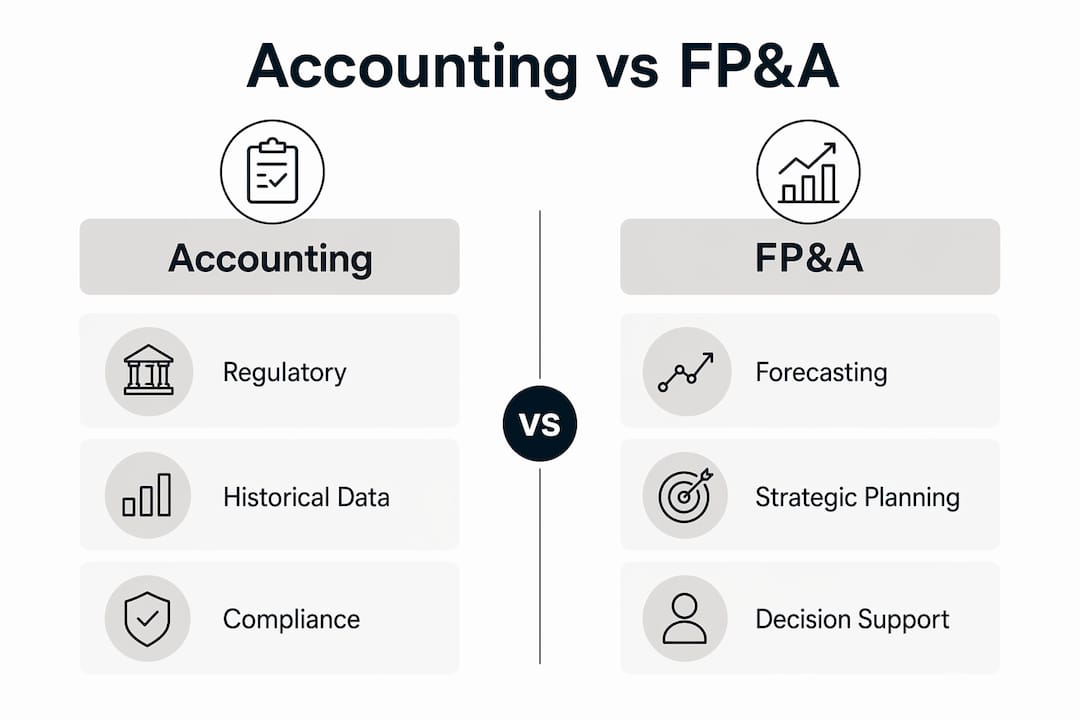
Accounting focuses on documenting transactions and ensuring compliance, while FP&A focuses on forecasting and strategic planning. Put simply: accounting tells you what happened, FP&A tells you what to do about it next.
Here is the clearest side-by-side breakdown:
- Time horizon: Accounting is backward-looking (historical records, closed books); FP&A is forward-looking (budgets, rolling forecasts, scenario models)
- Primary purpose: Accounting ensures compliance and accuracy; FP&A drives strategy and capital allocation
- Core outputs: Accounting produces financial statements, audit schedules, and regulatory filings; FP&A produces variance reports, forecasts, and board presentations
- Tools: Accounting runs on ERP systems and general ledgers (think QuickBooks, NetSuite); FP&A pulls that data into modeling platforms and interactive dashboards
- Skill set: Accounting demands GAAP/IFRS mastery, journal entry precision, and a compliance-oriented mindset; FP&A requires driver-based modeling, hypothesis-driven analysis, and the ability to tell a financial story to non-finance executives
- Stakeholders: Accountants primarily serve investors, regulators, and creditors; FP&A professionals partner with the CFO, department heads, and the executive team
Regulatory compliance sits squarely in accounting's domain. GAAP standards, audit trails, and statutory filings are non-negotiable. FP&A complements that by using the compliant data accounting produces to build forecasts that reflect real constraints, like covenant thresholds or revenue recognition timing.
As the AFP frames it, accounting's goal is to create the book of record; FP&A's goal is to apply finance acumen to support decisions and drive business performance.
Table of Contents
- Why accounting and FP&A teams so often clash
- How AI integration closes the gap between accounting and FP&A
- What Peregrine does differently for accounting and FP&A teams
- Why manual spreadsheets are a liability for growing businesses
- AI integration in practice: what it looks like in real finance operations
- How data actually flows between accounting and FP&A
- Where accounting and FP&A roles are headed as AI advances
- Peregrine gives your finance team CFO-grade visibility from day one
- Key Takeaways
Why accounting and FP&A teams so often clash
The tension between these two functions is almost structural. Accounting closes the books on a fixed schedule with precision as the priority. FP&A needs that data fast, in a format built for modeling, not compliance. Those two requirements frequently collide.
Traditional workflows involve manual data requests and slow reconciliation, creating productivity losses and inaccurate forecasts. An FP&A analyst waiting three days after month-end close to get usable actuals is not an edge case — it is the norm at most mid-market companies.
The cultural gap compounds the operational one. Finance industry consensus in 2026 highlights differing skill sets and mindsets as a core source of organizational silos: accounting managers prioritize precision and regulatory compliance, while FP&A managers prioritize data-driven storytelling and commercial insight. Neither is wrong. They just speak different dialects of finance.
Common pain points that result:
- FP&A teams building forecasts on data that accounting has not yet reconciled
- Accounting teams fielding constant ad hoc data pulls that interrupt close workflows
- Duplicate spreadsheets with conflicting figures circulating across both teams
- Blame cycles when actuals miss forecast, with each team pointing at the other's data quality
- No shared KPI definitions, so "revenue" means something slightly different depending on who you ask
How AI integration closes the gap between accounting and FP&A
When accounting and FP&A functions align with shared KPIs and collaborative workflows, organizations gain real-time insights that enable fast and trustworthy decisions. AI-driven platforms make that alignment practical rather than aspirational.

The most direct benefit is eliminating manual data cleanup. When an AI platform connects directly to your general ledger and syncs actuals automatically, FP&A analysts stop spending half their week reformatting accounting exports. Using AI-powered tools, finance teams move from spreadsheet maintenance to identifying operational inefficiencies and modeling new revenue streams.
Specific organizational benefits of AI-powered integration:
- Faster month-end close: Automated reconciliation significantly reduces the duration of close cycles
- Real-time forecast updates: Rolling forecasts refresh continuously as new actuals become available
- Standardized data definitions: A unified platform ensures consistent definitions of every metric across both functions
- Anomaly detection: AI flags unusual transactions early to help maintain forecast accuracy and reduce audit risk
- Regulatory support: Automated audit trails and compliance processes support accounting efforts during close
For finance leaders evaluating platforms, the finance tech stack decision is often the single highest-leverage choice they make.
Pro Tip: When evaluating AI finance platforms, prioritize native integration with your existing general ledger — particularly QuickBooks Online — over standalone tools that require manual data exports. A direct sync eliminates the reconciliation step entirely, which is where most of the time and error risk lives.
What Peregrine does differently for accounting and FP&A teams
Peregrine is built specifically to collapse the distance between accounting data and FP&A insight. It connects directly to QuickBooks Online, pulling verified actuals into a real-time financial command center without any manual export or reformatting step.
| Feature | What it does for your team |
|---|---|
| Automated month-end close | Cuts reconciliation time and reduces close-cycle errors |
| Cash-flow forecasting | Generates rolling forecasts updated from live QuickBooks data |
| Anomaly detection | Flags unusual transactions in real time, protecting both compliance and forecast accuracy |
| Plain-English financial queries | Finance leaders ask questions in natural language; Peregrine surfaces the answer instantly |
| Covenant and debt tracking | Monitors compliance thresholds automatically, reducing audit preparation burden |
| Board pack generation | Produces presentation-ready reports without manual formatting |
| Multi-client role-based access | Fractional CFOs and accounting firms manage multiple entities from one dashboard |
Peregrine automates month-end close and generates real-time dashboards, improving accuracy and efficiency for business owners and finance teams who need CFO-grade visibility without the overhead of a full-time CFO hire.
For a fractional CFO managing a portfolio of clients, Peregrine's multi-entity access means switching between companies without re-exporting data or rebuilding models. For an in-house finance leader, the plain-English query feature means getting an answer to "what is our runway at current burn?" in seconds rather than building a spreadsheet to find out.
Outcomes Peregrine enables:
- Finance teams can focus more on analysis rather than manual data preparation
- Business owners can view revenue, cash flow, and operational metrics consolidated in one platform
- Accounting and FP&A functions benefit from a shared, reliable source of financial data
- Compliance monitoring is enhanced through timely and ongoing oversight rather than limited to periodic checks
Why manual spreadsheets are a liability for growing businesses
Spreadsheets are not neutral. At a certain scale, they actively create risk. Growing businesses face risks from spreadsheet inconsistencies, while AI-powered platforms maintain continuous data visibility supporting proactive financial management.
The failure modes are predictable:
- Version control errors: Analysts working from differing spreadsheet versions can produce conflicting numbers for a board meeting
- Formula drift: Errors in spreadsheet formulas may go unnoticed until late in the reporting process
- Slow reporting: Manual data transfers from accounting can delay FP&A deliverables
- Audit exposure: Spreadsheet records often lack comprehensive audit trails expected by regulators and lenders
- Forecast lag: Forecast updates based on manual data loads can result in outdated insights
For AI bookkeeping software that addresses these risks directly, the core value proposition is continuous sync rather than periodic export. That shift alone removes most of the version control and reconciliation problems that plague spreadsheet-dependent teams.
AI integration in practice: what it looks like in real finance operations
The clearest illustration of successful AI integration is the month-end close cycle. In a traditional setup, accounting spends the first week of the month closing the prior period, then manually exports actuals to a shared drive. FP&A picks up those files, reformats them, loads them into models, and begins variance analysis — often in week two or three. By then, the insights are two to three weeks old.
With an integrated AI platform connected to QuickBooks Online, actuals flow into FP&A models continuously. The close process still happens, but the data handoff is automatic. FP&A can begin variance analysis on day one of the new month rather than day ten.
A second example: covenant monitoring. Companies carrying debt typically have financial covenants tied to metrics like leverage ratio or minimum liquidity. Tracking these manually means pulling accounting data, calculating ratios in a spreadsheet, and hoping nothing was missed. An AI platform with covenant tracking monitors these thresholds in real time and alerts the finance team before a breach, not after.
How data actually flows between accounting and FP&A
The data relationship between these two functions runs in both directions, and understanding the flow clarifies why integration matters so much.
Accounting produces the verified actuals: closed general ledger entries, reconciled balance sheet accounts, and finalized income statements. FP&A takes those actuals as inputs, compares them against budget and prior forecasts, and builds the next planning cycle on top of them. That is the downstream flow.
The upstream flow is less obvious but equally important. FP&A's variance analysis often surfaces questions that accounting needs to investigate: an unexpected expense in a cost center, a revenue recognition timing issue, or a one-time item that needs reclassification. When those two teams communicate well, the feedback loop tightens the accuracy of both the books and the forecast.
Integrated workflows between general ledger systems and planning platforms reduce manual reconciliation and accelerate month-end close. The practical implication: a shared platform is not just a convenience, it is the infrastructure that makes the feedback loop work at speed.
For teams evaluating QuickBooks integration options, the key question is whether the integration is read-only or bidirectional, and whether it updates in real time or on a scheduled sync.
Where accounting and FP&A roles are headed as AI advances
The most significant shift already underway is the automation of routine accounting tasks. Reconciliations, invoice matching, and anomaly flagging are increasingly handled by machine learning, which means accountants have more bandwidth for judgment-intensive work — reviewing exceptions, advising on accounting policy, and collaborating with FP&A on close assumptions.
On the FP&A side, AI-driven rolling forecasts that update automatically as new data flows in are replacing the quarterly reforecast cycle. The analyst who spent three days rebuilding a model after month-end close is being replaced by one who spends those three days interpreting what the model is showing and recommending action.
The roles are not disappearing. They are shifting up the value chain. The AFP's FP&A certification and CPA credentials remain relevant, but the professionals who thrive will be those who can work alongside AI tools rather than around them. For finance leaders, that means hiring for interpretation and communication skills, not just technical execution.
Peregrine gives your finance team CFO-grade visibility from day one
Most finance teams do not lack data. They lack data they can trust, in a format they can act on, without spending a week cleaning it first.
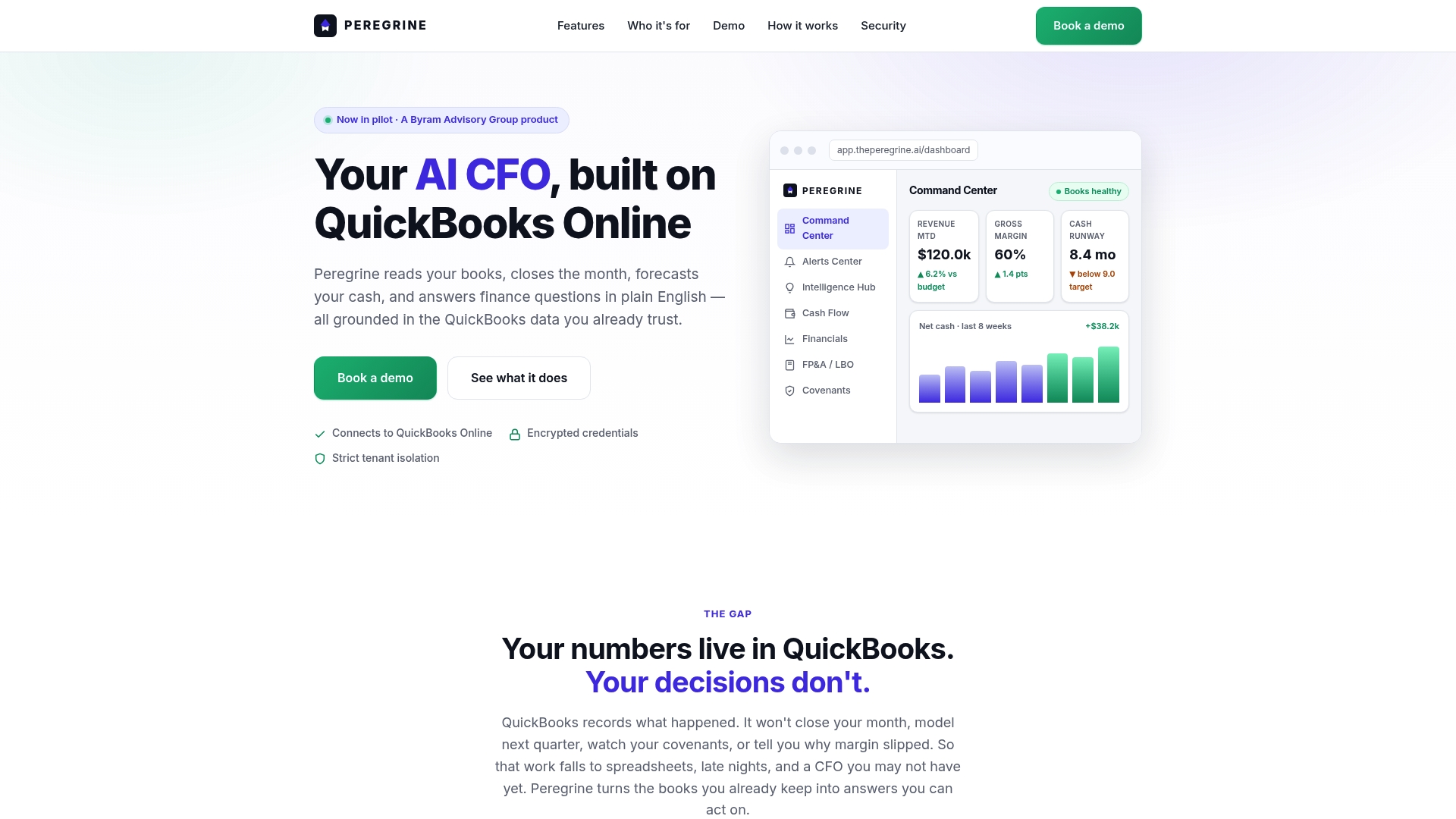
Peregrine solves that by connecting directly to QuickBooks Online and turning your existing accounting data into a real-time financial command center. Month-end close runs faster. Cash-flow forecasts update automatically. Anomalies surface before they become problems. And when a board member asks a question you did not anticipate, plain-English queries get you the answer in seconds rather than hours.
For fractional CFOs managing multiple clients, the multi-entity dashboard means one login, full visibility across every portfolio company. For business owners who want CFO-grade insight without the CFO salary, Peregrine delivers exactly that on a per-company subscription after a 14-day free trial. Start your free trial at theperegrine.ai.
Key Takeaways
Integrating accounting and FP&A through an AI-driven platform like Peregrine is the most direct path from manual data cleanup to real-time strategic decision-making.
| Point | Details |
|---|---|
| Accounting vs FP&A core split | Accounting records verified historical data; FP&A uses that data to forecast and guide strategy. |
| Silos are structural, not personal | Disconnected tools and different data formats create delays and inaccurate forecasts between teams. |
| AI integration removes the bottleneck | Automated data sync eliminates manual exports, cutting close cycles and improving forecast accuracy. |
| Spreadsheets create compounding risk | Version errors, formula drift, and audit exposure grow faster than manual processes can manage. |
| Peregrine unifies both functions | Peregrine connects to QuickBooks Online to deliver real-time dashboards, anomaly detection, and automated close for accounting and FP&A teams. |