
Finding financial modeling software that delivers live forecasts and consolidated KPIs is harder than it should be when options differ on automation and integration. Most older tools require manual uploads, lack QuickBooks connections, or do not refresh dashboards with live accounting data. This comparison covers pricing, integrations, automation, and dashboard options so finance teams and CFOs can choose a platform that matches their workflow.
Table of Contents
Peregrine
At a Glance
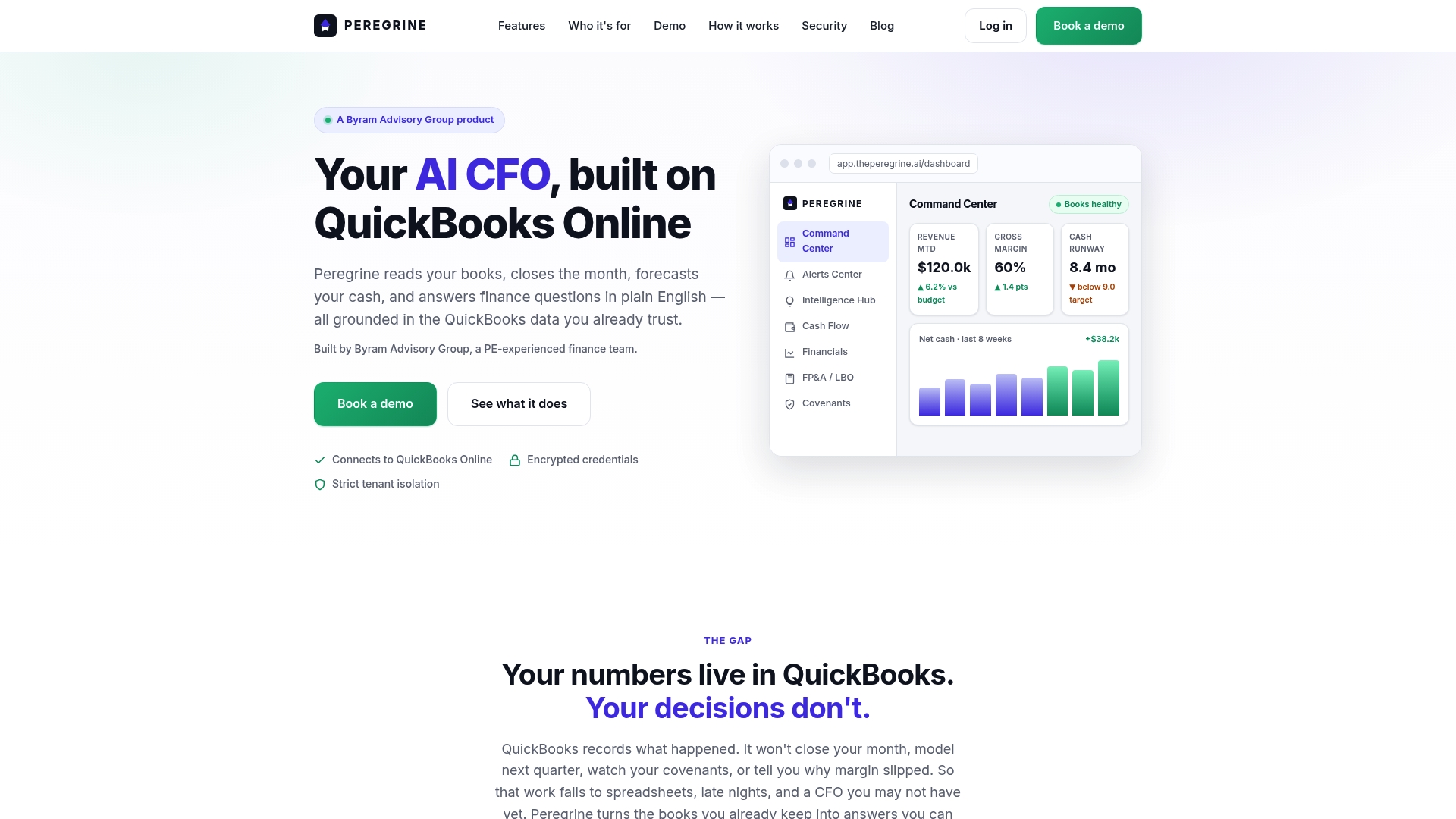
Connects directly to QuickBooks Online and displays a live dashboard of revenue, margin, cash, and runway with alerting. The platform automates month end close tasks, cash flow forecasting, and reporting while flagging anomalies during close. Data access uses encryption, tenant isolation, and human oversight for accuracy and security.
Core Features
Peregrine groups bookkeeping source data into a live dashboard that tracks revenue, margin, cash, and runway and pushes alerts when figures deviate. It runs an AI powered month end close checklist with anomaly detection and offers 13 week cash flow forecasting with editable assumptions. The system also includes financial planning tools such as budgets and LBO models, covenant and debt tracking with early warning alerts, and a plain English Q A named Ask Peregrine that shows the source numbers behind answers.
Key Differentiator
Deep QuickBooks integration plus a library of specialized finance agent tools sets Peregrine apart from simple chat overlays. The agent toolkit maps to finance workflows such as close, covenant monitoring, and scenario forecasting rather than acting as a generic assistant. That connection to QuickBooks keeps outputs grounded in source accounting data and lets teams standardize multi entity reporting and visibility.
Pros
The QuickBooks connection enables automated, near real time insights that come from existing accounting records rather than rebuilt copies. Built by a finance advisory firm, the platform supplies pre tuned agent tools for month end, forecasting, covenant tracking, and reporting that reduce repetitive work. Peregrine also supports portfolio and multi entity setups, so accounting practices and CFOs can maintain consistent metrics across clients or subsidiaries.
Cons
- Complex implementation and setup time, which may be time consuming for smaller teams.
Who It's For
Finance teams, CFOs, and advisory firms that run multiple entities in QuickBooks Online and need consistent, fast reporting. Teams that want CFO grade visibility without hiring a full time CFO will gain the most. Smaller businesses without dedicated finance resources may find the setup effort challenging.
Unique Value Proposition
The plain English Ask Peregrine Q A that returns source numbers lets non technical stakeholders get fast, auditable answers. That feature shortens the time you spend tracing variances and lets business leaders get CFO level context from live accounting data. For an advisory firm, this reduces back and forth with clients and speeds board pack preparation without rebuilding spreadsheets.
Real World Use Case
A mid sized company CFO uses Peregrine to cut the close calendar by automating reconciliations, flagging anomalies, and producing board friendly reports the morning after month end. The same setup runs 13 week forecasting from live ledger balances and alerts the finance team when covenant ratios move toward thresholds.
Pricing
Pricing is not publicly specified. The model appears to be enterprise or subscription oriented and tailored to finance teams and advisory firms. Prospective buyers will need to request a custom quote from sales to get exact pricing and packaging details.
Website: https://theperegrine.ai
Ornbo
At a Glance
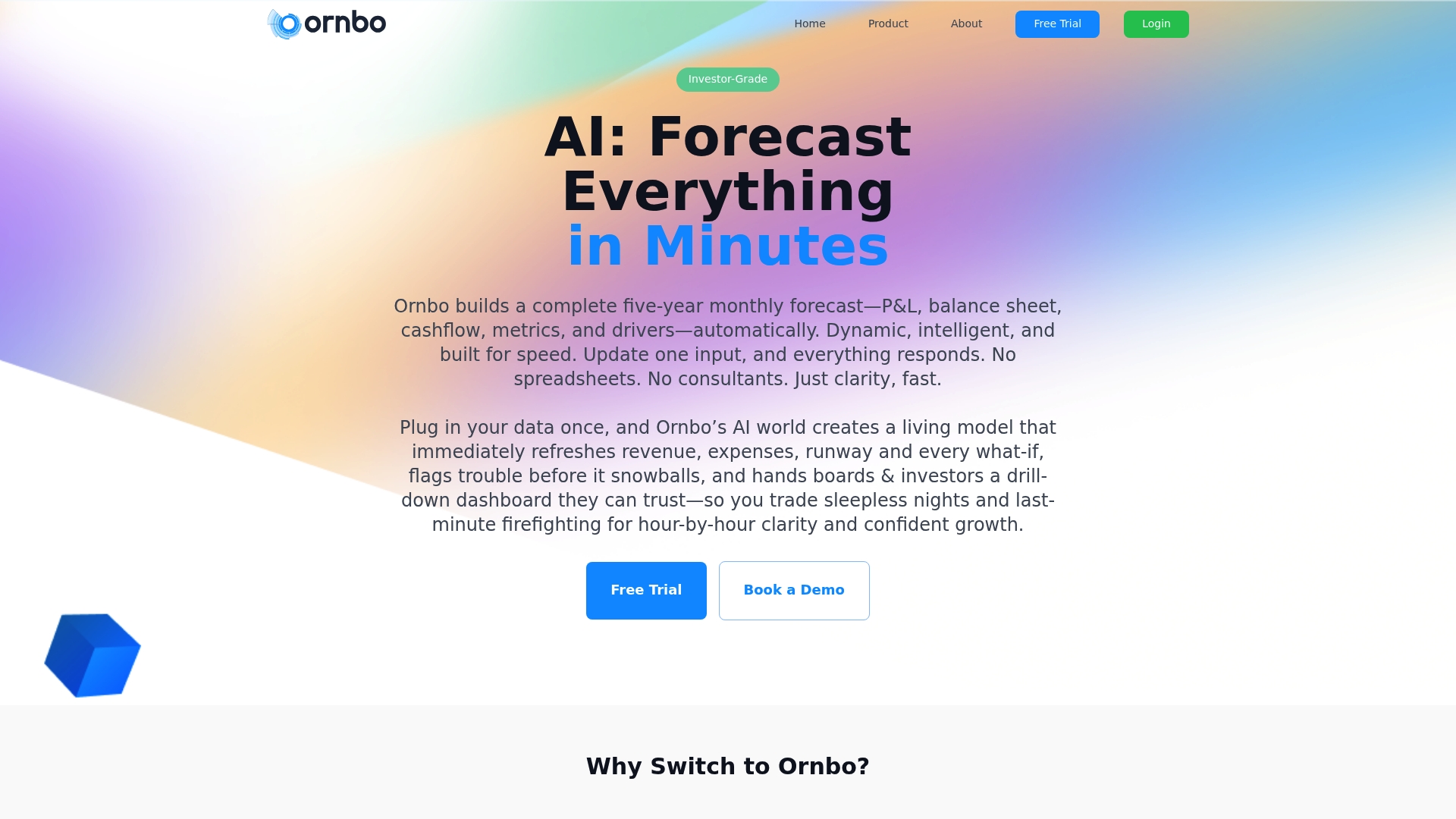
Ornbo's marketing materials state it builds a complete five-year monthly financial forecast from a blank canvas to full financial statements in minutes. The platform targets investor-grade models with live scenario adjustments and built-in industry benchmarks. It connects to accounting and payment systems so forecasts update as actuals arrive.
Core Features
The AI Model Builder generates full financial statements from a blank sheet and the Scenario Playground lets you run prompt driven scenario tests in multiple languages. Daily Real Time Variance compares actuals to plan so you can spot deviations as they occur. Collaborative sharing, consultant level benchmarks, and imports from Xero, QuickBooks, Stripe, HubSpot, SQL, and custom APIs round out the workflow.
Key Differentiator
Ornbo centers on automated, AI driven five year forecasts that combine scenario editing with industry benchmarks. That speed claim frames the product as a planning tool built to create investor ready outputs without a consultant. Live variance and benchmark overlays make the models easier for investors and lenders to review.
Pros
The vendor advertises 10+ hours per week saved in financial planning, which points to real time gains for teams that previously modeled manually. Live, audit ready models and exportable investor reports reduce back and forth with investors and advisors. Built in runway alerts and encrypted AWS hosting support a secure, collaborative forecast lifecycle.
Cons
- Limited independent review data. External validation of accuracy and experience is sparse, making peer feedback harder to find.
- Learning curve for users new to financial models or to prompt based AI tools. Some finance teams will need a setup period.
- Plan limits for very small or very large enterprises. Organizations needing highly customized reports may hit those caps.
When It May Not Fit
If your team expects plug and play outputs with no financial model knowledge, Ornbo may feel complex. Companies that require bespoke reporting templates or firm specific accounting treatments might need a consultant instead. If independent third party reviews and community references matter, this product has fewer public reviews than some legacy vendors.
Notable Integrations
Ornbo integrates with Xero, QuickBooks, Stripe, HubSpot, SQL, and custom APIs for continuous data sync. Those connections let forecasts refresh automatically as accounting and payment systems post transactions.
Who It's For
Founders, CEOs, and finance teams at startups and small to medium-sized enterprises seeking investor ready forecasts will get the most value. Finance leaders who want scenario driven conversations with investors will appreciate the live sharing and export options. Teams with basic modeling skills will adopt faster than those starting from zero.
Real World Use Case
A SaaS founder uses Ornbo to produce a five year forecast that updates when Stripe payments post and when QuickBooks entries change. The founder shares a live model link with an investor and receives runway alerts before cash becomes critical. That workflow shortens investor diligence and keeps board conversations focused on scenarios.
Pricing
Pricing is not publicly listed. Contact Ornbo for current plans and any trial options or pilot pricing.
Website: https://ornbo.com
Tangently
At a Glance
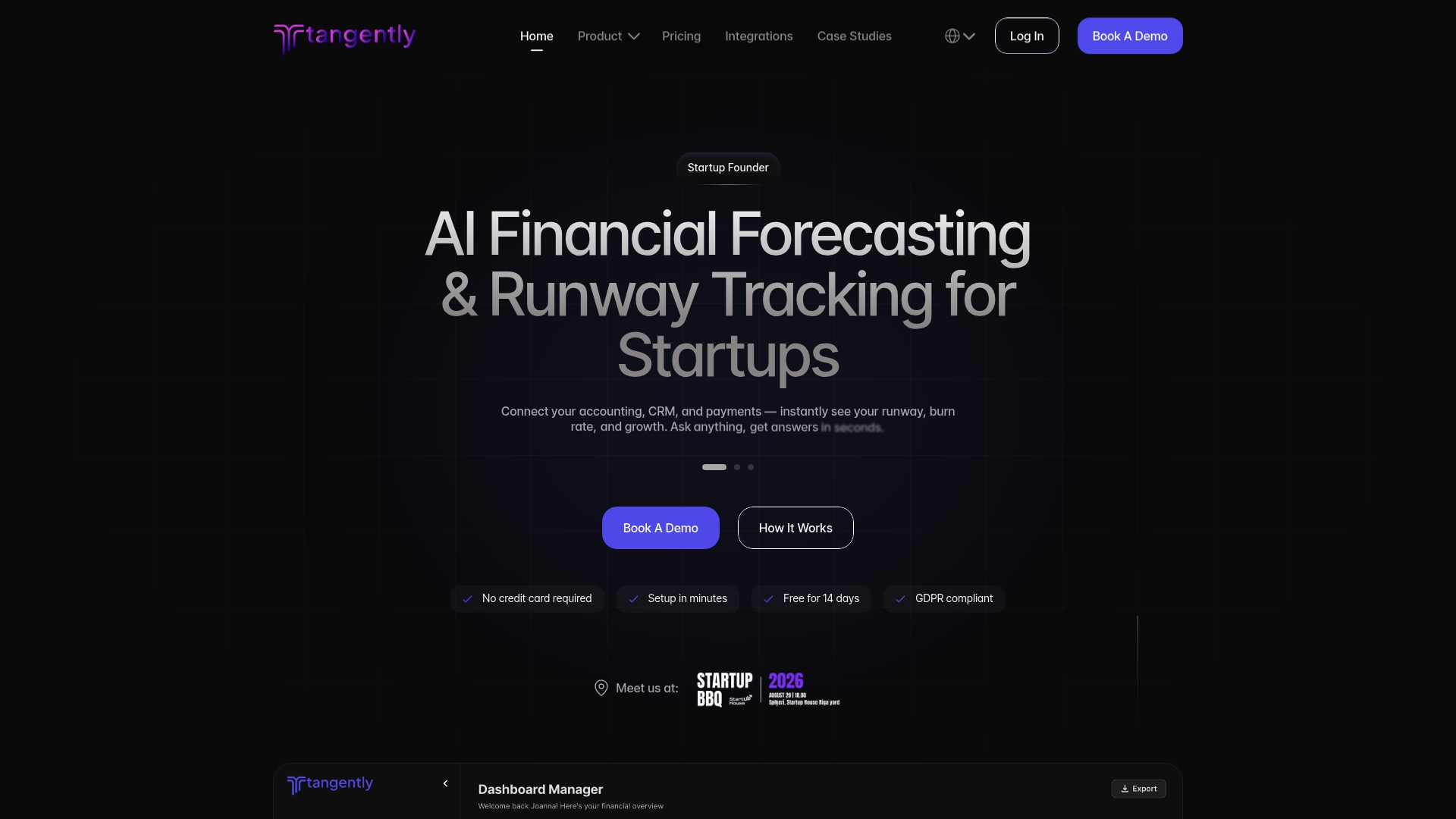
Tangently reports integrations with over 200 tools. That breadth lets startups pull accounting, CRM, and payment data into live financial statements. An AI assistant answers finance questions and runs scenario tests for runway and budgeting.
Core Features
It builds real-time three statement financial models and updates income statement, balance sheet, and cash flow automatically. The platform connects to accounting, CRM, and payment systems and offers automated reporting and dashboards. Users can ask the AI assistant questions, run scenario tests, and export investor ready reports.
Key Differentiator
Tangently focuses on startups and growth stage B2B SaaS companies. It automates three statement financial models while keeping integrations and AI driven insights central to workflows. That combination speeds forecasting for teams without full-time finance hires.
Pros
The platform reduces manual spreadsheet work by automating three statement builds and keeping reports current with live data. Nontechnical founders can link accounting, CRM, and payments without an engineer, which speeds setup and reduces integration friction. The AI assistant answers finance questions instantly and supports scenario testing that helps plan runway and budgeting. Investor report templates and exportable dashboards let teams produce presentation quality materials quickly before fundraising or board meetings.
Cons
- Privacy concerns: some user reviews call out gaps in the privacy policy and handling of sensitive data.
- Security liability: reviewers warn that a data breach could expose companies to liability if controls are weak.
- Limited compliance detail: public materials offer little technical information on security protocols and certifications.
When It May Not Fit
Not intended for large enterprises with complex consolidation or bespoke accounting needs. Companies in highly regulated industries should be cautious because public documentation includes limited compliance detail. Buyers seeking detailed security protocols will find little technical information in public materials.
Notable Integrations
Connects with these tools:
- Exact Online
- HubSpot
- Stripe
- Procountor
- Netvisor
- Visma eAccounting
- Shopify
- Pipedrive
Who It's For
Founders, operators, and finance teams at early to growth stage B2B SaaS companies will get the most value. Teams without a large finance headcount who need live runway, burn rate, and investor ready reports benefit especially. Companies that require documented compliance and enterprise grade controls should evaluate further.
Real World Use Case
A SaaS startup links accounting, CRM, and payments to Tangently, then the CEO asks the AI assistant for current runway and burn rate. The team uses the same data to generate investor ready reports for a seed funding round.
Pricing
Starting from €99/month for startups, with higher tiers for scaling and enterprise needs. Paid plans include unlimited integrations and options for dedicated support.
Website: https://tangently.ai
Parallel
At a Glance
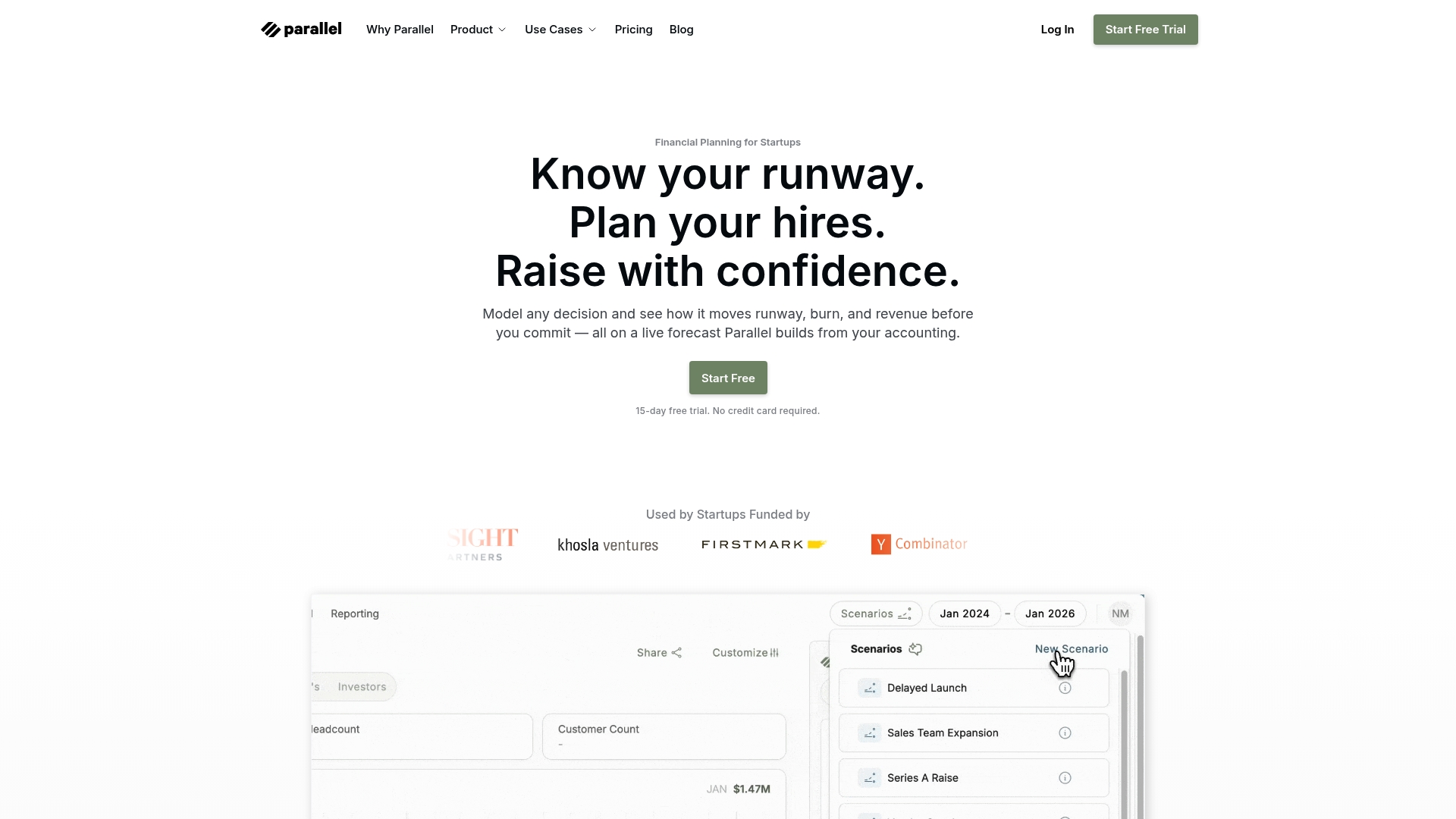
Connects accounting data from QuickBooks Online and Puzzle to automatically build live three statement financial models. The live link keeps forecasts and dashboards current as accounting entries change. Parallel also offers side by side scenario comparison for hiring, runway, and fundraising choices.
Core Features
Parallel links directly to accounting systems and generates complete profit and loss, balance sheet, and cash flow statements. It supports headcount planning with fully loaded cost assumptions and rule based triggers while offering side by side scenario modeling. Real time dashboards deliver key SaaS metrics and reporting exports tailored for fundraising and board reviews.
Key Differentiator
Parallel's defining feature is the automated live connection to core accounting data paired with easy scenario comparison. That live connection reduces the need to copy ledgers into spreadsheets for each forecast. The approach targets founders and early stage finance teams who need fast, data backed scenario answers.
Pros
Support is responsive and professional, which helps when accounting links or setup require attention. Automation removes many manual data entry steps and reduces reconciliation errors between accounting and forecasts. Scenario analysis is versatile and straightforward, so you can compare hiring and fundraising options side by side. Integrations with common accounting tools keep actuals and forecasts aligned without repeated exports.
Cons
- Automated account restrictions tied to fraud detection can trigger frequent frustrations for users.
- Account suspensions sometimes occur with unclear reasons and interrupt access to models and reports.
- Initial setup can hit false positives or delays because automation flags certain accounts.
- Support can resolve issues, but responses may require persistence from users.
When It May Not Fit
If your company cannot tolerate interruptions during critical reporting windows, Parallel may cause risk because of its automated account restrictions. Teams that need guaranteed uninterrupted access to historical ledgers may find the suspension behavior unacceptable. Larger finance organizations that require bespoke integration controls might need a solution with more manual account management.
Notable Integrations
Parallel integrates with QuickBooks Online and Puzzle for live accounting sync. Those integrations are the primary routes for bringing actuals into forecasts and dashboards.
Who It's For
Founders and early stage SaaS teams seeking CFO level financial clarity without hiring a full time finance leader will get the most from Parallel. It fits companies that want automated actuals, scenario modeling, and investor ready exports. Teams that accept some automation risk during setup will gain the fastest benefit.
Real World Use Case
A founder connects QuickBooks, models multiple hiring and fundraising paths, and compares outcomes side by side. They export investor ready reports and use dashboards during investor meetings. The live connection shortens the prep time for each update.
Pricing
Pricing is not publicly listed and is reported as informational only. Contact Parallel for current plans, demo access, or an informational walkthrough to get exact pricing and onboarding details.
Website: https://getparallel.com
Modano
At a Glance
Modano reports a reduction in modeling and month end time of up to 90%. The platform targets finance teams and advisors who need repeatable, model-driven forecasts. It combines content libraries and expert support to keep complex forecasts current.
Core Features
Modano uses a modular content management system to assemble models from reusable building blocks and industry modules. It supports automated model roll forward and updates, and delivers driver based forecasting with custom formulas. The platform also includes scenario analysis, portfolio consolidation, and tools for detailed budgeting and planning.
Key Differentiator
Modano’s core distinction is a modular, driver based approach that pairs automation with hands-on finance support. That setup reduces repetitive rebuild work and lets teams reuse validated model components. The vendor advertises expert support to help adapt modules to a business or portfolio.
Pros
The product automates repetitive model maintenance and month end tasks, which lowers manual effort and error risk. That reduction reported above gives finance teams more time for analysis rather than spreadsheet housekeeping. Modano also connects directly to major cloud accounting systems to provide near real time data flow, and its modular library shortens setup time for common industries.
Cons
- Pricing may be prohibitive for very small startups or solo practitioners.
- The learning curve can be steep for people unfamiliar with advanced financial modeling techniques.
- Heavy reliance on integrations means connection problems with accounting software could temporarily limit functionality.
When It May Not Fit
Modano may not suit businesses that still run on desktop accounting or paper processes. Companies without cloud based accounting will not get the full benefit of automated updates. Teams that lack modeling experience may prefer a simpler tool while they build internal capability.
Notable Integrations
- Xero
- QuickBooks
- Sage
- Oracle Netsuite
- Microsoft Dynamics
- MYOB
Who It's For
Finance teams, business owners, and advisors who need scalable, repeatable financial models will find Modano relevant. It fits groups that want to move from manual spreadsheets to structured modules. Private equity and investment teams that consolidate portfolios will benefit most.
Real World Use Case
A private equity firm uses Modano to consolidate portfolio company forecasts and run scenario analysis. The firm reduces manual data entry and shortens cycle time for monthly reporting. That change improves review cadence and decision quality.
Pricing
Modano uses subscription pricing with options for pay per model and plans tailored to business and team size. Exact tier names and list prices are not publicly listed on the site.
Website: https://modano.com
Datatrixs
At a Glance
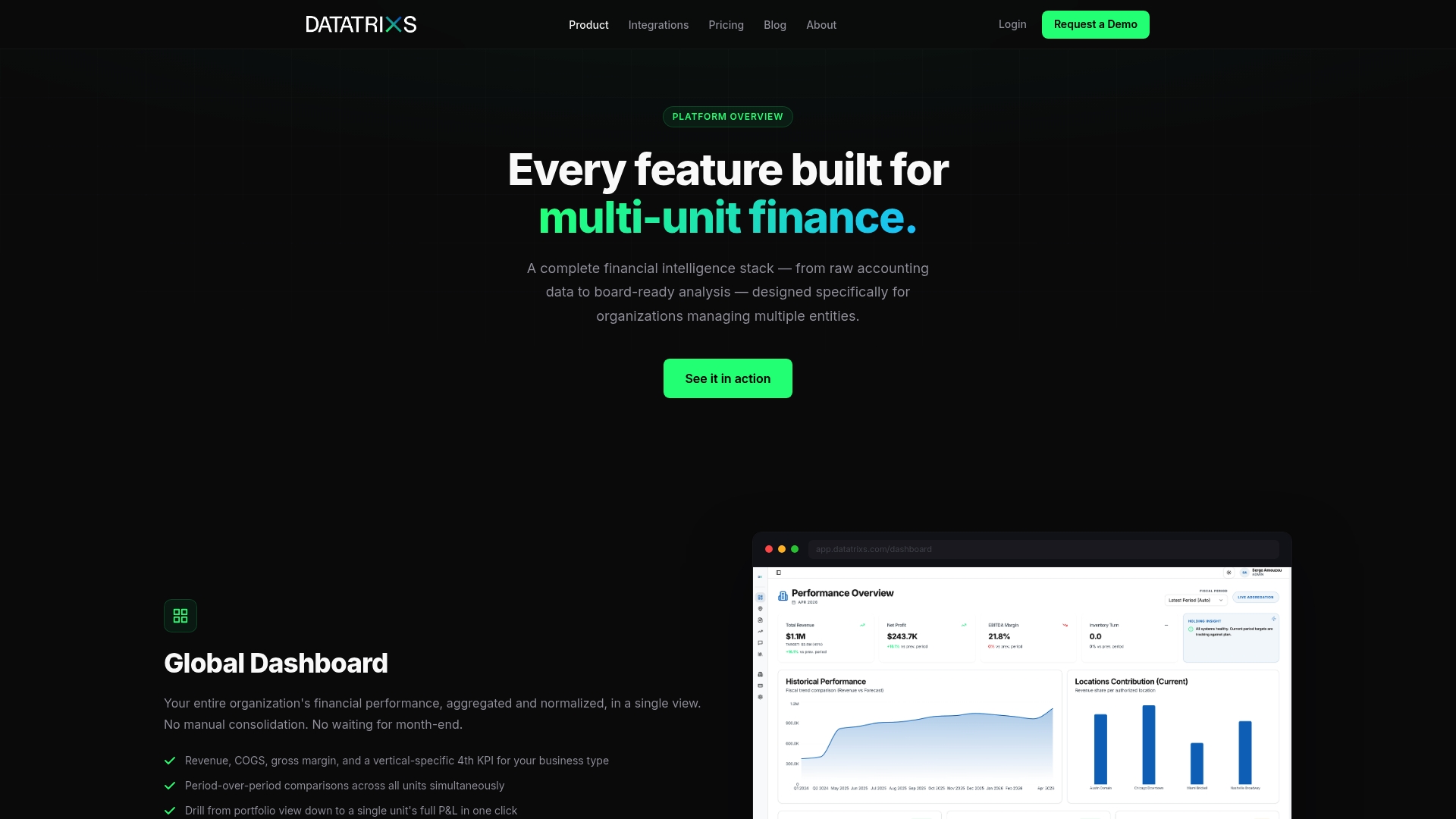
Datatrixs ships an AI financial analyst named Warren that answers complex financial questions in plain English against live connected data and visualizations. The platform normalizes ledgers across multiple entities so finance teams see consolidated KPIs without manual consolidation. That live query capability makes it practical for CFOs who need quick answers across a portfolio of subsidiaries.
Core Features
Datatrixs delivers a Global Dashboard that surfaces organization wide KPIs alongside role based dashboards for finance, operations, and executives. It supports multi unit management with fast data source connection and automated normalization, plus one click formatted financial reports and structured exports. Built in FP&A includes live scenario planning with bear, base, and bull models for forecasting.
Key Differentiator
The standout is the built in AI analyst Warren, which answers plain English queries and returns charts drawn from live, normalized ledgers. That capability pairs natural language queries with real time consolidation, which targets multi entity finance teams more narrowly than single entity reporting tools. Datatrixs focuses on portfolios of subsidiaries rather than single company bookkeeping.
Pros
Datatrixs connects directly to common accounting platforms and supports CSV uploads, reducing manual file work and source errors. Its automated normalization reconciles different chart of accounts so consolidated P&L and balance sheets align quickly. The product includes role based access and scenario planning, and the vendor reports Enterprise tiers that scale to unlimited units, which helps larger groups avoid month end Excel consolidation. Built in plain English queries speed routine analysis for nontechnical stakeholders.
Cons
- Smaller finance teams with minimal integration may find the initial setup complex, especially for bespoke systems.
- Pricing is custom and based on unit count, which can be costly for very large portfolios.
- Several buyers report a learning curve when modeling multi entity structures and mapping accounts.
When It May Not Fit
Datatrixs works best for organizations already using mainstream accounting systems. Teams that rely on ad hoc spreadsheets or bespoke ledgers may face integration overhead and extra implementation time. Very small single entity companies will likely find the platform more feature rich than they need and may prefer simpler reporting tools with fixed pricing.
Notable Integrations
Datatrixs lists direct connectors to QuickBooks Online, NetSuite, Sage Intacct, plus CSV and Excel uploads. Those integrations support multi ledger consolidation and let you pull live transactional data into the dashboard and forecasts.
Who It's For
Finance teams in mid sized to large organizations that manage multiple subsidiaries, franchises, or locations will get the most value. It fits CFOs and FP&A teams that need consolidated P&L, role based KPIs, and scenario planning across units. Teams that need plain English access to live data will also find the query feature useful.
Real World Use Case
A mid market retail chain connects its QuickBooks accounts for each store and subsidiary to Datatrixs. The CFO views a real time consolidated P&L, produces audit ready reports, and runs scenario forecasts grounded in live data. Month end closes and manual Excel consolidations become far less frequent.
Pricing
Pricing is custom and based on organization scale and unit count. Datatrixs asks interested buyers to contact sales for a tailored quote that reflects portfolio size and integration scope.
Website: https://datatrixs.com/product
Comparison of alternatives
Financial modeling software must provide firms with accurate performance metrics, predictive insights, and streamlined workflows to assist in decision-making. The solutions compared here showcase a range of capabilities tailored to financial workflows, with theperegrine.ai providing unique benefits due to its deep integration with QuickBooks and real-time financial tools.
Support for complex data landscapes
Peregrine integrates with QuickBooks, enabling continuous data synchronization and presenting live dashboards for revenue and margin monitoring. Tangently excels when connecting extensive financial systems, providing support for over 200 different tools. This diversity makes Tangently an excellent choice for organizations managing diverse financial ecosystems, though it may fall short in niche financial analysis requirements fulfilled by Peregrine.
Scenario creation and benchmarking
Ornbo's platform is tailored to organizations seeking to create and adjust five-year forecasting models quickly. Leveraging built-in industry benchmarks, its AI system simplifies the modeling process, making it ideal for startups needing fast investor-grade models with minimal manual input. In contrast, Peregrine's focus on AI-powered month-end automation and anomaly detection serves CFOs aiming to shorten reporting cycles with granular accuracy.
Best fit
- Financial teams seeking unified real-time visibility across multi-entity operations will benefit from the Peregrine platform.
- Startups requiring rapid, live scenario creation for investor communications should consider Ornbo.
- Companies aiming for reusable and scalable financial models should explore Modano.
- Enterprises managing aggregated performance across various subsidiaries will appreciate Datatrixs' strong multi-unit focus.
Our pick
Peregrine emerges as the solution for teams utilizing QuickBooks Online and aiming to automate their financial workflows with minimal manual effort. Its customizable cash flow forecasting and detailed interactive Q&A tool empower teams to make informed decisions faster. However, those prioritizing highly diverse integration use cases or pre-built investor-grade forecasting models may find alternatives such as Tangently or Ornbo to suit their specific needs better.
Different software solutions offer distinct benefits for financial modeling and analysis based on their integrations, automation, and use cases.
| Product | Key Differentiator | Best For | Pricing | Notable Limitation |
|---|---|---|---|---|
| Peregrine | Deep QuickBooks integration with specialized finance tools | Finance teams using QuickBooks and multi-entity setups | Price not published | Complex implementation for smaller teams |
| Ornbo | Automated AI-driven five-year forecasts with benchmarks | Founders and finance teams needing investor-ready models | Price not published | Sparse external validation reviews |
| Tangently | Integrations with 200+ tools and AI assistant | Early-stage and growth B2B SaaS teams | Starting at €99/month | Privacy policy gaps |
| Parallel | Live accounting sync for three-statement models | Founders needing fast scenario comparisons | Price not published | Automated account restrictions causing disruptions |
| Modano | Modular driver-based forecasting with content libraries | Finance teams and advisors scaling forecasts | Price not published | Steep learning curve for advanced techniques |
| Datatrixs | AI analyst "Warren" for multi-entity consolidated KPIs | CFOs managing portfolios of subsidiaries | Price not published | Custom pricing may be costly for large portfolios |
What Financial Teams Need From Modern Financial Modeling Software
Financial teams and CFOs often face delays and errors from manual month-end tasks and disconnected accounting data. The article highlights how important live data integration and automated forecasting are for consistent, accurate financial reporting. Peregrine offers real-time insights by linking directly to QuickBooks Online, reducing manual entries and flagging anomalies early. Teams managing multiple entities can rely on Peregrine’s consolidated dashboards and plain-English Q and A to get clear, CFO-level answers quickly.
If you want faster closes, accurate cash flow forecasts, and fewer reconciliation headaches, see why finance teams put their trust in Peregrine. Visit Peregrine to learn how automation and real-time visibility can free up time for strategic decisions. Benefit from CFO-grade reporting without adding headcount and start producing board-ready financials on demand.
FAQ
What features make Peregrine ideal for finance teams?
Peregrine offers automated, near real-time insights from existing accounting records. It includes a live dashboard that tracks revenue, margin, cash, and runway, along with a month end close checklist and anomaly detection. These features allow finance teams to efficiently manage their financial operations and maintain accurate reporting across multiple entities.
How does Peregrine compare to Ornbo in financial forecasting?
Ornbo creates five-year financial forecasts rapidly by generating full statements from a blank canvas and incorporating live scenario adjustments. In contrast, Peregrine excels in delivering continuous cash flow forecasting with editable assumptions while focusing on month end close tasks and anomaly detection. Depending on your team's primary focus—rapid model building versus detailed cash flow management—either solution could fit your needs.
Can I use Peregrine to track cash flow effectively?
Yes, Peregrine provides a 13-week cash flow forecasting feature that allows users to edit assumptions as needed. This capability enhances the accuracy and relevance of financial forecasts based on live data input. Teams looking for an effective cash flow management tool will find this feature particularly beneficial.
What challenges might smaller teams face when implementing Peregrine?
Smaller teams may find the complex implementation and setup time of Peregrine to be challenging. This can create hurdles if they lack dedicated finance resources or technical expertise to navigate the installation process efficiently.
How does the pricing model of Peregrine work?
Peregrine's pricing is not publicly specified and appears to follow an enterprise or subscription model tailored to finance teams and advisory firms. Prospective buyers must request a custom quote to obtain exact pricing and packaging details that fit their organizational needs.