
A covenant forecast is a lender-defined calculation that projects whether your company will satisfy the specific financial tests written into your credit agreement, measured on the exact schedule and using the exact definitions your lender uses. It is not your management EBITDA. It is not your board deck revenue bridge. Run a lender-defined headroom calculation on your next monthly close, and you will immediately see whether your operational forecast and your compliance position are telling the same story.
To reduce breach risk this month, work through these steps first:
- Pull the covenant definitions directly from your credit agreement (not from memory or a prior summary).
- Calculate headroom using lender-defined net debt and credit agreement EBITDA, not management-adjusted figures.
- Reconcile your cash balance to the bank feed as of the test date, not the forecast date.
- Document every assumption with a source reference and a preparer name.
- Check your leverage ratio, Debt Service Coverage Ratio (DSCR), and minimum liquidity covenant first — these are the three most commonly tested and the first to tighten under stress.
Key Takeaways
Covenant forecasting requires lender-defined math, monthly cadence, documented assumptions, and scenario analysis — not a repurposed operational model.
| Point | Details |
|---|---|
| Use lender-defined definitions | Credit agreement EBITDA and net debt differ materially from management-adjusted figures; use the contract language. |
| Run scenarios, not just a base case | A Downside and Severe scenario with breach-date estimates are the minimum defensible package for any lender submission. |
| Document every assumption | An assumptions register with preparer names, source references, and approval dates is what makes a forecast auditable. |
| Monitor monthly, not just at test dates | Running the covenant calculation monthly gives 60–90 days of lead time to address tightening headroom before a formal test. |
| Peregrine automates the workflow | Peregrine integrates with QuickBooks Online to deliver real-time headroom alerts, automated debt schedules, and a full audit trail. |
Table of Contents
- How does a covenant forecast differ from a standard FP&A forecast?
- Why poor covenant forecasting costs more than you think
- What data do you need to build a covenant forecast?
- How to build a covenant forecast that replicates your loan agreement
- How to run covenant sensitivity tests and stress cases
- What does a covenant reporting timeline look like?
- How do AICPA and SEC standards make your forecast defensible?
- Which features matter most in covenant forecasting tools?
- What should you deliver to the board and lenders this quarter?
- What finance teams consistently get wrong in covenant forecasting
- Peregrine gives finance teams a real covenant monitoring workflow
- Sources
How does a covenant forecast differ from a standard FP&A forecast?
Most finance teams already run rolling forecasts, but those models are built for management decisions, not lender compliance. The distinction matters more than most teams realize until a waiver conversation is already underway.
A standard FP&A forecast uses management-defined EBITDA, which typically includes add-backs for one-time items, stock compensation, and restructuring charges that your credit agreement may not permit. A covenant forecast uses credit agreement EBITDA, a defined term that lists permitted and excluded items explicitly. The two numbers can diverge by millions of dollars in a given quarter.
| Dimension | Standard FP&A Forecast | Covenant Forecast |
|---|---|---|
| Measurement basis | Management-adjusted EBITDA | Credit agreement EBITDA (defined term) |
| Time window | Rolling 12 months | Test period per credit agreement (LTM or quarterly) |
| Permitted adjustments | Management discretion | Enumerated in credit agreement only |
| Primary use | Internal decisions, board reporting | Lender compliance certificate |
| Downside scenarios | Optional | Required for defensible headroom analysis |
The AICPA draws a further distinction between a forecast (management's best estimate of what will happen) and a projection (a hypothetical "what if" under a specific set of assumptions). For covenant purposes, your compliance certificate is a forecast. Sensitivity cases and stress tests are projections. KPMG's guidance on prospective financial information recommends treating these as distinct documents with separate assumption registers and review controls.
Why poor covenant forecasting costs more than you think
The consequences of a covenant breach are not limited to the technical event itself. Lenders act on trajectory, not just snapshots. A compliance certificate that shows headroom shrinking significantly over several quarters will trigger relationship conversations before the breach arrives, and the quality of your forecast determines whether those conversations go well.
Specific consequences finance teams face when forecasting breaks down:
- Waiver fees and amendment costs. Waivers typically carry fees and often tighten future covenant levels or add new reporting requirements.
- Accelerated repayment risk. A technical default can give lenders the right to accelerate the full loan balance, even when the company is operationally sound.
- Reputational damage with the credit market. Sponsors and lenders share information. A poorly managed covenant process affects future financing terms.
- Loss of negotiating leverage. A company that surfaces a potential breach 90 days early, with a documented forecast and a remediation plan, negotiates from a fundamentally different position than one that misses a test date.
Practitioner analysis consistently finds that operational forecasts overstate covenant headroom because they use different definitions, apply linear improvement assumptions, and omit realistic downside cases. Lenders are aware of this pattern and discount management projections accordingly.
Pro Tip: When headroom drops below a critical threshold, engage your lender proactively. Bring a documented forecast with explicit assumptions, a sensitivity table, and a remediation option. Lenders respond better to early, organized disclosure than to surprises at the test date.
What data do you need to build a covenant forecast?
Every covenant input has a natural home in your systems. Getting the mapping right before you build the model saves hours of reconciliation later.
| Covenant Input | Source System | Usual Preparer |
|---|---|---|
| Credit agreement EBITDA | GL (P&L) + add-back schedule | FP&A lead |
| Net debt | Debt schedule + bank feed | Treasury / Controller |
| Cash and equivalents | Bank feed (as of test date) | Treasury |
| AR/AP aging | ERP or accounting system | Controller |
| Working capital | Balance sheet snapshot | Controller |
| Capital lease obligations | Lease schedule | Accounting |
| Tax estimates | Tax provision or accrual | Tax / Controller |
| Payroll and accrued compensation | Payroll system | HR / Accounting |
| One-time items and add-backs | Board-approved schedule | CFO / FP&A |
A few practical notes on data freshness. Bank feeds should be pulled as of the covenant test date, not the forecast preparation date. AR/AP aging cutoffs need to match the balance sheet date exactly. Late or partial inputs are common at quarter-end; build a cutoff log that records when each input was received, who provided it, and whether it was estimated or final. That log becomes part of your audit trail.
Lender best practice calls for every covenant entry to carry a source-page citation from the executed credit agreement so that auditors or examiners can trace values directly back to the contract language. Apply the same standard to your data sources: every input line in your covenant model should reference the GL account, the bank statement date, or the schedule it came from.
How to build a covenant forecast that replicates your loan agreement
The goal is a calculation schedule that a lender, auditor, or new CFO could pick up and follow without asking you a single question.
- Extract the covenant language verbatim. Pull the exact definitions from your credit agreement, including all permitted add-backs, exclusions, and testing-period specifications. Do not paraphrase.
- Build a calculation schedule. Create a dedicated tab or document that translates each covenant definition into a formula. Label every line with the credit agreement section reference.
- Map inputs to GL accounts. Link each formula line to a specific GL account, sub-ledger, or schedule. Note the system source and the cutoff date.
- Connect to your 3-statement model. The covenant schedule should pull from your income statement, balance sheet, and cash flow statement, not from a standalone spreadsheet that drifts from the actuals.
- Reconcile to the last tested compliance certificate. Before projecting forward, confirm your model reproduces the most recently submitted certificate exactly. Any gap is a definition error that will compound in the forecast.
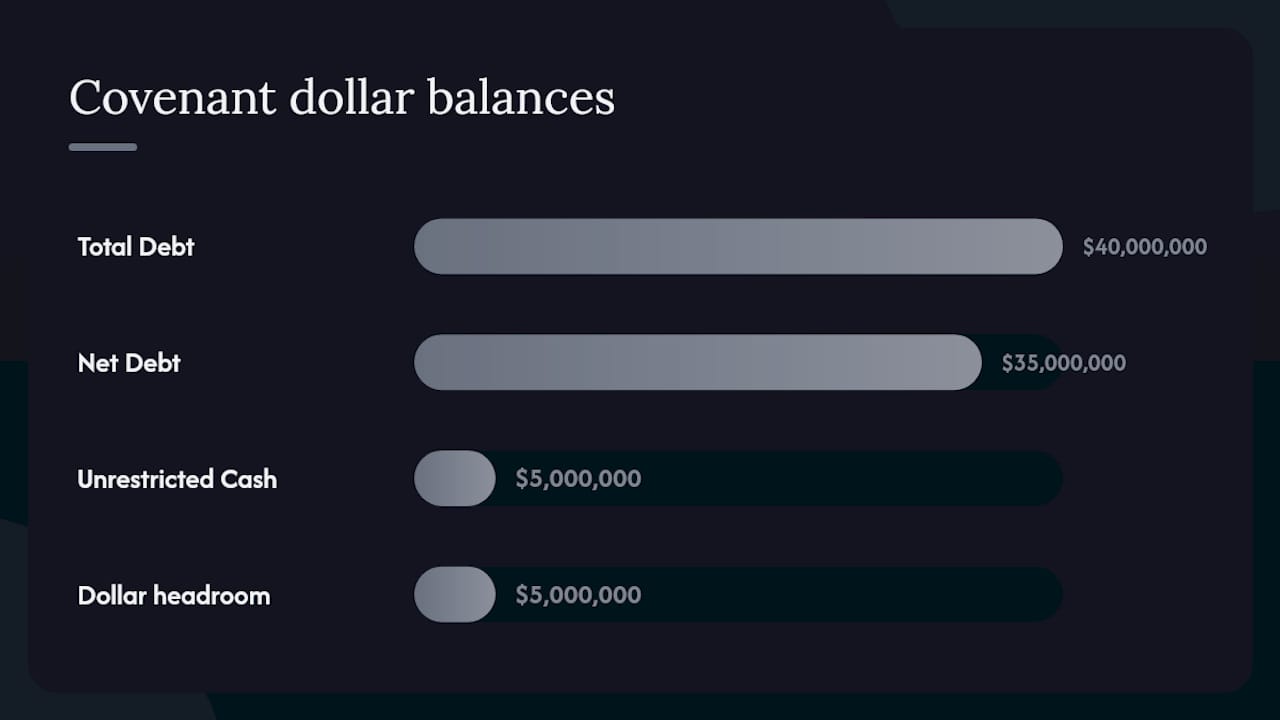
Example headroom calculation (leverage covenant):
- Total Debt: $40,000,000
- Unrestricted Cash: $5,000,000
- Net Debt: $35,000,000
- LTM Credit Agreement EBITDA: $10,000,000
- Current Leverage: 3.5x
- Covenant Maximum: 4.0x
- Headroom in turns: 0.5x
- Dollar headroom: 0.5 × $10,000,000 = $5,000,000 of EBITDA cushion before breach
That $5,000,000 figure is what you stress-test. At that rate, a $25,000,000 revenue miss closes the entire cushion.
Reconciliation checklist:
- Source page citation for each covenant definition
- GL account or schedule reference for each input
- Preparer name and date for each section
- Reviewer sign-off and date
- Version number and change log entry
Covenant management guidance recommends surfacing issues at least 60–90 days before a formal test date, which means your reconciliation process needs to run on a monthly cadence, not just at quarter-end.
How to run covenant sensitivity tests and stress cases
A single base-case forecast is not a covenant forecast. It is a starting point. The work that actually protects the company is the scenario analysis around it.
Define three scenarios before you run numbers:
- Base: Management's best estimate, using the same assumptions as the compliance certificate.
- Downside: A realistic adverse case. Stress revenue by 10–15%, compress margins by 2–3 percentage points, and assume working capital deteriorates by 30–45 days.
- Severe: A stress case designed to estimate breach timing. Push revenue 20–25% below base, assume capex timing slips, and model a working capital crunch.
A 3-statement-based early-warning dashboard that ties covenant definitions to forecasted financials and includes trajectory indicators converts these numbers into governance actions. A breach rarely arrives without warning when the model is built correctly.
For each scenario that shows a breach, predefine the response:
- Downside breach: Pause discretionary capex, draw on revolver to improve liquidity covenant, prepare waiver request with remediation timeline.
- Severe breach: Initiate lender engagement immediately, model equity cure eligibility under the credit agreement, retain restructuring counsel if the cure window is tight.
Pro Tip: Stress working capital separately from EBITDA. A company can be profitable and still breach a minimum liquidity covenant if AR collections slow by 15 days. Model cash independently of earnings in every scenario.
What does a covenant reporting timeline look like?
Timing failures are the most avoidable cause of lender friction. A compliance certificate submitted late, or submitted with numbers that do not reconcile to the audited financials, signals a control problem regardless of whether the company is in compliance.
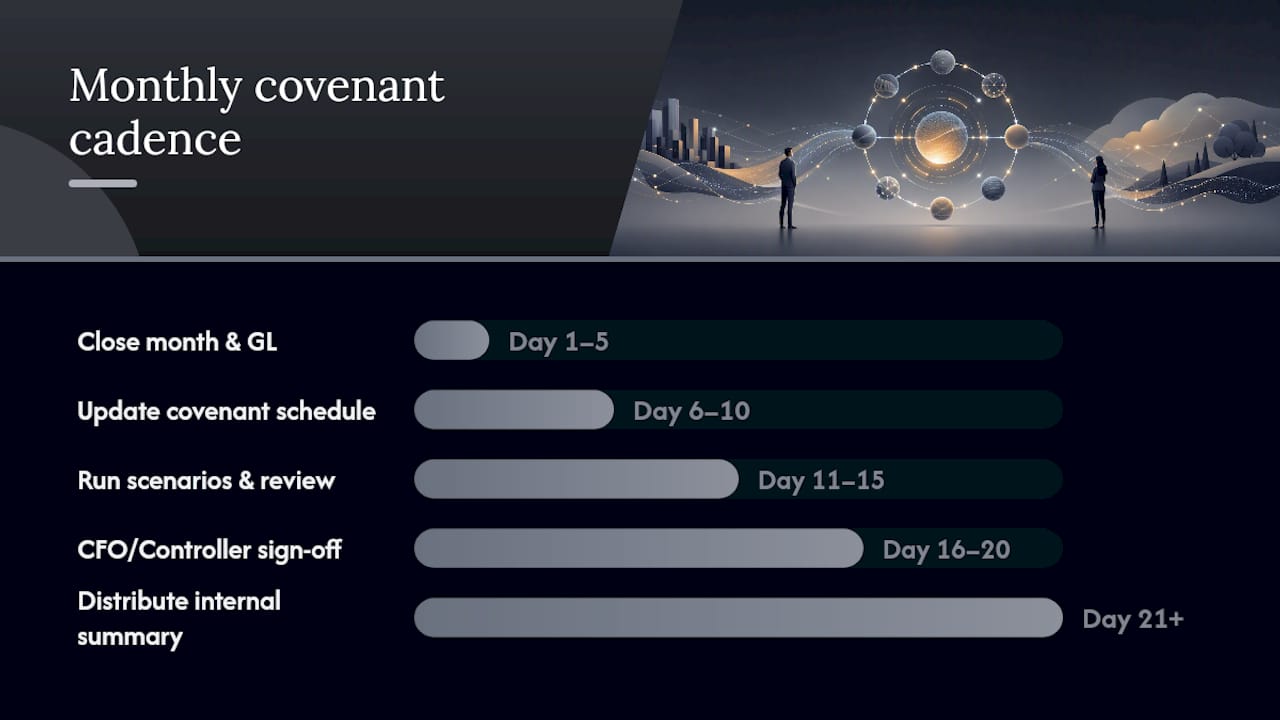
Monthly cadence:
- Day 1–5: Close the month, pull GL trial balance, update bank reconciliation.
- Day 6–10: Update covenant calculation schedule with actuals; flag any inputs still estimated.
- Day 11–15: Run base and downside scenarios; review headroom trajectory.
- Day 16–20: CFO or Controller reviews and signs off; update assumptions register.
- Day 21+: Distribute internal covenant summary to CFO, board finance committee, and lender relationship manager if headroom is below the watch threshold.
Quarterly and annual testing:
- 60–90 days before test date: Run preliminary covenant calculation using latest actuals and forward projections.
- 30 days before test date: Complete scenario pack; obtain CFO approval; draft compliance certificate.
- Test date: Submit compliance certificate with supporting schedules per credit agreement deadline.
- Post-submission: File signed certificate, supporting GL extracts, and assumption register in the version-controlled document repository.
Approval matrix:
| Deliverable | Preparer | Reviewer | Final Sign-Off |
|---|---|---|---|
| Covenant calculation schedule | FP&A Analyst | Controller | CFO |
| Scenario pack | FP&A Lead | CFO | CFO / Board |
| Compliance certificate | Controller | CFO | CEO / CFO |
| Lender submission package | CFO / Treasury | Legal | CFO |
Align your 13-week cash forecast, your covenant forecast, and your compliance certificate to the same data cutoff. When these three documents use different balance dates, reconciliation gaps appear and lenders ask questions you should not need to answer.
How do AICPA and SEC standards make your forecast defensible?
When a covenant forecast is used in a filing, an acquisition, or a lender examination, it becomes prospective financial information (PFI) subject to formal standards. Understanding which standard applies to your situation determines what documentation you need.
The AICPA distinguishes between a forecast (management's best estimate of expected results) and a projection (results under hypothetical assumptions). Both require the responsible party to represent that the assumptions are reasonable and that the document presents the information in accordance with AICPA guidelines. A practitioner examining a forecast under PCAOB AT 301 must issue an adverse report if assumptions are unreasonable or required disclosures are missing.
SEC Rule § 210.11-03 requires that forecasts included in certain filings cover at least 12 months and be prepared in accordance with AICPA presentation guidelines, with clear disclosure of all assumptions material to the transaction. If your covenant forecast will appear in a proxy, an S-1, or an acquisition filing, these requirements apply directly.
For private company lender reporting, the AICPA standard still sets the practical expectation. KPMG's guidance on PFI recommends robust documentation, assumption support, and review controls as the baseline for any forecast that will be reviewed by an external party.
Documentation checklist:
- Assumptions register: every significant assumption listed with its basis, source, and the name of the person who approved it.
- Source-page citations: credit agreement page and section number for each covenant definition.
- Preparer and reviewer assertions: signed or initialed by the preparer and the reviewing officer.
- Version log: date, version number, and a one-line description of what changed.
- Supporting schedules: GL extracts, debt schedule, bank statements, and lease schedules tied to the test date.
Pro Tip: Keep your assumptions register in a separate, version-controlled document, not embedded in the model. When a lender or auditor asks why you used a specific revenue growth rate, you want a signed, dated document, not a cell comment.
Which features matter most in covenant forecasting tools?
The right tool does not just calculate headroom. It enforces the process: source citations, version control, alerts, and an audit trail that holds up under scrutiny.
Features that materially reduce risk and effort:
- Credit agreement ingestion. The tool should allow you to enter covenant definitions with source-page references, not just formula outputs.
- Automated debt schedules. Principal, interest, and fee accruals should update automatically from the debt schedule, not require manual entry each period.
- Real-time cash feeds. Bank feed integration eliminates the most common source of data-lag errors in liquidity covenants.
- Headroom alerts. Policy-band alerts at defined thresholds (a watch level around 10% headroom is standard lender practice) give the team time to act before the test date.
- Scenario toggles. Base, Downside, and Severe scenarios should be switchable without rebuilding the model.
- Audit trail. Every input change, assumption override, and approval action should be logged with a timestamp and user name.
- Role-based approvals. Preparers, reviewers, and approvers should have distinct permissions so the sign-off chain is enforced by the system, not by email convention.
Linking the covenant layer to your 3-statement model is the implementation step most teams skip. When the covenant schedule pulls directly from the income statement, balance sheet, and cash flow statement, definition drift becomes visible immediately. When it lives in a separate spreadsheet, it drifts silently.
For cash flow forecasting specifically, automation matters most in the liquidity covenant context. A 13-week cash model that updates from bank feeds and AR/AP aging gives you a real-time view of minimum cash compliance between formal test dates.
What should you deliver to the board and lenders this quarter?
A covenant deliverable package has five components. Finance teams that produce all five consistently rarely face lender surprises.
| Deliverable | Contents | Audience |
|---|---|---|
| Reconciled headroom table | Required vs. actual vs. headroom for each covenant, current period | CFO, Board, Lender |
| Scenario pack | Base, Downside, Severe headroom; breach date estimate for stress cases | CFO, Board |
| Assumptions register | All significant assumptions, basis, approver, date | CFO, Auditor, Lender |
| Supporting GL extracts | Trial balance, AR/AP aging, bank reconciliation tied to test date | Controller, Auditor |
| Debt schedule reconciliation | Opening balance, draws, repayments, fees, closing balance | Treasury, Lender |
For lender outreach, the CFO or treasury lead should own the relationship contact.
A cover note for a lender submission should follow this structure: one sentence confirming the test period and the covenants being certified; one sentence stating the result (in compliance / not in compliance); one paragraph summarizing headroom and any material changes from the prior period; one sentence identifying the contact for questions. Keep it to one page. Lenders read dozens of these; clarity and brevity signal competence.
What finance teams consistently get wrong in covenant forecasting
The most common structural failure is using the operational forecast as the covenant forecast. These are different documents built for different purposes, and treating them as interchangeable is the single fastest path to a waiver conversation you were not prepared for.
Definition drift is the second most persistent problem. A company closes an acquisition, adds a new lease, or restructures a subsidiary, and the covenant calculation schedule is not updated to reflect the new entity structure. Six months later, the compliance certificate is wrong, and no one noticed because the operational forecast looked fine.
Typical control failures and short remediation actions:
- No source-page citations in the model. Fix: add a "Credit Agreement Reference" column to every covenant line before the next test date.
- Assumptions embedded in cell formulas. Fix: move all assumptions to a dedicated register with preparer and approval fields.
- Covenant schedule not reconciled to last certificate. Fix: make back-reconciliation the first step of every new forecast cycle, not an afterthought.
- No downside scenario. Fix: build a Downside case using a 10–15% revenue haircut and present it alongside the base case at every board meeting.
- Late data inputs accepted without a cutoff log. Fix: establish a data cutoff policy and document every late or estimated input with a flag and a follow-up date.
Embedding covenant monitoring into the monthly operating cadence is the governance change that makes the biggest difference. When the covenant calculation runs every month alongside the close, issues surface with enough lead time to address them. When it runs only at quarter-end, the team is always one bad quarter away from a crisis.
Peregrine gives finance teams a real covenant monitoring workflow
Covenant forecasting requires live data, a clean audit trail, and scenario analysis that updates without manual rebuilding. Peregrine delivers all three through its direct QuickBooks Online integration, pulling real-time cash, AR/AP, and GL data into a financial command center that finance teams can configure for their specific covenant definitions.
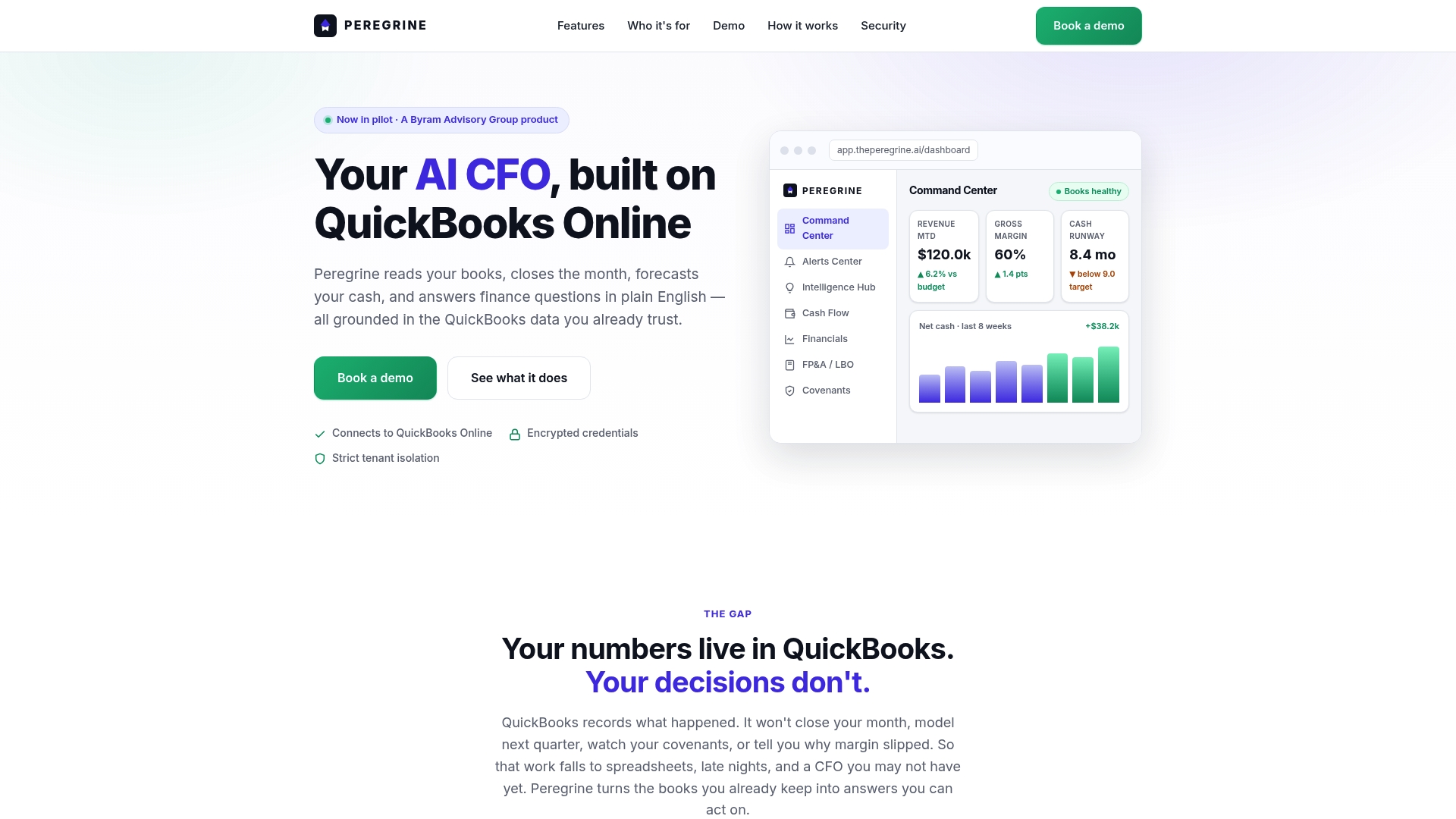
Peregrine automates the debt schedule, flags anomalies in cash and working capital before they reach the test date, and maintains a full audit trail of every input change and approval action. The headroom alert system surfaces tightening covenants before they become lender conversations. For finance teams that currently manage covenant compliance in spreadsheets, Peregrine replaces the manual rebuild cycle with a live model that stays current between test dates.
Start a Theperegrine and connect your QuickBooks Online entity in minutes. Your first covenant headroom table can be running before your next monthly close.
Sources
- AT 301 — Attestation Standards on Prospective Financial Statements (PCAOB source cited in provided materials)
- Relevant guidance on prospective financial information (KPMG)
- Covenant forecasting pitfalls: Why models overstate headroom (A Faster Exit)
- Covenant monitoring best practices for commercial lenders (Aloan)
- How to build a covenant breach early-warning dashboard from a 3-statement model (Model Reef)
This article is general information, not a substitute for advice from a qualified financial advisor. Consult a qualified financial professional about your own circumstances before acting on anything here.