
What are the most effective ways to improve cash flow?
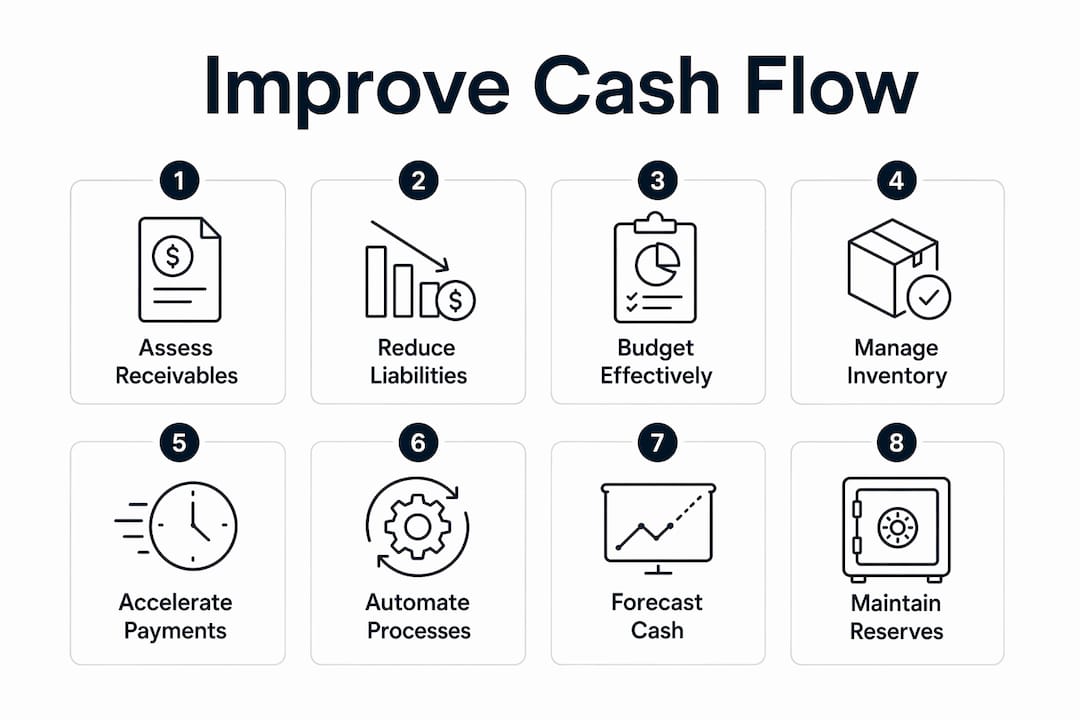
The fastest way to improve cash flow is to attack it from three directions at once: pull cash in sooner, push payments out as long as legitimately possible, and keep a buffer so a slow month doesn't become a crisis. Cash flow provides a more accurate picture of company health than profit alone, which is why a business can show a healthy income statement and still run out of money.
Here are the core moves that make the biggest difference:
- Accelerate receivables. Send invoices the moment work is complete, offer early payment discounts, and follow up promptly on overdue accounts.
- Extend payables. Pay vendors on the exact due date, not before. Negotiate longer terms where you can.
- Cut unnecessary expenses. Pull a full vendor spend report for the prior year and challenge every line item.
- Manage inventory tightly. Excess stock is cash sitting on a shelf. Set reorder points as low as operations allow.
- Build a cash reserve. A buffer covering at least three months of operating expenses keeps you out of emergency borrowing.
- Forecast regularly. A rolling 13-week cash plan updated weekly catches shortfalls before they arrive.
- Automate billing and collections. Manual invoicing introduces delays and errors that cost you days of float.
Each of these strategies is covered in depth below, with specific tactics you can put into practice this week.
How do you reduce liabilities and improve asset management?
Debt and underperforming assets are two of the quietest cash drains in a small business. Reducing liabilities frees up cash that was going to interest and fees; tightening asset management stops cash from getting locked in places it can't work for you.

On the liability side, start by consolidating high-interest debt into lower-rate products when the terms genuinely improve your position. Avoid paying for subscriptions, retainers, or service contracts that no longer deliver value. The AssetBuilt framework for debt repayment recommends sequencing payoffs by interest rate and cash impact rather than balance size, which often frees operating cash faster than the popular "smallest balance first" approach.
On the asset side, accounts receivable (AR) is the biggest lever most small businesses underuse. Monitoring AR balances closely and acting quickly on overdue invoices compresses payment cycles in ways that show up in your bank account within weeks. Days Sales Outstanding (DSO) is the metric to watch: every day you shave off DSO is a day's worth of revenue you collect sooner.
- Review AR aging weekly. Invoices older than 30 days need a phone call, not just an email.
- Sell or lease idle assets. Equipment sitting unused is capital that could be working elsewhere.
- Refinance long-term assets only when you can secure materially better terms, not just marginally better ones.
- Challenge every recurring cost. Sign every check or electronic payment yourself for at least one quarter; you'll find expenses that shouldn't exist.
How does budgeting help you monitor and control cash flow?
A budget without a cash flow forecast is just a wish list. The two tools work together: the budget sets targets for revenue and spending, while the cash flow forecast tells you when the money actually moves. Businesses that track both catch shortfalls weeks before they hit the bank account.
Build your forecast at the monthly level at minimum, and quarterly for planning purposes. Include every known inflow (customer payments, loan draws, asset sales) and every known outflow (payroll, rent, vendor invoices, loan repayments, taxes). The goal is to see your ending cash balance for each period before it happens, not after.
- Update your cash flow statement monthly. Stale data leads to stale decisions.
- Flag any month where projected ending cash falls below your reserve target. That's your early warning signal.
- Use accounting software (QuickBooks Online is the most common platform for small businesses) to pull actuals automatically rather than entering them by hand.
- Compare actuals to forecast every month. The variance tells you where your assumptions were wrong and where to look harder.
Pro Tip: Set a recurring 30-minute calendar block each week to review your cash position. Business owners who treat this as a fixed appointment catch problems earlier than those who check "when something feels off."
How does inventory management free up cash?
Inventory is cash in disguise, and most small businesses hold more of it than they need. Every dollar sitting in unsold stock is a dollar that can't pay a vendor, cover payroll, or fund growth. Maintaining optimal inventory levels through just-in-time ordering and regular audits avoids tying up cash and reduces storage costs.
The just-in-time approach means ordering closer to when you actually need stock rather than buying in bulk to feel safe. It requires tighter coordination with suppliers but pays off in cash availability. Pair it with automated reorder triggers in your inventory system so you're not relying on someone remembering to place an order.
- Set reorder points as low as operations can tolerate. The Yale SOM cash management framework puts it plainly: inventory is bad. Have as little as possible at all times.
- Run a quarterly audit to identify slow-moving or obsolete stock. Discount it aggressively to convert it back to cash.
- Track inventory turns by product line, not just in aggregate. You may find that 20% of your SKUs consume 60% of your inventory cash.
- Negotiate smaller, more frequent deliveries with key suppliers to reduce the amount of stock you carry at any given time.
How can you get customers to pay you faster?
Getting paid faster is the single highest-leverage move for most small businesses, and it's almost entirely within your control. Automating invoicing and offering early payment discounts like 2/10 net 30 accelerate cash inflows and reduce DSO. Offering early payment discounts gives customers financial incentives to pay sooner, which costs you a small margin but can dramatically improve your weekly cash position.
Send invoices the moment a job is complete or a product ships. A company that bills monthly and sends invoices on the last day of the month is effectively giving customers an extra 30 days of float for free. That's a choice, not a requirement.
- Automate invoice generation so invoices go out within hours of delivery, not days.
- Offer multiple payment options. Accepting credit cards, ACH, and digital wallets removes friction and encourages faster payment.
- Charge a late payment fee (typically 1.5% per month) and state it clearly on every invoice. Many customers will pay on time simply to avoid it.
- Follow up on day 31 for net 30 accounts. Don't wait until day 45 or 60. The Yale SOM research is explicit: dated receivables become increasingly difficult to collect.
- Consider requiring deposits for large or custom orders before work begins.
How do you negotiate better payment terms with vendors?
The goal with accounts payable (AP) is simple: pay on the exact due date, not a day earlier. Every day you hold cash before it's due is a day it's working for you instead of your vendor. Negotiating extended payment windows or bulk purchase discounts improves cash availability without damaging supplier relationships when handled professionally.
Start with your largest vendors, where the cash impact is greatest. Ask for net 60 instead of net 30, or request a volume discount in exchange for a longer-term commitment. Most vendors would rather extend terms than lose a reliable customer.
- Never pay early unless there's a discount that justifies it. Paying net 30 invoices on day 15 is a gift to your vendor, not a virtue.
- Prioritize payments by due date, not by which vendor calls most often.
- Build relationships before you need flexibility. A vendor who knows you as a reliable, communicative customer is far more likely to work with you during a tight month.
- Ask for a credit line with key suppliers. Many will offer 60- or 90-day terms to established accounts, effectively giving you an interest-free short-term loan.
How does automating financial processes improve cash flow?
Manual billing and collections workflows introduce errors and delays that cost businesses real money. Automation of invoice generation, payment tracking, and real-time cash visibility reduces errors and cuts administrative lag. When an invoice goes out automatically the moment a job closes, you've already eliminated one of the most common sources of payment delay.
Integrated accounting software connects your billing, bank accounts, and reporting into a single system. That means your cash position updates in real time rather than waiting for someone to reconcile spreadsheets at the end of the month. Alerts for overdue invoices, low cash balances, or unusual transactions catch problems before they compound.
- Automate recurring invoices for subscription or retainer clients so they go out on a fixed schedule without manual intervention.
- Set up automatic payment reminders at 7 days before due, on the due date, and at 3 days past due.
- Use bank feed integrations to pull transactions automatically into your accounting system, eliminating manual data entry.
- Enable real-time cash dashboards so you can see your actual cash position any time, not just at month-end.
For finance teams looking to reduce the manual burden of closing the books, month-end close automation is one of the highest-ROI process changes available.

How do you build a cash flow forecast that actually works?
A forecast that sits in a spreadsheet and gets updated once a quarter isn't a forecast. It's a document. A working forecast is a rolling model, updated weekly with real data, that shows you your cash position for the next 13 weeks at all times. Rolling, scenario-based forecasts updated weekly improve accuracy and help plan financing needs proactively.
Scenario analysis is what separates a useful forecast from a single-point guess. Build three versions: a base case using your most likely assumptions, a downside case where your two or three biggest customers pay 30 days late, and an upside case where a large deal closes early. The downside case tells you exactly how much credit you'd need and when.
- Start with a 13-week rolling model. Thirteen weeks is long enough to plan but short enough to forecast with reasonable accuracy.
- Update actuals every week so the model reflects what's really happening, not what you hoped would happen.
- Include every known cash event: tax payments, loan installments, seasonal payroll spikes, and large vendor invoices.
- Use the forecast to time financing decisions. If the model shows a cash gap in week 8, you have seven weeks to arrange a line of credit rather than scrambling at week 7.
For a deeper look at the tools that make this process faster, the best cash flow forecasting software options in 2026 range from basic spreadsheet add-ins to AI-driven platforms that update forecasts automatically.
How does AI improve cash flow management for small businesses?
AI-based forecasting tools enable more frequent, accurate cash position updates, helping businesses respond to potential shortfalls faster and with less manual effort. That's not a marginal improvement. A business owner who previously updated their forecast monthly now has a model that refreshes daily, flags anomalies automatically, and answers plain-English questions like "What happens to my cash if my top client pays 45 days late?"
Insight: Proactive forecasting is the single most effective defense against insolvency caused by timing mismatches, not by actual losses. A business can be profitable and still run out of cash if receivables lag payables by even a few weeks.
Peregrine integrates directly with QuickBooks Online to automate cash flow forecasting, month-end close, and financial planning without requiring a full-time CFO. Its anomaly detection flags unusual transactions before they distort your numbers, and its customizable forecasting models let you run scenario analysis in minutes rather than hours.
- Automated data ingestion pulls actuals from QuickBooks Online continuously, so forecasts reflect real transactions, not manual entries.
- Plain-English financial queries let you ask questions about your cash position without building a custom report.
- Real-time dashboards give you CFO-grade visibility into revenue, cash flow, and operational metrics at any time.
- Anomaly detection catches errors, duplicate payments, and unusual spending patterns before they compound.
For businesses evaluating AI-driven options, the top AI forecasting tools in 2026 cover a range of complexity and price points, from lightweight add-ons to full FP&A platforms.
How much cash reserve should a business keep?
Maintaining a cash reserve covering operating expenses gives businesses the ability to handle unexpected costs and seize opportunities without emergency borrowing. Three months is the floor, not the target. Businesses in seasonal industries or with concentrated customer bases often need more.
The reserve isn't just a safety net. A healthy cash buffer also builds lender trust and improves your access to capital on favorable terms when you do need it. Lenders look at your cash management history, and a business that consistently maintains reserves looks fundamentally different from one that's always at the edge.
Keep reserves in a high-yield business savings account or a money market account so the cash earns something while it sits. Avoid locking it into instruments with withdrawal penalties, since the whole point is that it's accessible when you need it.
What short-term financing options help bridge cash gaps?
Even well-managed businesses hit cash gaps, usually from timing mismatches between when expenses are due and when customers pay. Short-term financing bridges those gaps without forcing you to make bad operational decisions (like delaying payroll or missing a vendor payment) to stay liquid.
A business line of credit is the most flexible option. You draw only what you need and pay interest only on what you use. Set one up before you need it; banks are far more willing to extend credit to a business that doesn't appear desperate. Invoice factoring is another option: some factoring providers advance up to 90% of invoice value upfront, converting outstanding receivables to immediate cash. The cost is higher than a line of credit, but the speed can be worth it for a specific cash crunch.
SBA loans and term loans work better for planned capital needs than for short-term gaps. If you know you'll need cash for equipment or a seasonal inventory build three months from now, a term loan is appropriate. If you need cash next week because a client is 45 days late, a line of credit or factoring is the right tool.
How can pricing strategy improve your cash position?
Pricing is a cash flow lever that most small businesses underuse. Raising prices even modestly on your highest-margin products or services improves cash inflow without adding a single new customer or transaction. The key is knowing your cost structure well enough to identify where margin is thickest and where you're essentially working for free.
Review your pricing at least annually against your actual costs, not the costs you had when you set the price. Inflation in materials, labor, and overhead erodes margin quietly. A product priced for a 30% margin two years ago may now deliver 18% if costs have risen and the price hasn't moved.
Consider tiered pricing or bundling to shift customers toward higher-value offerings. Offering a premium tier with faster delivery, priority support, or additional features often generates disproportionate margin because the incremental cost is low. Prepaid or subscription pricing also improves cash flow by collecting revenue before the work is performed.
How do payment terms with customers affect your cash flow?
Customer payment terms are a direct dial on your cash cycle. Net 60 terms mean you're financing your customers for two months. Net 15 terms mean cash arrives quickly enough to pay your own vendors on time. The right terms depend on your industry and customer relationships, but most small businesses can tighten their standard terms without losing accounts.
Start by segmenting customers by payment behavior. Customers who consistently pay on time can keep standard terms. Customers who routinely pay late should move to shorter terms, prepayment requirements, or both. Adjusting payment terms strategically aligns your cash flow with your operational cycle rather than your customers' preferences.
Offering a small early payment discount (the 2/10 net 30 structure mentioned earlier) is often more effective than chasing late payments after the fact. You're giving customers a financial reason to pay early rather than relying on goodwill or follow-up calls. For new customers, requiring a 25–50% deposit before work begins is standard practice in many service industries and eliminates a significant portion of collection risk.
Key Takeaways
Improving cash flow requires consistent action across receivables, payables, inventory, forecasting, and reserves, not a single fix.
| Point | Details |
|---|---|
| Accelerate receivables | Send invoices immediately after delivery and follow up promptly on overdue accounts. |
| Extend payables | Pay vendors on the exact due date; negotiate net 60 or longer terms with key suppliers. |
| Maintain a cash reserve | Keep at least three months of operating expenses in an accessible, liquid account. |
| Forecast with a rolling model | Update a 13-week cash forecast weekly with real actuals to catch shortfalls before they hit. |
| Use automation and AI | Automated invoicing, bank feeds, and AI-driven tools like Peregrine reduce errors and give real-time cash visibility. |
See your cash flow clearly with Peregrine
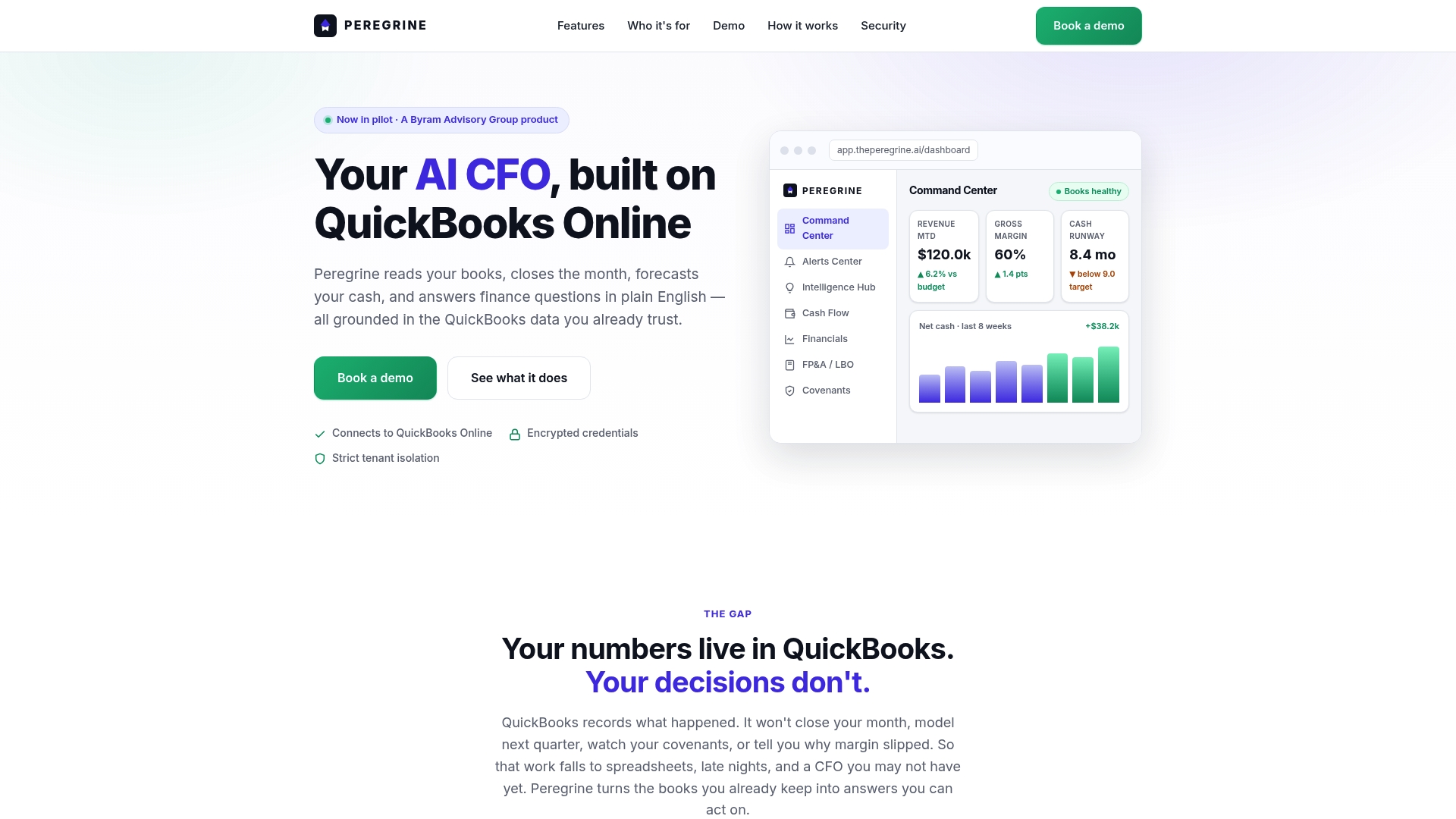
Most small business owners manage cash flow reactively, checking the bank balance when something feels wrong. Peregrine flips that. By connecting directly to QuickBooks Online, Peregrine gives you a real-time financial command center with automated forecasting, anomaly detection, and plain-English answers to your most pressing cash flow questions, without hiring a full-time CFO.
If you're ready to move from reactive to proactive, explore Peregrine and see what CFO-grade cash visibility looks like for a business your size.