
A controller owns the accounting foundation; a CFO turns that foundation into strategy. That single sentence captures the core difference between controller and CFO roles, and it should guide every hiring decision and career conversation you have about finance leadership.
- Controller: Reports to the CFO (or directly to the CEO in smaller companies); primary focus is the past and present — accurate books, clean close, airtight controls.
- CFO: Reports to the CEO and board; primary focus is the future — capital allocation, investor relations, and strategic planning.
Most companies need a controller before they need a CFO. Clean, timely financials are the prerequisite for any strategic finance work worth doing.
Pro Tip: If your books close late, your reconciliations are a mess, or your last audit was painful, you need a controller first. A CFO cannot build a credible forecast on unreliable data.
Key Takeaways
The controller builds the financial foundation; the CFO decides what to build on top of it. Hire in that order unless a capital event forces a different sequence.
| Point | Details |
|---|---|
| Controller first, CFO second | Most companies need reliable books before strategic finance leadership can add value. |
| Different time horizons | Controllers own past and present accuracy; CFOs own future forecasting and capital decisions. |
| Career path is real but requires deliberate gaps to close | Controllers targeting CFO roles need capital markets, investor communication, and FP&A experience. |
| Compensation scales with strategic scope | CFO total compensation is heavily weighted toward bonus and equity; controller pay is primarily base salary. |
| Peregrine as a bridge | Peregrine automates month-end close and delivers CFO-grade forecasting for companies not yet ready for a full-time hire. |
A note on choosing between hiring and automating
Most of the controller vs CFO debate assumes you're choosing between two full-time hires. That framing is increasingly outdated. The more useful question for most growth-stage companies is: what combination of people, fractional services, and technology covers the financial leadership you actually need right now?
In most cases, the answer is controller-first — clean books are non-negotiable. But once that foundation exists, a well-configured AI platform can deliver a significant portion of the CFO-layer work: rolling forecasts, cash flow visibility, anomaly detection, and board-ready reporting. Fractional CFOs fill the relationship and judgment gaps that software can't. The companies that get this right don't wait until they can afford both full-time hires. They build the foundation, automate what they can, and bring in human expertise where judgment and relationships matter most.
Table of Contents
- What does a financial controller do?
- What does a CFO actually own?
- How do the controller vs CFO roles actually differ?
- Detailed duties: what each role does day to day
- When should you hire a controller vs a CFO?
- Can a controller become a CFO?
- Controller vs CFO salary: what U.S. ranges look like
- Skills and certifications: what each role requires
- Tools and technology: what each role actually uses
- How AI platforms and fractional CFOs are reshaping these roles
- Practical hiring guide: checklists and interview questions
- CFO-grade financial visibility without the full-time hire
- Sources
What does a financial controller do?
The controller is the lead accounting officer. The role owns the month-end close, general ledger maintenance, account reconciliations, internal controls, and GAAP-compliant financial reporting. In most organizations, the controller reports to the CFO, though in smaller companies the reporting line goes straight to the CEO or owner.
Controllers focus on accounting accuracy, GAAP compliance, and audit coordination — the work that keeps the books reliable and the auditors satisfied. That scope makes the controller the operational backbone of any finance function.
Where the controller sits in a typical org chart:
- Reports to: CFO (or CEO in smaller firms)
- Direct reports: Accounting staff, AP/AR teams, payroll (sometimes)
- Peers: FP&A manager, treasury, tax
Common variations on the title:
- Comptroller is the equivalent title used in government agencies and many nonprofits. The responsibilities map closely to a private-sector controller. (More on this distinction below.)
- In smaller companies, the controller may be a senior manager. In mid-market and enterprise firms, the role is often a director or VP.
Signals you need a controller now:
- Month-end close takes longer than a reasonable time frame
- Bookkeepers are overwhelmed or making recurring errors
- An audit is coming and your documentation is thin
- You have multiple entities and no one owns consolidation
Financial reporting best practices for QuickBooks Online teams often start with getting the controller function right before layering on any strategic finance work.
What does a CFO actually own?
The CFO is the C-suite's financial strategist. Where the controller looks backward and inward, the CFO looks forward and outward — toward investors, lenders, the board, and the market. The role translates what the numbers say into decisions about where the company goes next.
CFOs synthesize accounting outputs into forecasts, board packs, and capital decisions, which means they depend entirely on the controller's clean data to do their job well.
Primary CFO stakeholders:
- CEO and executive team
- Board of directors
- Investors and equity holders
- Banks, lenders, and credit partners
Typical CFO direct reports: Controller, FP&A lead, treasury, tax, internal audit.
CFO responsibilities that controllers rarely own:
- Raising debt or equity capital
- Leading or evaluating M&A transactions
- Managing investor and board relationships
- Setting capital structure and dividend policy
- Scenario planning and long-range financial modeling
- Negotiating credit facilities and covenant terms
Understanding strategic finance as a discipline helps clarify why the CFO role requires a fundamentally different orientation than the controller role — one that is externally focused and forward-looking by design.
How do the controller vs CFO roles actually differ?
The differences are not just about seniority. They reflect two distinct orientations toward financial work.
- Time horizon: Controller = past and present (actuals, close, compliance). CFO = future (forecasts, scenarios, capital plans).
- Primary audience: Controller = internal (accounting team, auditors, tax). CFO = external (board, investors, lenders) and executive leadership.
- Core deliverable: Controller = accurate financial statements. CFO = strategic financial guidance and capital decisions.
- Risk focus: Controller = compliance risk, audit risk, internal control failures. CFO = business risk, market risk, capital structure risk.
- Typical background: Controllers usually hold a CPA and come from public accounting or audit. CFOs often come from FP&A, investment banking, or controllership, and many hold an MBA or CFA.
- Compensation shape: Controller compensation is weighted toward base salary. CFO compensation includes a larger variable component — bonus, equity, and long-term incentives — reflecting the strategic accountability.
Most firms need a controller first to provide reliable financials before a CFO can produce effective strategic finance work. Skipping that sequence is one of the most common and costly finance-hiring mistakes.
Detailed duties: what each role does day to day
Controller responsibilities
The controller's work is cyclical and deadline-driven. Every month, the same core tasks repeat:
- Month-end close: Posting journal entries, reconciling accounts, closing sub-ledgers, producing the trial balance.
- GL maintenance: Keeping the chart of accounts clean, managing intercompany eliminations in multi-entity structures.
- Reconciliations: Bank, balance sheet, and intercompany accounts — every balance tied out and documented.
- Audit coordination: Preparing PBC (prepared by client) schedules, managing auditor requests, maintaining workpapers.
- Internal controls: Designing and enforcing segregation of duties, approval workflows, and documentation standards.
- Tax support: Coordinating with external tax advisors, preparing schedules, managing sales tax compliance.
- AP/AR oversight: Reviewing aging reports, approving vendor payments, managing collections escalations.
Controllers own internal controls, GAAP-compliant reporting, and the close process — the unglamorous work that makes everything else possible.
CFO responsibilities
The CFO's calendar looks very different. Less close, more conversation:
- Forecasting and scenario modeling: Rolling 12-month P&L, cash flow, and balance sheet forecasts with multiple scenarios.
- Board and investor reporting: Preparing board decks, investor updates, and management presentations.
- Capital allocation: Deciding where to deploy cash — capex, hiring, acquisitions, debt paydown.
- Bank and credit relationships: Negotiating credit lines, managing covenant compliance, communicating with lenders.
- Strategic planning: Leading annual planning, setting financial targets, aligning finance with business strategy.
- M&A and fundraising: Running or supporting due diligence, managing advisors, modeling deal economics.
FP&A is the connective tissue between controller-produced actuals and CFO strategy — many CFOs come from FP&A backgrounds precisely because that function bridges the two worlds.
Where responsibilities overlap: In mid-market companies, controllers often produce the first draft of board reporting and manage the FP&A function. In enterprise firms, those functions are clearly separated. The overlap shrinks as the company grows.
Pro Tip: Before handing off to a CFO, a controller should produce a clean close package: reconciled trial balance, variance commentary, open items log, and a one-page cash summary. That package is what makes CFO-level analysis possible without a week of back-and-forth.
Financial benchmarking is one area where controller outputs and CFO analysis converge — controllers produce the actuals, CFOs compare them to industry benchmarks to drive decisions.
When should you hire a controller vs a CFO?
Revenue alone is a weak proxy for hiring timing. A $5M SaaS company with multiple entities, investor reporting requirements, and a credit facility needs different finance leadership than a $5M cash-based retail business. Complexity drives the decision more than revenue.
That said, rules of thumb tying revenue bands to hires are useful starting points — just temper them with business-specific factors.
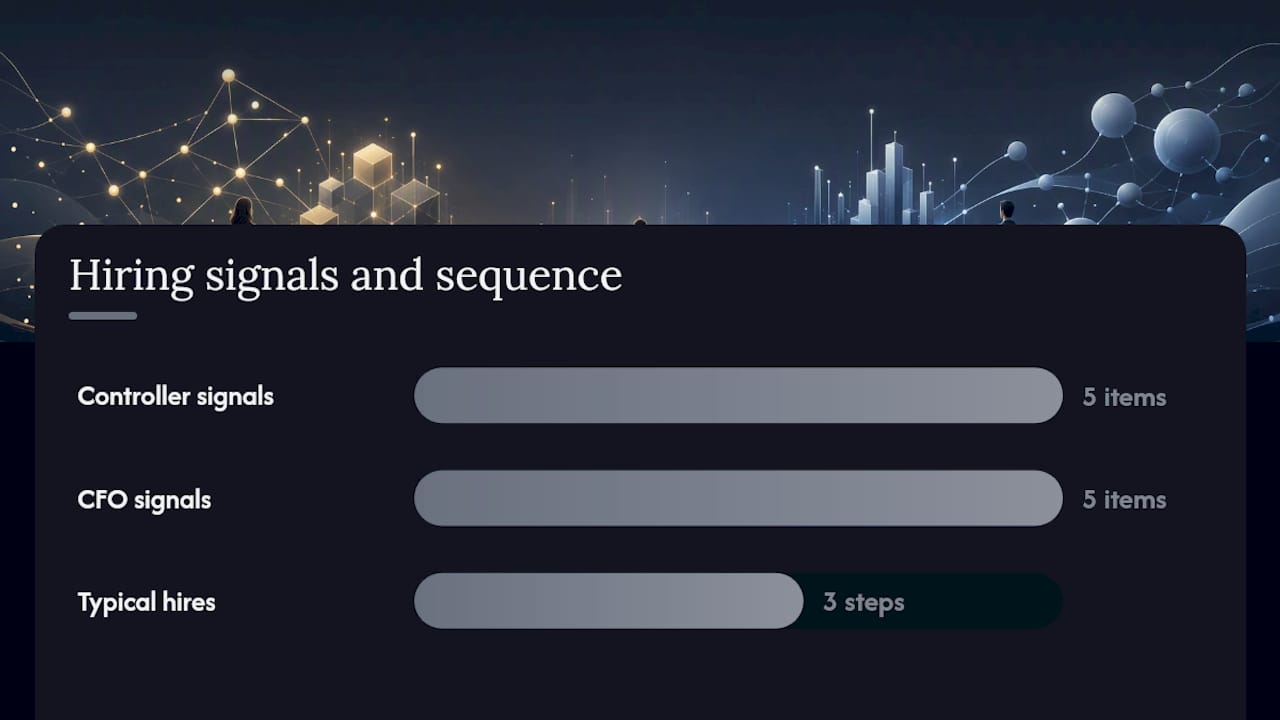
Signals you need a controller:
- Month-end close consistently takes longer than a reasonable time frame
- You've had audit findings or material weaknesses
- Your bookkeeper is making judgment calls they shouldn't be making
- You're managing multiple entities with no consolidation process
- AP and AR are running on spreadsheets and tribal knowledge
Signals you need a CFO:
- You're raising a Series A or a significant debt facility
- The board or investors are asking questions your controller can't answer
- You're evaluating an acquisition or a major strategic pivot
- Cash flow management has become a survival issue, not just a reporting issue
- You need someone to own the relationship with your bank or equity partners
Typical sequencing:
- Bookkeeper or staff accountant (early stage)
- Controller or senior accountant (as complexity grows)
- CFO (when capital events, investor relations, or strategic planning demand it)
Common exceptions: PE-backed companies often bring in a CFO immediately post-close because the investor relationship and reporting requirements demand it, even if the books aren't perfect yet. Early-stage startups sometimes hire a fractional CFO before a full-time controller because fundraising is the immediate priority.
Hiring timing varies by complexity, and company-specific factors often matter more than raw revenue. A manufacturing company with inventory, multi-state payroll, and a revolving credit line needs a controller much earlier than a professional services firm of the same size.
Can a controller become a CFO?
Yes, and it's one of the most common paths into the CFO seat. But the transition requires deliberate skill-building, not just time in the controller role.
The controller-to-CFO path typically requires broadening from ledger accuracy to investor-facing financial storytelling, modeling, and capital-raising experience. Controllers who make the jump successfully usually spend time in FP&A or treasury first, or they take on stretch assignments that expose them to board reporting and external financing.
Skill gaps controllers typically need to close:
- Capital markets literacy (debt structures, equity mechanics, term sheets)
- Investor and board communication (presenting to non-finance audiences)
- Strategic financial modeling (scenario analysis, LBO basics, M&A modeling)
- Cross-functional leadership (influencing sales, ops, and product without authority)
- External relationship management (banks, investors, advisors)
Step-by-step development path for controllers targeting CFO:
- Own the board reporting package. Volunteer to draft the CFO's board deck. This forces you to tell a financial story, not just report numbers.
- Rotate into FP&A. Even a 12-month stretch in FP&A builds the modeling and forecasting muscles the CFO role demands.
- Get external financing exposure. Join the team for a bank negotiation, a credit facility renewal, or an investor meeting. Observe how the CFO frames the business.
- Build cross-functional relationships. Start meeting regularly with sales, ops, and product leaders. CFOs spend as much time influencing the business as they do analyzing it.
- Pursue an MBA or CFA if the gap is significant. Not always required, but both credentials signal capital markets competency to boards and search firms.
- Take a fractional or interim CFO engagement. If you're in a smaller company, ask to act as CFO during a transition. The experience is worth more than any credential.
The 12–24 month window is realistic for a controller who is already producing board-ready work and has some FP&A exposure. The gap is wider for controllers who have spent their careers purely in close and compliance.
Controller vs CFO salary: what U.S. ranges look like
Compensation for both roles varies significantly by company size, industry, and geography. Public company CFOs earn multiples of what their private-company counterparts make, largely because of equity.
Controllers usually come from accounting backgrounds and own the accounting close and financial reporting; CFOs often come from varied finance backgrounds and own capital markets and strategy. That background difference shows up in compensation structure as much as in base salary.
Typical U.S. base salary ranges:
- Financial Controller: $100,000–$180,000 base for mid-market private companies; higher in large enterprises or high-cost markets like New York or San Francisco.
- CFO: $150,000–$300,000+ base for private companies; public company CFOs routinely earn $400,000–$600,000+ in base alone, with total compensation well above that when equity is included.
Compensation components by role:
| Component | Controller | CFO |
|---|---|---|
| Base salary | Primary component | Significant but not dominant |
| Annual bonus | 10% of base, performance-tied | larger variable component tied to company targets |
| Equity / stock | Rare in private firms; possible in PE-backed | Common; often the largest component in public or PE-backed firms |
| Benefits | Standard executive package | Enhanced — sometimes includes deferred comp, supplemental retirement |
Fractional alternatives: A fractional CFO typically costs $5,000–$15,000 per month depending on scope and hours, which is often less than the fully-loaded cost of a full-time controller at a mid-market firm. For companies that need strategic finance leadership but not a full-time hire, fractional CFO cost is worth modeling against the full-time alternative before committing to a search.
Skills and certifications: what each role requires
Controller credentials
The CPA is the most common credential for controllers, and for good reason. Public accounting trains the technical accounting, audit, and GAAP skills the controller role demands. The CMA (Certified Management Accountant) is a strong alternative for controllers who came up through industry rather than public accounting.
Controllers focus on preparing accurate financial statements and staying current with accounting standards like GAAP — the credential and the job description align closely.
Controller skill profile:
- Deep GAAP/IFRS knowledge
- SOX compliance and internal controls design (for public or PE-backed companies)
- ERP proficiency (NetSuite, SAP, Microsoft Dynamics, QuickBooks)
- Close process management and automation
- Audit coordination and documentation
- Tax compliance coordination (not necessarily tax expertise)
CFO credentials
The CFO credential landscape is broader. An MBA from a recognized program signals strategic and capital markets competency. The CFA is valued in CFO roles with heavy investment or treasury responsibilities. Many CFOs hold a CPA as well, particularly those who came up through controllership or public accounting.
CFO skill profile:
- Financial modeling and scenario analysis
- Capital markets and financing structures
- Investor and board communication
- M&A process management
- Strategic planning and business partnering
- Cross-functional leadership and executive presence
The soft-skill gap between a strong controller and a CFO-ready executive is often larger than the technical gap. Board presence, the ability to simplify complex financial narratives for non-finance audiences, and the confidence to push back on the CEO — these are the competencies that separate good controllers from effective CFOs.
Tools and technology: what each role actually uses
Controller toolset
Controllers live in accounting systems and close management tools:
- ERP/accounting systems: NetSuite, SAP, Microsoft Dynamics, QuickBooks Online for smaller firms
- Close automation: FloQast, Blackline for reconciliation and close management
- Audit management: AuditBoard, Workiva for SOX and audit documentation
- Payroll integrations: ADP, Gusto, Rippling connected to the GL
- Expense management: Expensify, Concur for AP and T&E
CFO toolset
CFOs work at a higher level of abstraction, relying on modeled outputs rather than transaction-level data:
- FP&A platforms: Adaptive Insights, Anaplan, Mosaic for budgeting and forecasting
- Board reporting: Visible, Notion, or custom decks built from FP&A outputs
- BI and analytics: Tableau, Power BI, Looker for business performance dashboards
- Treasury and banking: Kyriba, TreasuryXpress for cash management
- Scenario modeling: Excel and Google Sheets remain dominant for bespoke models
The accounting vs FP&A interface is where most finance tech stacks either work well or fall apart. Shared data architecture — a single source of truth that both the controller and CFO pull from — is what makes the handoff clean.
How AI platforms and fractional CFOs are reshaping these roles
The boundary between controller and CFO work is shifting. AI-driven finance platforms can now automate month-end close tasks, flag anomalies in real time, and produce rolling forecasts that previously required a dedicated FP&A team. That changes the calculus for smaller companies deciding when and whether to hire.

Modern AI-driven finance platforms can automate many controller tasks and make CFO-level insights accessible to smaller firms via software or fractional services. A company that once needed a full-time controller to manage close and a fractional CFO to produce forecasts can now accomplish both with a leaner team and the right platform.
What this means in practice:
- Controllers can shift time from manual reconciliation to exception management and controls oversight
- Smaller firms can access board-ready dashboards and cash flow forecasts without a full-time CFO
- Fractional CFOs become more effective when the underlying data is automated and reliable
- The hiring decision shifts from "do we need a controller or CFO?" to "what combination of people and technology covers our needs?"
When fractional CFOs make sense:
- You need investor or board-facing financial leadership but can't justify a $250,000+ full-time hire
- You're in a capital-raising process and need experienced deal support for 6–12 months
- Your controller is strong but needs a strategic finance partner to work alongside
When you need full-time hires:
- Your company is public or preparing to go public
- You have daily investor or board interaction that requires a dedicated executive
- The complexity of your capital structure or M&A activity demands full-time attention
Fractional CFO services are a legitimate bridge for growth-stage companies, but they work best when the accounting foundation is already solid.
Pro Tip: Before deciding between a full-time hire, a fractional engagement, or an AI platform, map the specific problems you need solved in the next 90 days. If the problems are operational (close, reconciliations, controls), you need controller capacity. If they're strategic (fundraising, board reporting, scenario planning), you need CFO capacity. Many companies need both — and the right technology can cover a significant portion of the operational layer.
Practical hiring guide: checklists and interview questions
Pre-hire checklist
Before posting a job description, answer these questions:
For a controller hire:
- Is our month-end close taking more than 10 business days?
- Do we have documented internal controls and approval workflows?
- Are we managing multiple entities without a consolidation process?
- Is an audit or investor due diligence coming in the next 12 months?
- Is our bookkeeper making decisions above their competency level?
For a CFO hire:
- Are we raising capital in the next 12–18 months?
- Does our board or investor group need a dedicated financial executive to engage with?
- Are we evaluating acquisitions or significant strategic pivots?
- Is cash flow management a survival issue, not just a reporting issue?
- Does our controller have the capacity and credibility to present to the board?
Sample job-description bullets
Controller:
- Own the month-end close process with a target close of 5 business days
- Maintain GAAP-compliant financial statements across [X] entities
- Design and enforce internal controls; lead annual audit coordination
- Produce monthly financial package for CFO/CEO review
CFO:
- Lead financial planning, forecasting, and scenario modeling for board and investor reporting
- Own capital structure decisions and banking relationships
- Partner with CEO on strategic planning and M&A evaluation
- Build and lead the finance team, including controller, FP&A, and treasury functions
Interview questions
For controller candidates:
- Walk me through your month-end close process. What's your target close day and how do you hit it?
- Describe an internal control weakness you identified and how you remediated it.
- How do you manage the audit process? What does your PBC package look like?
For CFO candidates:
- Tell me about a capital raise you led. What was your role and what would you do differently?
- How do you build a rolling forecast when the business is changing faster than the model?
- Describe a time you pushed back on the CEO or board with a financial recommendation they didn't want to hear.
Evaluating cultural fit: Ask both candidates how they've worked with non-finance leaders. Controllers should demonstrate they can translate accounting requirements into operational guidance. CFOs should show they can simplify financial complexity for a board that may have limited finance backgrounds.
Comptroller vs controller: a quick note
The titles are functionally equivalent in most contexts. Comptroller is the preferred term in government agencies, public universities, and many nonprofits. The responsibilities — financial oversight, accounting accuracy, internal controls, and reporting — map directly to what a private-sector controller does.
Practical tips for hiring managers and resume readers:
- A resume listing "State Comptroller's Office" experience signals strong GAAP, audit, and internal controls background — the same skills you'd expect from a private-sector controller.
- Government comptrollers often have deep experience with fund accounting and appropriations, which may or may not transfer directly to a private company context.
- When evaluating a comptroller candidate for a controller role, focus on close process experience, reconciliation discipline, and audit coordination — the core competencies translate regardless of the title.
CFO-grade financial visibility without the full-time hire
If your books are solid but you're not ready to commit to a full-time CFO, Peregrine gives you the strategic financial layer without the six-figure salary. Built directly on QuickBooks Online, Peregrine automates month-end close, runs rolling cash flow forecasts, flags anomalies before they become problems, and delivers board-ready dashboards in plain English.
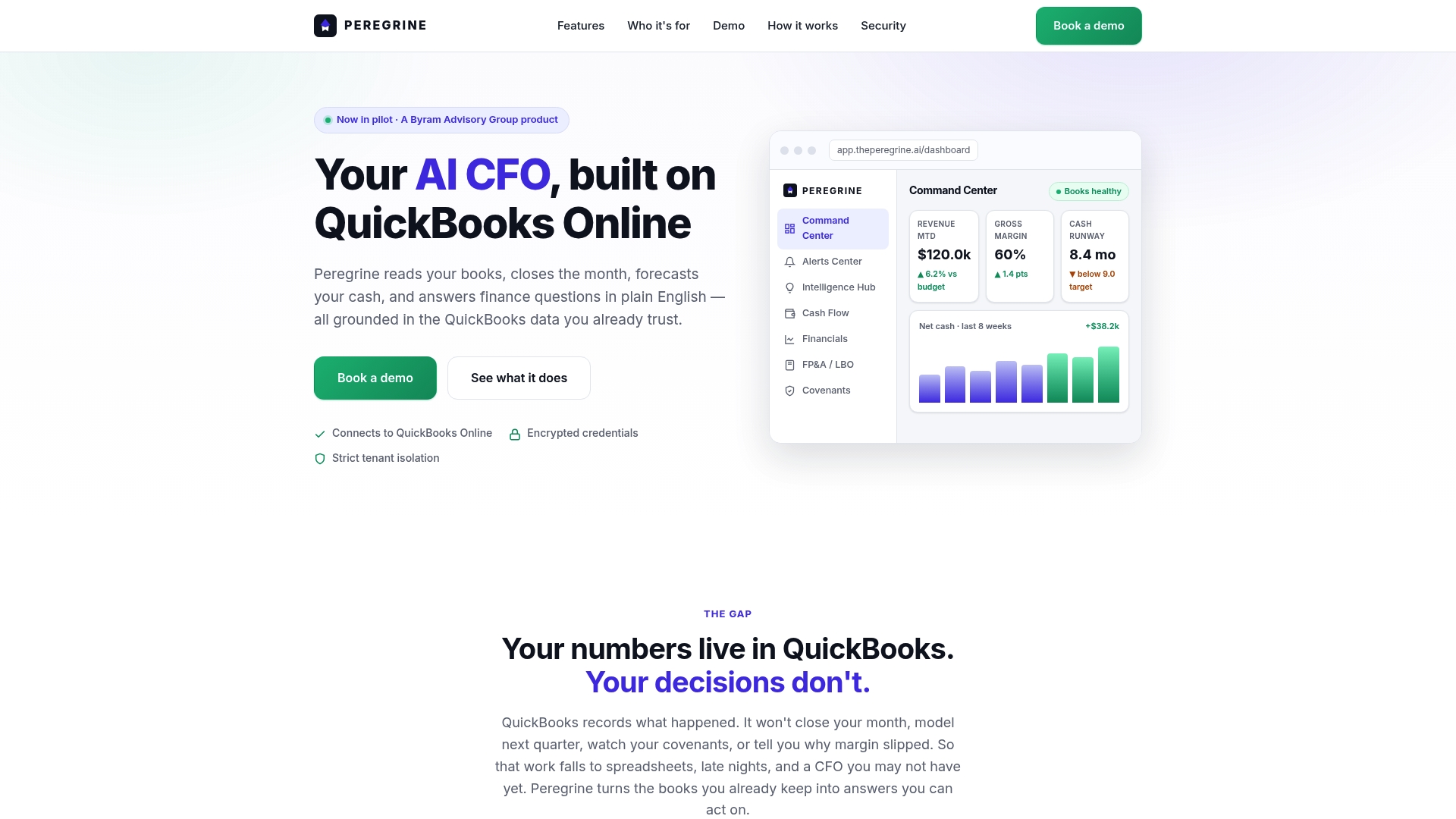
The gap between "we have a controller" and "we have CFO-grade visibility" used to require a full-time hire or an expensive fractional engagement. Peregrine closes that gap at a fraction of the cost, giving finance teams and business owners real-time insight into revenue, cash flow, and operational performance without manual reporting cycles. For companies evaluating their next finance hire, it's worth knowing what the platform can cover before committing to a search. Start a 14-day free trial at Peregrine and see what your financials look like with a real-time command center behind them.
Sources
- Controller vs CFO: Roles, Responsibilities & Differences | Trullion
- Controller vs CFO: The Brutally Honest Guide | BlackpeakCFO
- Controller vs CFO: Roles, Similarities, & Differences | Indeed
- Bill